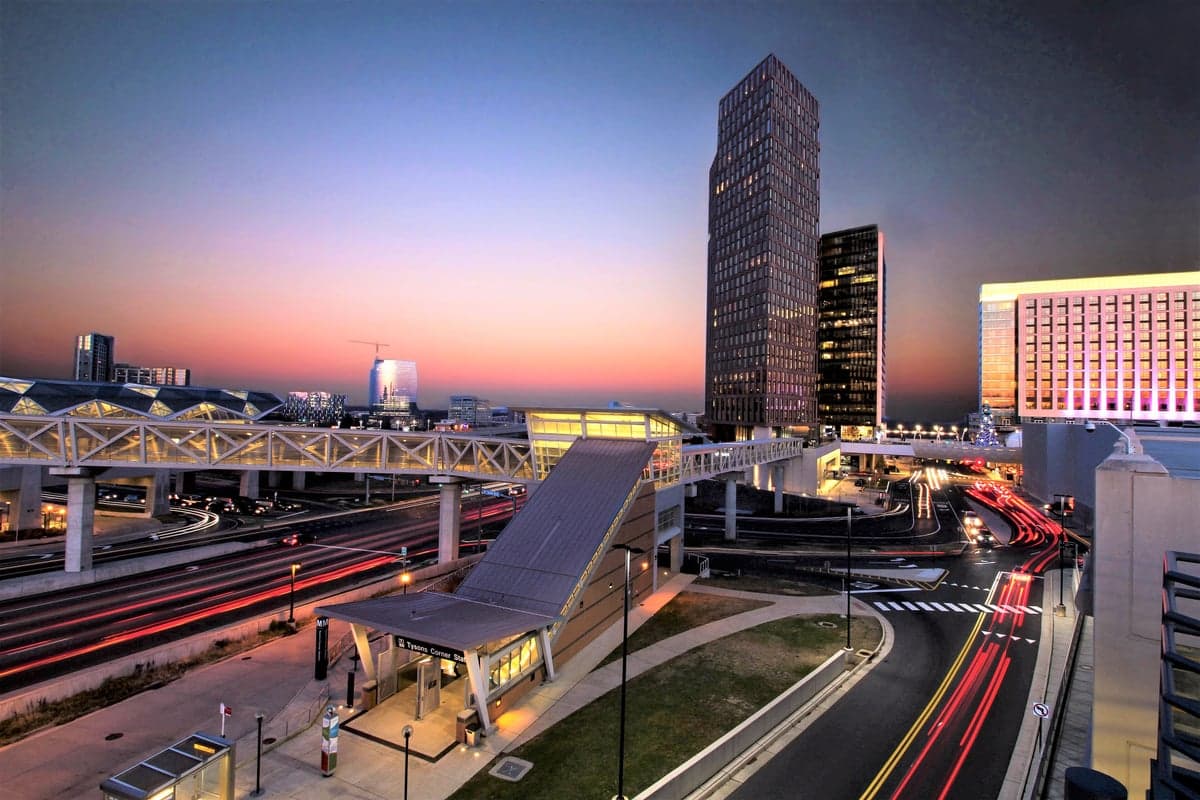
Photo: Wikipedia
Personal Sovereignty in Fairfax County
Viable for self-reliance. Generally workable, though some barriers may limit total independence.
What does Personal Sovereignty tell us?
Personal Sovereignty measures your capacity for self-reliance and independence with minimal government friction. Higher scores mean fewer barriers between you and the way you want to live... but it assumes you have the space you need and good neighbors.
What does this tell us?
Personal Sovereignty measures your capacity for self-reliance and independence with minimal government friction. Higher scores mean fewer barriers between you and the way you want to live... but it assumes you have the space you need and good neighbors.
State Policy
Energy independence: Importer (20% of energy produced in-state)
Personal Liberty
Homesteading

Personal Liberty Analysis
Fairfax County, Virginia, presents a complex environment for personal sovereignty, where high levels of local regulation and taxation coexist with strong state-level protections for individual rights. While the county’s dense, suburban character imposes significant constraints on self-reliance and homesteading, Virginia’s legal framework provides robust safeguards for self-defense, parental rights, and property use. For a relocation-minded individual or family prioritizing autonomy, the key is understanding that personal freedom in Fairfax County is heavily mediated by local governance, making the choice of specific town or neighborhood—from the more rural Clifton to the urbanized Tysons—a critical determinant of your day-to-day independence.
Tax burden and regulatory posture: How heavy is the local government footprint?
Fairfax County’s tax and regulatory environment is among the most demanding in Virginia, reflecting its status as a wealthy, high-service jurisdiction. The county’s real property tax rate is $1.11 per $100 of assessed value (2025), which, combined with high home valuations, results in an effective tax burden that can exceed $8,000 annually on a median-priced home. This is significantly higher than in neighboring Loudoun County ($0.865) or more rural areas like Fauquier County ($0.53). The county also imposes a personal property tax on vehicles at a rate of $4.57 per $100 of assessed value, one of the highest in the state. Regulatory posture is similarly heavy: the county’s zoning ordinance is detailed and restrictive, with minimum lot sizes of 20,000 square feet in most residential districts, and a complex permitting process for home additions, fences, or home-based businesses. Home occupation permits, for example, require county approval and limit client visits to two per day. For a self-reliant individual, this means that activities like running a small repair shop or keeping backyard chickens (allowed only on lots of 20,000 sq. ft. or more) are tightly controlled. The county’s reliance on property taxes and fees means there is little appetite for tax-cutting measures, and the local political climate is consistently pro-government services. For those seeking a lighter regulatory touch, towns like Herndon and Vienna have their own town councils that can be slightly more business-friendly, but they still operate under the county’s overarching code.
Self-defense and gun law specifics: What are the actual rules for carrying and owning firearms?
Virginia is a “shall-issue” state for concealed carry permits, and Fairfax County does not impose any additional local restrictions beyond state law. This means that any law-abiding resident aged 21 or older who completes a background check and a 16-hour training course can obtain a concealed handgun permit (CHP) from the county circuit court. The process is straightforward, with typical processing times of 30-45 days. Open carry of handguns is legal for anyone 18 or older who can legally possess a firearm, though it is rare in Fairfax County’s suburban environment and may attract police attention. The county does have a local ordinance prohibiting the discharge of firearms within 1,000 feet of a occupied dwelling, which effectively bans recreational shooting on most residential properties. Virginia’s “stand your ground” law (codified in § 18.2-279) applies statewide, meaning there is no duty to retreat before using deadly force in self-defense if you are lawfully present. However, the county’s dense population means that self-defense scenarios are more likely to involve home defense than public encounters. Gun ranges are limited: the county operates the Fairfax County Shooting Range in Lorton (a public, indoor facility), and private clubs like the NRA Headquarters Range in Vienna offer memberships. For those who prioritize a gun-friendly culture, the western towns of Clifton and Great Falls have larger lots and a more rural character, where firearm ownership is more common and less socially stigmatized than in the denser eastern areas like Falls Church or McLean. The county’s sheriff, while not explicitly pro-gun, follows state law without adding local restrictions, so the legal environment is predictable.
Self-reliance and homesteading viability: Lot sizes, zoning, and off-grid feasibility
Fairfax County’s zoning and density make traditional homesteading or off-grid living extremely difficult, but not impossible in specific pockets. The county’s minimum lot size of 20,000 square feet (about half an acre) in most residential zones is a barrier to significant food production or livestock. Keeping chickens is allowed only on lots of 20,000 sq. ft. or more, and roosters are prohibited. Beekeeping is permitted with a county registration, but hives must be placed at least 10 feet from property lines. Goats, sheep, and other livestock are generally prohibited on residential lots under 2 acres. For those seeking more land, the Clifton area (ZIP 20124) and parts of Great Falls (22066) have larger parcels—some exceeding 5 acres—where small-scale farming is feasible, though still subject to county agricultural zoning rules. Off-grid living is effectively illegal: the county requires connection to public water and sewer in most areas, and solar panels must comply with building codes and homeowners association (HOA) covenants, which often restrict their visibility. Rainwater harvesting is legal but limited to 250 gallons per property without a permit. The county’s building code is strict, and any structure intended for habitation must meet modern energy and safety standards. For a self-reliant individual, the best option is to target the western edge of the county, near the town of Clifton, where rural zoning allows for larger lots and more flexibility. Even there, however, the county’s regulatory reach is long, and true self-sufficiency is more aspirational than practical. The county’s reliance on a centralized grid and municipal services means that independence from utilities is not a realistic goal for most residents.
Personal liberties: Parental rights, medical autonomy, speech, and property
Virginia law provides strong protections for parental rights, and Fairfax County generally follows state statutes. Under Virginia Code § 1-240.1, parents have the fundamental right to make decisions concerning the care, custody, and control of their children, including medical decisions and education. The county’s public school system, Fairfax County Public Schools (FCPS), has been a focal point of parental rights debates, particularly around curriculum transparency and library materials. In 2023, the school board adopted a policy requiring parental notification for any changes to a student’s mental, emotional, or physical health, including gender identity, though implementation has been uneven. For families seeking more control, the county has a robust homeschooling community, with over 5,000 students registered as homeschoolers (2024 data). Medical autonomy is more constrained: Virginia does not have a broad medical freedom law, and Fairfax County’s health department follows state mandates on vaccinations and public health orders. The county’s board of supervisors has not enacted any local health mandates since the COVID-19 pandemic, but the political climate is generally supportive of public health measures. Free speech is protected under the First Amendment, and the county does not have any local ordinances restricting speech beyond state and federal law. Property rights are strong in theory, but in practice, the county’s zoning and HOA covenants (which cover over 60% of residential properties) impose significant restrictions on what owners can do with their land. For example, building a fence over 4 feet tall requires a permit, and many HOAs prohibit front-yard landscaping that deviates from neighborhood standards. The town of Vienna has its own zoning code that is slightly more permissive for home-based businesses, while Falls Church (an independent city) has its own property tax rate and regulatory environment, which is similarly restrictive.
Overall, personal sovereignty in Fairfax County is a trade-off: you gain strong state-level protections for self-defense, parental rights, and property use, but you lose significant autonomy to local taxation, zoning, and HOA governance. Compared to more rural Virginia counties like Fauquier or Rappahannock, Fairfax is far more regulated and expensive, but it offers a predictable legal environment and access to amenities that many self-reliant individuals value, such as excellent schools and low crime. For a relocation-minded person who prioritizes independence, the best strategy is to target the western towns—Clifton, Great Falls, and Herndon—where lot sizes are larger, HOA density is lower, and the regulatory touch is slightly lighter. The county will never be a haven for off-grid living or minimal government, but for those who can navigate its rules, it provides a stable, rights-respecting framework within a high-density suburban context.

* Values derived from national, state, county, city and local statistics and may differ in a specific area. Last updated: 2026-06-15T20:50:45.000Z
Narrative content on this page is AI-generated and may contain mistakes. Verify any details that matter before acting on them.
ReloMaps may earn a commission from affiliate links at no extra cost to you.

