
Photo: Wikipedia
Political ClimatePolitical Climate in Fairfax County
Showing district-level results — no local-only data available.
Local Political AnalysisPolitical Analysis of Fairfax County
Fairfax County is one of the most reliably Democratic jurisdictions in Virginia, with a Cook Partisan Voting Index (PVI) of D+18, meaning it votes about 18 points more Democratic than the national average. This makes it a deep-blue anchor in a state that, as a whole, leans Democratic but is far more competitive—Virginia’s statewide PVI is D+4. The county has been trending leftward for decades, driven by rapid suburbanization, a highly educated workforce, and a diversifying population, and there’s little sign of that trajectory reversing anytime soon.
How it compares
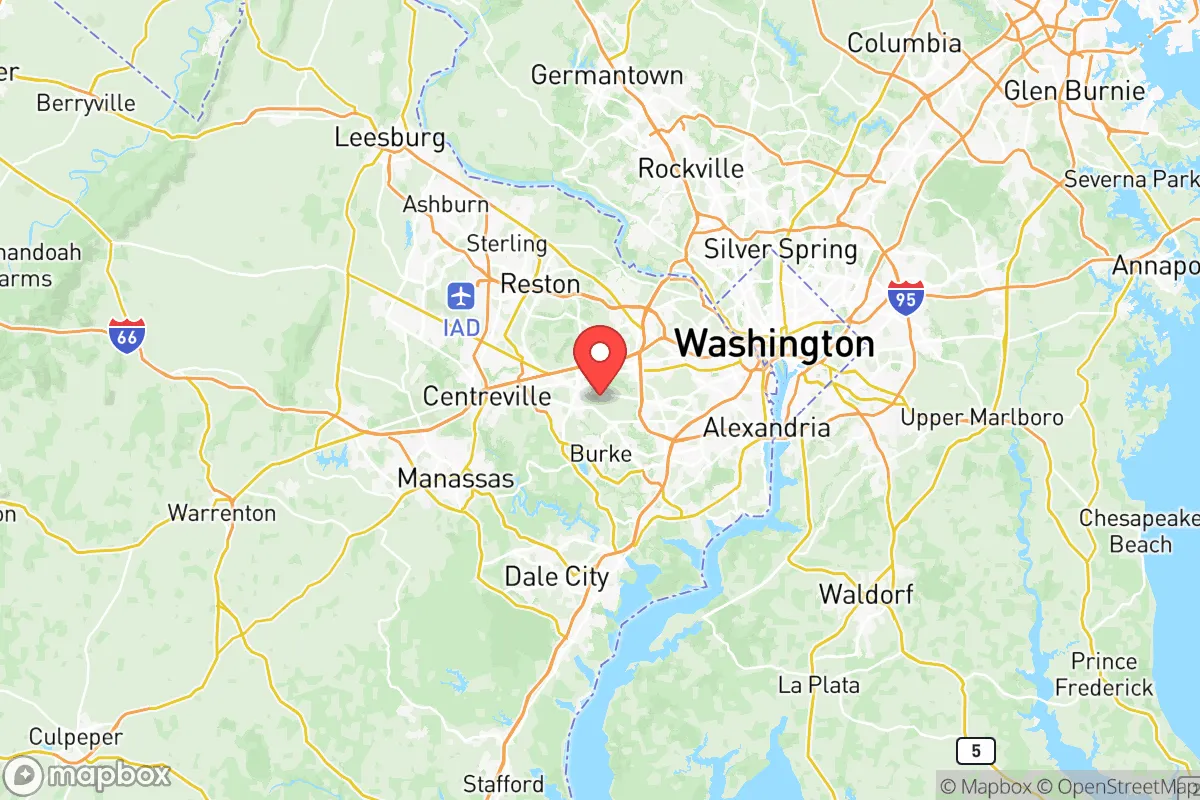
The gap between Fairfax County’s D+18 and Virginia’s D+4 is massive—it’s the difference between a safe Democratic stronghold and a swing state. In practice, this means Fairfax County often delivers margins that single-handedly offset Republican wins in the rest of the state. For example, in the 2020 presidential election, Fairfax County gave Joe Biden over 350,000 more votes than Donald Trump, while many rural and exurban counties in Southside and Southwest Virginia went for Trump by 2-to-1 or 3-to-1 margins. Within the county itself, the political geography isn’t uniform. The inner suburbs closest to Washington, D.C.—like Falls Church, McLean, and Arlington-adjacent areas—are the bluest, often hitting D+25 or higher. Moving west and south, towns like Centreville, Chantilly, and Lorton are still Democratic but by narrower margins, sometimes D+5 to D+10. The most conservative pockets are in the far southwestern corner, around Clifton and parts of Burke, where precincts can lean Republican by single digits, but these are small and shrinking. The county’s swing precincts—those that occasionally flip—are mostly in the western edge near Loudoun County, but even there, the trend is steadily blue.
What this means for residents
For liberal residents, Fairfax County feels like a political safe space where their views are the norm. Local elections are effectively decided in Democratic primaries, and the county government—controlled by Democrats for decades—pursues progressive policies like increased funding for public transit, affordable housing mandates, and climate action plans. For conservative residents, the reality is more about feeling outnumbered. Republican candidates rarely win countywide office, and conservative voices can struggle to gain traction on issues like taxes or school curriculum. However, the county’s political culture is generally pragmatic rather than activist; most day-to-day governance focuses on managing growth, traffic, and schools, which are concerns shared across the aisle. The Fairfax County Board of Supervisors has a Democratic supermajority, but decisions on zoning, school budgets, and public safety are often shaped by input from homeowner associations and business groups, not just party lines.
One notable cultural distinction is the county’s relationship with the federal government. With over 50,000 federal employees living in Fairfax, the local economy and political identity are deeply tied to the stability of federal agencies and defense spending. This creates a unique dynamic: even conservative residents here tend to support robust federal investment, which can soften partisan edges. The county’s school system, Fairfax County Public Schools, is a frequent flashpoint—debates over curriculum, equity initiatives, and funding often mirror national culture wars, but the outcomes lean progressive due to the board’s Democratic majority. Overall, Fairfax County’s political climate is best understood as a deep-blue bubble within a purple state, where the practical effects of that lean are felt most acutely in local policy and the daily experience of being in the political majority or minority.

State Political ClimatePolitical Climate in Virginia
State Political AnalysisPolitical Environment in the State
Virginia is a classic swing state that has drifted steadily blue over the past two decades, now carrying a Cook PVI of D+4. The shift is driven almost entirely by explosive growth in the Washington, D.C. suburbs—places like Loudoun, Prince William, and Fairfax counties—which now cast enough votes to outweigh the rest of the state. A generation ago, Virginia was reliably red in presidential races; today, it hasn’t voted for a Republican for president since 2004, and the state legislature has flipped back and forth between parties every few cycles. For a conservative relocator, the reality is that you’re moving into a purple state with a blue-tinted governor’s mansion and a legislature that can swing either way depending on turnout in Northern Virginia.
Urban vs. rural divide
The political map of Virginia is a tale of two commonwealths. The urban crescent—Northern Virginia, Richmond, and Hampton Roads—is overwhelmingly Democratic. Fairfax County alone, with over 1.1 million residents, votes about 65-70% Democratic, and its population is larger than that of many states. Loudoun County, once a conservative stronghold, flipped blue in the 2010s and now votes about 55-60% Democratic. Richmond, the capital, is a deep-blue city with a strong progressive activist scene. Hampton Roads (Norfolk, Virginia Beach, Chesapeake) is more mixed, with Virginia Beach leaning purple and the rest of the region solidly blue. Meanwhile, rural and exurban Virginia—places like Roanoke, Lynchburg, the Shenandoah Valley, and Southside Virginia—votes heavily Republican. The 5th Congressional District, which includes Charlottesville and Southside, is a classic swing district, but most rural counties vote 65-75% Republican. The divide is stark: you can drive 30 minutes west of D.C. and go from a deep-blue suburb to a deep-red farm county. This split means that state elections are decided by turnout in the suburbs, not the rural areas.
Policy environment
Virginia’s policy environment is a mixed bag that reflects its purple status. The state income tax is a flat 5.75% on all income over $3,000, which is moderate compared to neighboring Maryland (up to 5.75% but with local add-ons) and North Carolina (flat 4.5%). Sales tax is 5.3% statewide, with local add-ons up to 7% in some areas. Property taxes are set locally and vary widely—Loudoun County’s rate is about $1.20 per $100 of assessed value, while rural counties like Grayson are under $0.50. Education policy is a flashpoint: Virginia has a mix of strong public schools in the suburbs and struggling rural districts. The state has a school choice program (the Virginia Education Improvement Scholarship Tax Credit) but no universal voucher system. Election laws are moderately restrictive: Virginia requires a photo ID to vote, has no-excuse absentee voting, and offers same-day registration during early voting but not on Election Day. The state has a Republican-controlled House of Delegates (as of 2026) and a Democratic-controlled Senate, with Governor Glenn Youngkin (R) serving until 2028. This divided government means major policy shifts are rare, but the state has seen significant changes in the last decade.
Recent policy direction
Virginia’s recent policy direction is a tug-of-war between the two parties, with concrete results on both sides. On gun rights, Virginia passed a red-flag law in 2020 (allowing temporary seizure of firearms from individuals deemed a threat) and a one-handgun-per-month limit, but Governor Youngkin signed a repeal of the permit requirement for concealed carry in 2022, restoring constitutional carry. On education, Youngkin’s administration has pushed for “parental rights” legislation, including a model policy requiring schools to notify parents if a child requests a name or pronoun change, which has been challenged in court. The state also banned critical race theory from K-12 curriculum in 2022, though the ban is largely symbolic. On abortion, Virginia is an outlier in the South: abortion is legal up to 26 weeks, with no waiting period or mandatory counseling, and the state has a buffer zone around clinics. However, Youngkin has proposed a 15-week ban with exceptions, which has stalled in the Senate. On voting, Virginia passed a voter ID law in 2013 and has maintained it, but also expanded early voting to 45 days before elections. On property rights, Virginia has a strong right-to-farm law and limited eminent domain, but the state’s land-use policies are largely local. On privacy, Virginia passed the Consumer Data Protection Act in 2021, giving residents control over their personal data. For a conservative relocator, the key takeaway is that Virginia is not a deep-blue state on most issues—it’s a state where the legislature is closely divided, and the governor’s party can shift policy significantly every four years.
Civil unrest & political movements
Virginia has a history of political flashpoints that a new resident would notice. The 2017 Unite the Right rally in Charlottesville, which turned violent, left a lasting mark on the state’s politics and led to the removal of Confederate statues across the state. The 2020 protests in Richmond over police brutality and the removal of the Robert E. Lee statue on Monument Avenue drew national attention and resulted in some property damage. On the right, the “Virginia is for Lovers” slogan has been co-opted by the “Virginia is for Gun Lovers” movement, and the state has seen large Second Amendment rallies at the Capitol in 2020, when the legislature was considering gun control measures. Immigration politics are relatively quiet compared to border states, but Northern Virginia has a large immigrant population, and some localities (like Fairfax County) have sanctuary policies limiting cooperation with ICE. Election integrity has been a hot topic since 2020, with Republican activists alleging irregularities in mail-in voting, though no major fraud has been proven. The state’s elections are run by local registrars, and the system is generally considered secure. A new resident would notice that political signs are common in yards, especially in the suburbs, and that local news covers state politics heavily—Virginians are engaged in their state government.
Projection
Over the next 5-10 years, Virginia is likely to continue its slow drift leftward, driven by demographic trends. Northern Virginia’s population is growing faster than the rest of the state, and its voters are increasingly Democratic. The 2020 census gave Virginia an 11th congressional district, which is safely Democratic. However, the state’s rural areas are not shrinking as fast as in some other states, and the exurban counties (like Spotsylvania and Stafford) are trending more Republican as they fill with people leaving the D.C. suburbs. The key swing area is Hampton Roads, which is growing slowly and could tip the balance in close elections. A conservative moving in now should expect that the state will remain purple but with a slight blue tilt, meaning that state-level elections will be competitive but national elections will lean Democratic. The governor’s race in 2028 will be critical—if a Democrat wins, the state could see more progressive policies on taxes, education, and abortion. If a Republican wins, the state could see more conservative policies on gun rights, school choice, and parental rights. The bottom line is that Virginia is not a safe haven for either party—it’s a state where your vote matters, and where the political climate can change significantly with each election cycle.
For a new resident, the practical takeaway is that Virginia offers a mix of conservative and liberal policies depending on where you live and who is in power. If you’re a conservative, you’ll find a strong rural and exurban community, a governor who has pushed for parental rights and gun rights, and a state that is not as blue as its PVI suggests. If you’re a liberal, you’ll find a strong urban and suburban base, a state that protects abortion access and has strong data privacy laws. The key is to choose your locality carefully—Fairfax County and Loudoun County are deep blue, while Roanoke and Lynchburg are deep red. The state’s politics are a reflection of its geography, and that’s not going to change anytime soon.
* Values derived from national, state, county, city and local statistics and may differ in a specific area. Last updated: 2026-06-15T20:50:45.000Z
Narrative content on this page is AI-generated and may contain mistakes. Verify any details that matter before acting on them.
ReloMaps may earn a commission from affiliate links at no extra cost to you.

