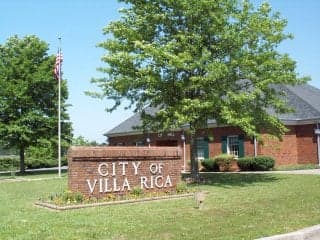
Photo: Wikipedia
Political ClimatePolitical Climate in Villa Rica, GA
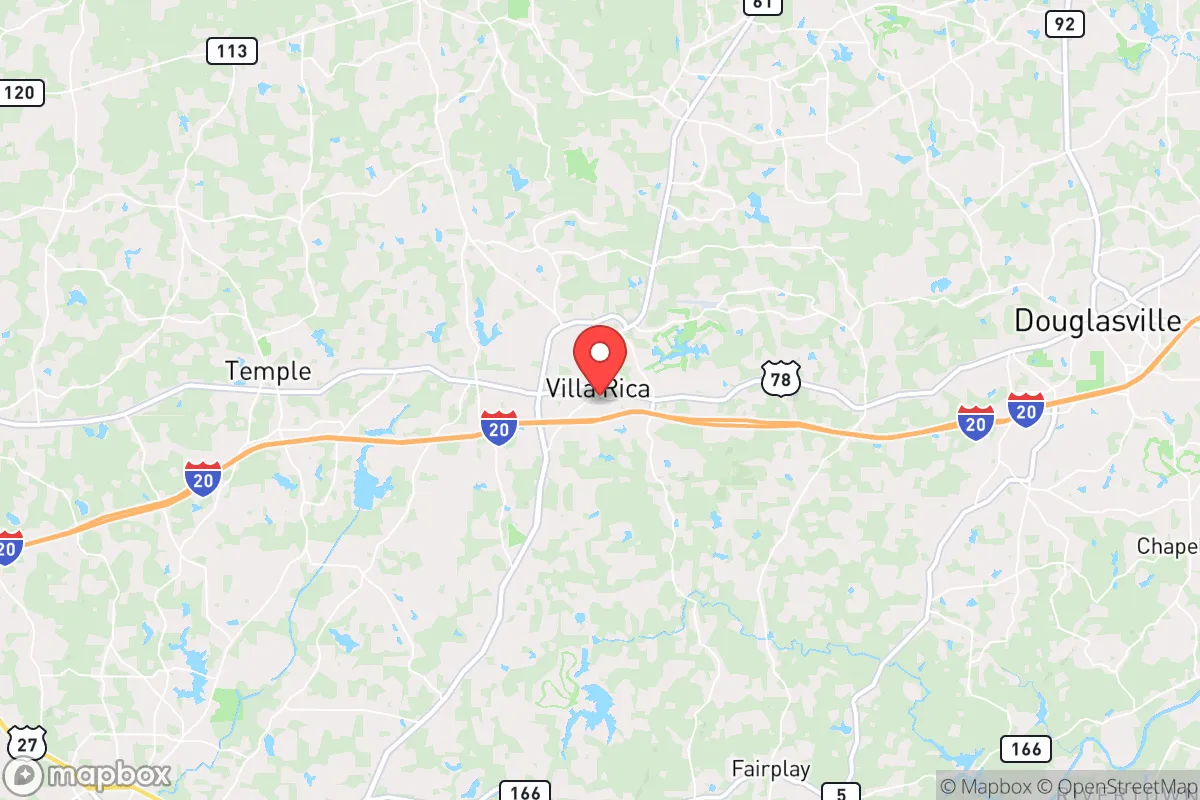
District shown is the primary district for this city’s centroid. Cities may span multiple districts.
Local Political AnalysisPolitical Analysis of Villa Rica, GA
Villa Rica is a reliably conservative community, anchored by a Cook Partisan Voting Index of R+15, meaning it votes about 15 points more Republican than the national average. This isn’t a recent shift—it’s been a steady trend for decades, though the flavor of that conservatism has evolved as the town has grown. Back in the 1990s, Villa Rica was a sleepy railroad town where everyone knew everyone, and politics were more about local roads and school bonds than national culture wars. Today, with Atlanta’s exurban sprawl pushing west along I-20, the political climate is still solidly red, but it’s now a mix of longtime rural conservatives and newer arrivals—many from more liberal Cobb or Fulton counties—who’ve brought a slightly more suburban, pragmatic edge to local elections. The trajectory is toward a slow, modest moderation, but don’t expect Villa Rica to flip blue anytime soon; the R+15 rating is baked into the area’s DNA.
How it compares
Villa Rica sits in Carroll County, which is notably more conservative than the state of Georgia as a whole. Georgia’s statewide Cook PVI is unknown, but recent presidential elections show it as a toss-up—Biden won it by less than 0.3% in 2020, and Trump carried it by about 5% in 2016. Villa Rica’s R+15 puts it in a different league entirely, more aligned with neighboring Bremen or Carrollton than with metro Atlanta’s core. For contrast, drive 20 miles east to Douglasville in Douglas County, which leans Democratic (Biden won it by 12 points in 2020), or 30 miles northeast to Marietta in Cobb County, which is now a purple battleground. Villa Rica’s politics feel closer to rural west Georgia towns like Tallapoosa or Bowdon, where conservative values around gun rights, low taxes, and limited government are the default. The key difference is that Villa Rica’s growth—its population has nearly doubled since 2000—has introduced a small but vocal minority of moderate and liberal residents, mostly commuters working in Atlanta or at the nearby Kia Motors plant in West Point.
What this means for residents
For conservative residents, Villa Rica is a comfortable fit. Local government leans Republican, property taxes are relatively low (Carroll County’s millage rate is around 12.5 mills), and you’ll find plenty of churches, gun shops, and “Support Our Troops” banners. School board meetings tend to focus on curriculum transparency and fiscal responsibility rather than culture-war flashpoints. For liberal residents, life is more about finding your niche. You won’t be ostracized, but you’ll be in the minority—local Democratic candidates rarely break 40% in countywide races. That said, the influx of new residents has made the town more tolerant; you’ll see a few Pride flags during June, and the downtown coffee shop attracts a mixed crowd. The practical reality is that most local decisions—zoning, school funding, police budgets—are made without much partisan drama, because the community is so uniformly red that primaries often matter more than general elections.
Culturally, Villa Rica stands out for its strong sense of local identity that transcends party lines. The annual Gold Rush Festival celebrates the town’s 19th-century gold mining history, and the downtown square—with its brick storefronts and the historic Villa Rica Depot—is a point of pride for everyone. Policy-wise, the area is more libertarian than hardline conservative: you won’t find strict blue laws (alcohol sales are allowed on Sundays), and the city has embraced some growth-friendly policies like tax incentives for new businesses. The biggest distinction from Georgia’s more polarized suburbs is that Villa Rica’s politics are still personal—you’re more likely to argue about the new roundabout on Highway 61 than about national politics. That’s changing as the town grows, but for now, it’s a place where the R+15 rating feels less like a political statement and more like a quiet, lived-in reality.

State Political ClimatePolitical Climate in Georgia
State Political AnalysisPolitical Environment in the State
Georgia has transformed from a reliably Republican stronghold into the nation’s premier battleground state over the past two decades. The state’s current political climate is defined by a razor-thin partisan split, with Democrats winning the presidential vote in 2020 and both Senate seats in 2021, while Republicans maintain unified control of the state legislature and all other statewide offices. This tug-of-war reflects a fundamental demographic and geographic realignment: the explosive growth of the Atlanta metro, particularly its diverse and highly educated northern suburbs, has created a blue-leaning coalition that now nearly matches the deep-red rural and exurban vote.
Urban vs. rural divide
The political map of Georgia is a study in stark contrasts. The Atlanta metropolitan area, home to roughly 60% of the state’s population, is the engine of Democratic growth. Fulton County (Atlanta) and DeKalb County routinely deliver margins of 70-80% for Democrats, while the fast-growing northern suburbs—Gwinnett, Cobb, and Henry counties—have flipped from reliably red to purple or blue over the last decade. Gwinnett County, once a Republican bastion, voted for Joe Biden by 18 points in 2020. Meanwhile, the rest of the state remains deeply conservative. Rural south Georgia, the coastal plains, and the northern mountain counties vote Republican by margins of 30-40 points. Columbus and Augusta are competitive swing areas, while Savannah leans Democratic but is surrounded by conservative rural counties. The political divide is not just urban vs. rural; it’s also generational and educational, with college-educated voters in the suburbs increasingly aligning with the Democratic coalition.
Policy environment
Georgia’s policy environment reflects its divided government: a Republican-controlled legislature and governor’s office that have pursued a conservative agenda, tempered by the reality of a competitive statewide electorate. The state has a flat income tax rate of 5.49% (scheduled to drop to 4.99% by 2029), a relatively low corporate tax rate, and a homestead exemption that keeps property taxes moderate for homeowners. Georgia is a right-to-work state with no state-level minimum wage above the federal $7.25. Education policy has been a flashpoint: the state has expanded school choice through tax-credit scholarships and charter schools, but has not yet passed a universal school voucher program. The state’s election laws have been a national focus, with the 2021 Election Integrity Act (SB 202) adding voter ID requirements for absentee ballots, limiting drop boxes, and restricting third-party ballot collection. On healthcare, Georgia has not expanded Medicaid, leaving a coverage gap for roughly 300,000 low-income adults. The state has a permitless carry law for firearms (effective 2022) and maintains a strong preemption law that prevents local governments from enacting stricter gun ordinances.
Recent policy direction
Recent legislation in Georgia signals a state that is simultaneously consolidating conservative wins and responding to its competitive political environment. On gun rights, the 2022 permitless carry law (HB 218) removed the requirement for a license to carry a concealed firearm, making Georgia one of the most permissive states in the Southeast. On education, the 2024 Georgia Promise Scholarship Act created a $6,500 education savings account for students in low-performing schools, a significant expansion of school choice. The state has also passed a near-total abortion ban (HB 481) that prohibits the procedure after roughly six weeks, with limited exceptions for rape, incest, and medical emergencies. This law has been a major driver of political mobilization on both sides. On voting access, SB 202 remains the most consequential law, though its practical effects have been debated; turnout in 2022 and 2024 remained high, suggesting the law has not suppressed participation. On property rights, Georgia has strong eminent domain protections and no state-level rent control. On privacy and surveillance, the state has no comprehensive data privacy law, though a 2023 law (SB 36) restricts the use of facial recognition technology by law enforcement without a warrant. The state’s tax policy continues to trend toward lower rates, with the flat tax scheduled to decline further.
Civil unrest & political movements
Georgia has been a focal point for national political movements and occasional civil unrest. The 2020 election cycle saw massive protests in Atlanta following the killing of George Floyd, with some demonstrations turning destructive along the city’s commercial corridors. The 2021 election law (SB 202) sparked a major backlash from corporate giants like Coca-Cola and Delta Air Lines, both headquartered in Atlanta, leading to a high-profile standoff with Republican lawmakers. The state has seen a surge in organized activism on both sides: the Georgia Democratic Party has built a formidable grassroots operation in the suburbs, while conservative groups like the Georgia Republican Assembly and the Georgia Carry organization have been active in pushing gun rights and election integrity measures. Immigration politics are less volatile than in border states, but the 2024 passage of a law requiring local law enforcement to cooperate with federal immigration authorities (SB 180) has created tension in some metro Atlanta counties. There has been no serious secession or nullification rhetoric in Georgia, though some rural counties have passed symbolic resolutions asserting local control. Election integrity remains a live issue, with ongoing litigation over absentee ballot rules and the state’s voter roll maintenance practices.
Projection
Over the next 5-10 years, Georgia is likely to remain a competitive battleground, but the trajectory favors Democrats in presidential elections while Republicans maintain structural advantages in state-level races. The Atlanta metro’s continued growth—particularly in the diverse and educated suburbs of Gwinnett, Cobb, and Henry counties—will continue to shift the statewide electorate leftward. However, the state’s rural and exurban areas are also growing, and the Republican base is highly motivated. The key variable is turnout: if Democrats can sustain the high turnout they achieved in 2020 and 2022, Georgia will be a true swing state; if not, it could revert to a lean-Republican posture. The state’s in-migration from other states—particularly from California, New York, and Florida—is politically mixed, but the net effect appears to be slightly favorable to Democrats. Expect continued legislative battles over abortion, voting access, and education funding, with the outcome depending on which party controls the governorship and legislature after the 2026 and 2028 elections. A new resident moving in now should expect a state where every election is competitive, where policy can swing sharply depending on the party in power, and where the political culture is increasingly polarized between the Atlanta metro and the rest of the state.
For a new resident, the bottom line is that Georgia offers a politically dynamic environment where your vote genuinely matters. If you’re a conservative, you’ll find a state government that has delivered on many of your priorities—gun rights, tax cuts, school choice, and election security—but you’ll need to stay engaged to protect those gains. If you’re a liberal, you’ll find a growing coalition in the Atlanta metro that has made the state competitive, but you’ll face a legislature that is likely to remain Republican-controlled for the foreseeable future. The practical takeaway: Georgia is not a deep-red state where you can take conservative policies for granted, nor a blue state where progressive values are baked in. It’s a place where politics is lived, debated, and decided at the ballot box every two years.
* Values derived from national, state, county, city and local statistics and may differ in a specific area. Last updated: 2026-10-17T00:01:56.000Z
Narrative content on this page is AI-generated and may contain mistakes. Verify any details that matter before acting on them.
ReloMaps may earn a commission from affiliate links at no extra cost to you.

