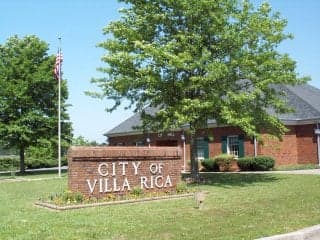
Photo: Wikipedia
Personal Sovereignty in Villa Rica, GA
Viable for self-reliance. Generally workable, though some barriers may limit total independence.
What does Personal Sovereignty tell us?
Personal Sovereignty measures your capacity for self-reliance and independence with minimal government friction. Higher scores mean fewer barriers between you and the way you want to live... but it assumes you have the space you need and good neighbors.
What does this tell us?
Personal Sovereignty measures your capacity for self-reliance and independence with minimal government friction. Higher scores mean fewer barriers between you and the way you want to live... but it assumes you have the space you need and good neighbors.
State Policy
Energy independence: Importer (12% of energy produced in-state)
Personal Liberty
Homesteading

Personal Liberty Analysis
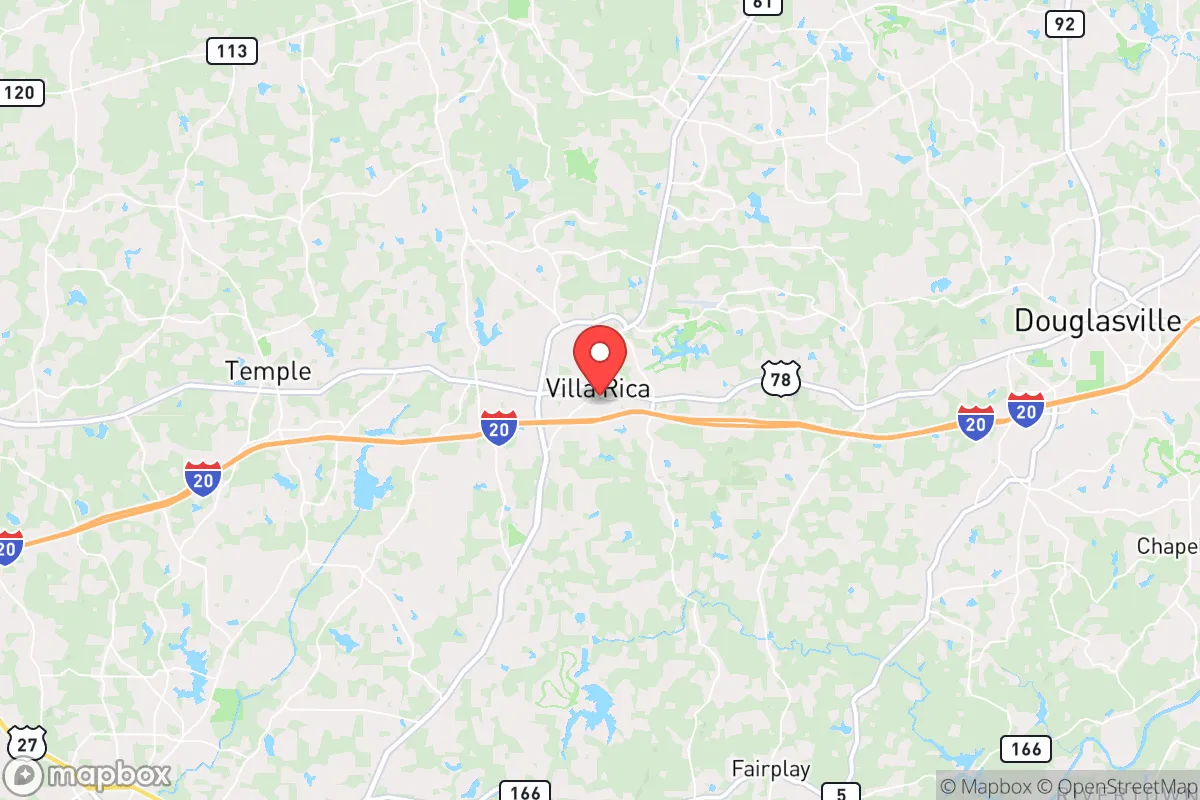
Villa Rica, Georgia, offers a personal sovereignty environment shaped by Georgia’s strong tilt toward individual autonomy, particularly in tax policy, self-defense law, and property rights. Located about 35 miles west of Atlanta in Carroll and Douglas counties, this city of roughly 16,000 residents sits in a state that ranks among the most tax-friendly and regulation-light in the Southeast. For a relocation reader prioritizing personal freedom—whether as a single individual or a family—Villa Rica provides a tangible balance of low state-level interference and local governance that generally avoids heavy-handed zoning or overreach, though some municipal codes do impose limits on certain self-reliant practices.
Tax burden and regulatory posture: How Georgia’s policies shape Villa Rica
Georgia’s tax structure is a major draw for sovereignty-minded residents. The state levies a flat personal income tax rate of 5.49% as of 2026, with ongoing legislative pressure to reduce it further—a trend that signals a light fiscal touch. Villa Rica itself imposes a 7% sales tax (4% state, 3% local), which is standard for the metro Atlanta region but not excessive by national standards. Property taxes are notably low: the combined millage rate in Carroll County hovers around 28 mills, translating to roughly $1,400 annually on a $250,000 home, while Douglas County’s rate is slightly higher at about 31 mills. Both counties offer homestead exemptions that cap annual increases, protecting long-term owners from sudden tax spikes. Regulatory posture at the state level is consistently pro-business and anti-red-tape: Georgia is a right-to-work state, has no state-level occupational licensing for many trades, and maintains a streamlined environmental permitting process. Locally, Villa Rica’s city government is generally hands-off on business operations, though it does enforce standard building codes and zoning ordinances. The city’s Unified Development Code, last updated in 2023, allows for home-based businesses by right in most residential zones, provided they don’t generate excessive traffic or noise—a nod to entrepreneurial autonomy. For a reader weighing tax burden and regulatory freedom, Villa Rica sits comfortably in the top tier of Georgia cities, with no local income tax and a municipal government that rarely invents new fees or permits.
Self-defense and gun law specifics: What Villa Rica residents can expect
Georgia is a constitutional carry state, meaning Villa Rica residents can carry a concealed firearm without a permit as of 2022. This law applies to anyone 21 or older who is legally allowed to own a firearm, and it extends to both open and concealed carry in most public spaces. The state also has a strong Stand Your Ground statute, codified in Georgia Code § 16-3-23.1, which removes any duty to retreat before using deadly force in self-defense if the individual is lawfully present. Villa Rica’s local government has not enacted any additional firearm restrictions beyond state law—no local assault weapon bans, no magazine capacity limits, and no extra waiting periods. The city’s police department, which employs about 40 sworn officers, generally defers to state preemption, meaning local ordinances cannot override Georgia’s firearm laws. For a family or individual prioritizing self-defense autonomy, Villa Rica offers a permissive environment: you can carry in your vehicle without a permit, store firearms in your home without registration, and use deadly force in defense of your home or person without legal presumption of wrongdoing. The only notable restrictions are federal—felons, domestic violence misdemeanants, and those under certain mental health adjudications are barred—and state-level prohibitions on carry in courthouses, jails, and some government buildings. For practical self-reliance, this legal framework means a Villa Rica resident can maintain a fully stocked home arsenal and carry daily without bureaucratic hurdles.
Self-reliance and homesteading viability: Lot sizes, zoning, and off-grid feasibility
Villa Rica’s zoning code and lot size requirements create a mixed picture for homesteading and off-grid living. Within the city limits, most residential lots are standard suburban parcels of 0.25 to 0.5 acres, with minimum lot sizes of 7,000 to 10,000 square feet depending on the zoning district. This density limits large-scale gardening, livestock, or significant self-sufficiency projects. However, the city’s Agricultural-Residential (AR) zoning district, found in the more rural western and southern edges of Villa Rica, allows lots as small as one acre but permits keeping horses, cattle, and poultry by right, with no special permit needed for up to two horses per acre. Outside city limits in unincorporated Carroll or Douglas County, lot sizes can be as large as 5 to 10 acres, and zoning is far more permissive: no building permits for agricultural structures under 1,000 square feet, no restrictions on rainwater collection, and no county-level bans on composting toilets or solar panels. Off-grid feasibility is moderate: Georgia law explicitly protects the right to install solar panels (Georgia Code § 44-9-20), and Villa Rica’s building code does not require connection to municipal water or sewer if a private well and septic system are installed, though the city does mandate that new construction within 200 feet of a water main must connect. For a family seeking full self-reliance, the best strategy is to buy land in the county—Carroll County has no zoning for most agricultural uses, and Douglas County allows accessory dwelling units (ADUs) on lots over two acres without a variance. The city itself is less homesteading-friendly, but the surrounding rural areas offer genuine off-grid potential within a 10-minute drive of downtown Villa Rica.
Personal liberties: Parental rights, medical autonomy, speech, and property
Georgia’s legal framework strongly supports parental rights in education and healthcare. The state’s Parents’ Bill of Rights (Georgia Code § 20-2-780), enacted in 2022, gives parents the explicit right to direct their child’s education, access all school records, and opt out of any curriculum or activity they find objectionable. Villa Rica’s local school district, Carroll County Schools, has not challenged this law and generally accommodates parental requests for alternative assignments or exemptions. Medical autonomy is more complex: Georgia has no state-level vaccine mandate for adults, and the state’s 2023 law banning vaccine passports (Georgia Code § 31-2A-1) prevents businesses and government from requiring proof of vaccination for services. However, Georgia does not have a broad medical freedom law akin to some Western states—there is no explicit right to refuse treatment for minors beyond standard religious exemptions, and the state’s emergency powers during public health crises remain broad. Free speech protections are robust: Georgia has no hate speech laws, no social media censorship mandates, and no local ordinances restricting political signage or public assembly. Villa Rica’s city council meetings include a public comment period, and the city has not attempted to limit protest or leafleting. Property rights are strongly protected under Georgia’s eminent domain laws, which require just compensation and a public purpose, and the state’s 2006 constitutional amendment (Article I, Section III) prohibits the taking of private property for economic development alone. For a reader concerned with personal liberties, Villa Rica offers a legal environment where parental control over education is codified, medical choices are largely unregulated, and property rights are constitutionally guarded—though the absence of a comprehensive medical freedom statute means some uncertainty remains during health emergencies.
Overall, Villa Rica’s personal sovereignty profile is strong but not absolute. It ranks favorably against most of the Southeast for tax burden, gun rights, and parental autonomy, but falls short of the most libertarian enclaves in states like New Hampshire or Idaho, where off-grid living and medical freedom are more explicitly protected. For a conservative-leaning individual or family seeking a balance of low taxes, constitutional carry, and a legal framework that respects property and parental rights, Villa Rica delivers a solid, middle-ground autonomy environment—one where you can live largely unbothered by government, but where municipal zoning and state emergency powers still impose some limits. The city’s proximity to Atlanta (35 miles) adds economic opportunity without sacrificing the rural-adjacent lifestyle that many sovereignty-minded residents seek, making it a practical choice for those who want freedom without isolation.

* Values derived from national, state, county, city and local statistics and may differ in a specific area. Last updated: 2026-10-17T00:01:56.000Z
Narrative content on this page is AI-generated and may contain mistakes. Verify any details that matter before acting on them.
ReloMaps may earn a commission from affiliate links at no extra cost to you.

