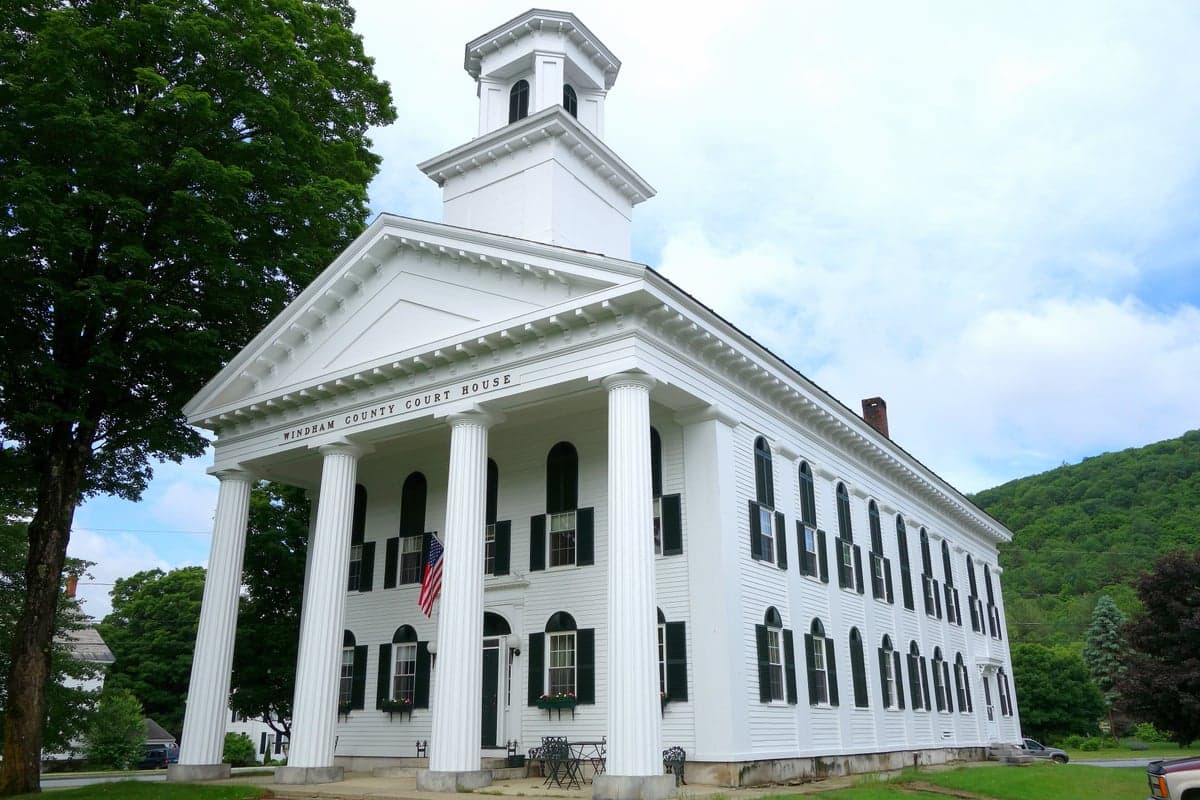
Photo: Wikipedia
Demographics of Windham County
Affluence Level in Windham County
A middle-class area roughly in line with national averages across income, home values, education, and employment.
People of Windham County
Windham County, Vermont, is home to approximately 45,913 residents, making it one of the state’s more populous counties yet retaining a distinctly rural and small-town character. The population is overwhelmingly white (90.6%) with a very low foreign-born share (1.0%), and a college education rate of 42.4% that reflects a concentration of professionals, artists, and second-home owners in towns like Brattleboro and Wilmington. The county’s identity is shaped by a legacy of Yankee independence, waves of European immigration in the 19th century, and a modern influx of out-of-state transplants drawn to its scenic valleys and progressive cultural pockets, creating a blend of old Vermont stock and newer, often wealthier, arrivals.
Settlement & growth (pre-1960)
The original inhabitants of Windham County were the Abenaki people, particularly the Sokoki band, who lived along the Connecticut River and its tributaries, including the West River and Saxtons River. They established seasonal villages for fishing, hunting, and maple sugaring, with key sites near present-day Brattleboro, Bellows Falls, and Westminster. English colonists from Massachusetts and Connecticut began settling in the area in the early 18th century, after the 1725 Treaty of Boston reduced conflict. The first permanent European settlement was at Fort Dummer near Brattleboro in 1724, a stockaded garrison town meant to protect the Massachusetts frontier.
After the American Revolution, Windham County’s population boomed. Between 1790 and 1830, settlers from southern New England—overwhelmingly of English and Scots-Irish descent—poured in, drawn by cheap land grants and the promise of subsistence farming. Towns like Newfane, Marlboro, and Wardsboro were chartered in the 1760s-1780s, with families clearing forests for dairy and sheep farming. The Connecticut River valley became a transportation corridor, and by 1849 the railroad reached Brattleboro, connecting the county to Boston and New York markets. This railroad catalyzed a second wave: between 1850 and 1900, Irish immigrants arrived to build tracks and work in the quarries of Rockingham (Bellows Falls) and the mills of Saxtons River. French-Canadian families migrated south from Quebec in the 1880s-1910s, settling in mill towns like Brattleboro and Jacksonville (in Whitingham), where they worked in textile and paper mills. These groups, while modest in number, added Catholic and Franco-American cultural layers to the dominant Yankee Protestant fabric.
A smaller but notable influx of Finnish immigrants came to West Townshend and Stratton in the early 1900s, seeking farmland and logging work. The county’s population peaked around 45,000 in the 1880s, then declined steadily through the mid-20th century as small farms consolidated and young people left for urban jobs. By 1960, the population had fallen to roughly 36,000, with a stagnant economy dependent on declining manufacturing and dairy farming. The region remained overwhelmingly white and native-born, with a strong sense of local, insular identity.
Modern era (post-1965)
The post-1965 era in Windham County was defined less by international immigration and more by domestic migration—specifically, the countercultural back-to-the-land movement of the 1970s. Young, college-educated idealists from cities like New York and Boston bought cheap farms in towns such as Putney, Dummerston, and Westminster, seeking self-sufficiency and rural community. This influx, sometimes called the “new Yankees,” brought higher education rates and progressive politics, clashing with and gradually blending into the older conservative farming culture. By 1990, the county’s population had rebounded to 43,500.
The foreign-born population remains tiny (1.0%), but has shifted from European to a more global, if minuscule, mix. A small number of East/Southeast Asian families—numbering approximately 550 individuals (1.2% of the population)—have settled in Brattleboro and Putney, often working in healthcare, education, or as owners of restaurants and small businesses. The Hispanic population, at 3.0% (roughly 1,380 people), is the fastest-growing ethnic group, with most residents in Brattleboro and Guilford, employed in construction, hospitality, and the ski industry at Mount Snow (in Dover) and Stratton Mountain (in Stratton). The Black population is very small (0.8%, about 370 people), and the Indian subcontinent population negligible (0.1%, about 45 people), concentrated in professional roles at Brattleboro Memorial Hospital or the region’s few tech firms.
Suburbanization has been limited, as the county lacks a major city. Instead, second-home development has transformed towns near ski areas: Wilmington, Dover, and Stratton now have a substantial seasonal population of wealthy out-of-state owners, often from New York, New Jersey, and Connecticut. This trend has driven up housing prices and widened the gap between year-round locals and wealthy part-timers. Since 2000, the county has added roughly 2,500 residents, largely in these ski-area towns and along the Interstate 91 corridor near Brattleboro.
The future
Windham County is projected to remain predominantly white and low-diversity over the next 10-20 years, but the Hispanic and East/Southeast Asian populations will likely grow slowly, primarily in Brattleboro and the ski towns, driven by labor demand in hospitality and elder care. The county’s natural population is aging—with a median age of 46, among the oldest in Vermont—and births are below replacement level. Future growth will depend entirely on in-migration, especially of retirees and remote workers seeking rural lifestyle, and of younger families priced out of southern New England. A new wave of domestic migration post-2020 (accelerated by the pandemic) has brought more remote workers to towns like Newfane and Wardsboro, but housing shortages and high costs are already cooling that trend.
Culturally, the county’s identity is evolving from a simple Yankee/Franco-American base into a more layered mix of old Vermonters, countercultural transplants, affluent part-time ski residents, and a modest but growing Hispanic working class. Political tensions between a Brattleboro-progressive bloc and the more conservative small towns (e.g., Rockingham, Athens) may intensify as the county diversifies, but the overall character remains insular, rural, and deeply tied to the land.
For someone moving in now, Windham County represents a place of strong community and natural beauty, but also one where the population is static, older, and largely homogeneous. New arrivals, especially those outside the dominant white group, will find small but welcoming enclaves, while the broader region continues to grapple with affordability, an aging workforce, and a cultural divide between year-round residents and seasonal newcomers. The future is one of slow, cautious change, not dramatic transformation.

* Values derived from national, state, county, city and local statistics and may differ in a specific area. Last updated: 2026-07-01T00:02:17.000Z
Narrative content on this page is AI-generated and may contain mistakes. Verify any details that matter before acting on them.
ReloMaps may earn a commission from affiliate links at no extra cost to you.

