
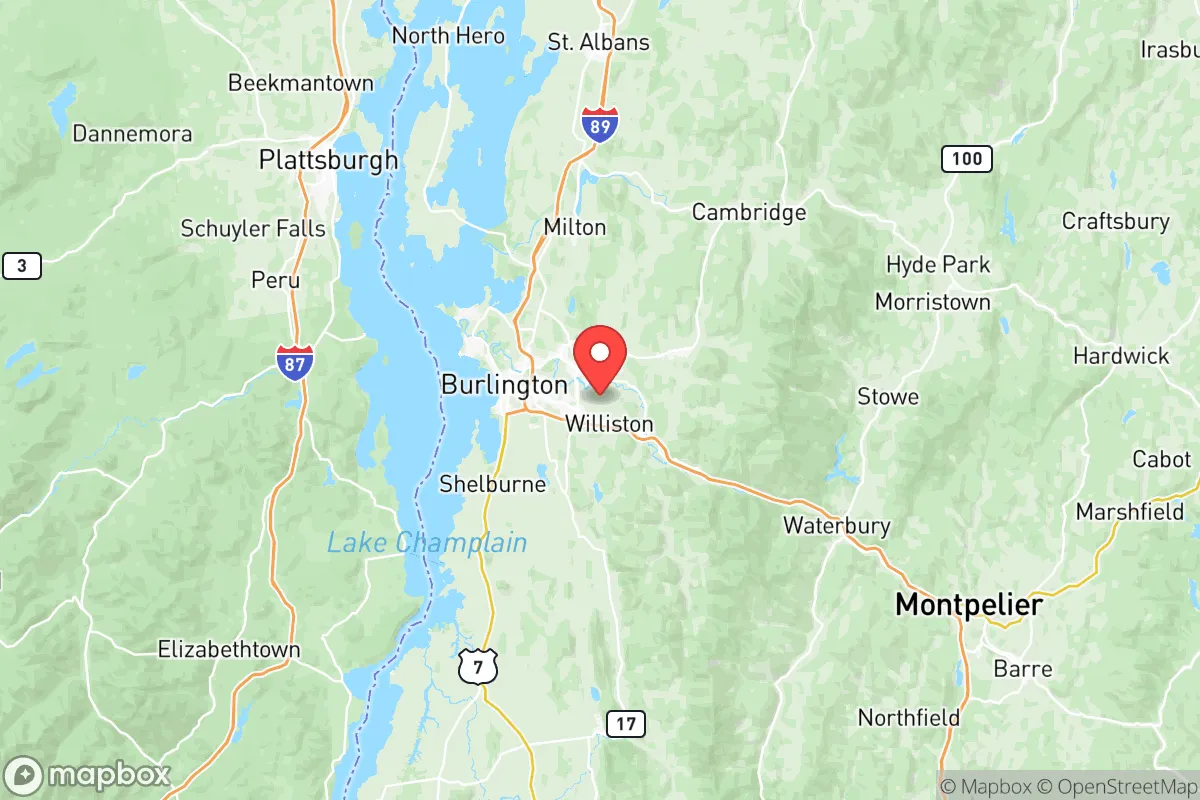
Photo: Wikipedia
Personal Sovereignty in Chittenden County
Moderate friction. Expect trade-offs in some aspect of personal liberty and independence.
What does Personal Sovereignty tell us?
Personal Sovereignty measures your capacity for self-reliance and independence with minimal government friction. Higher scores mean fewer barriers between you and the way you want to live... but it assumes you have the space you need and good neighbors.
What does this tell us?
Personal Sovereignty measures your capacity for self-reliance and independence with minimal government friction. Higher scores mean fewer barriers between you and the way you want to live... but it assumes you have the space you need and good neighbors.
State Policy
Energy independence: Importer (15% of energy produced in-state)
Personal Liberty
Homesteading

Personal Liberty Analysis
Chittenden County presents a mixed picture for those prioritizing personal sovereignty, where Vermont’s famously libertarian-leaning state culture collides with the regulatory realities of its most populous county. While the state constitution guarantees broad individual rights, the practical exercise of autonomy—from tax burden to self-defense to off-grid living—varies significantly depending on whether you are in the urban core of Burlington, the suburban ring of South Burlington and Williston, or the more rural towns of Hinesburg, Richmond, and Charlotte. For a conservative-leaning individual or family, the county offers genuine freedoms in some areas (medical autonomy, property rights) but imposes notable constraints in others (taxes, firearms regulation, land use).
Tax burden and regulatory posture in Chittenden County
Vermont’s overall tax burden ranks among the highest in the nation, and Chittenden County is the epicenter of that cost. Property taxes in the county average roughly 2.1% to 2.5% of assessed home value, with Burlington and South Burlington at the higher end due to additional municipal levies. For a $400,000 home, that translates to $8,400–$10,000 annually—a significant ongoing cost that directly impacts financial independence. The state income tax is progressive, topping out at 8.75% on income over $213,150, and the sales tax is 6% (with no local add-ons). Regulatory posture is generally heavy: Vermont has some of the strictest environmental and land-use laws in New England, administered through Act 250, a statewide development review process that applies to most subdivisions and commercial projects. In practice, this means even minor construction on a rural parcel in Hinesburg or Richmond can trigger months of permitting. However, the county’s towns are not monolithic: Williston and Colchester have more business-friendly zoning and faster permitting for commercial development, while Burlington imposes a 1% local option tax on meals, rooms, and alcohol, plus a city-level minimum wage of $15.00 per hour (higher than the state’s $13.67). For a family seeking to minimize regulatory friction, the outer-ring towns like Charlotte and Jericho offer a lighter touch than the urban core, though state-level rules remain constant.
Self-defense and gun law specifics in Vermont
Vermont has a historically strong tradition of gun rights, being the first state to adopt constitutional carry (no permit required for concealed or open carry) in 2016. However, the state legislature has tightened restrictions significantly since 2018, and Chittenden County is where enforcement is most concentrated. Vermont now bans magazines over 10 rounds for long guns and 15 rounds for handguns, prohibits bump stocks, and requires universal background checks on all firearm transfers, including private sales. The state also has a “red flag” law (Extreme Risk Protection Order) that allows law enforcement to petition a court to temporarily seize firearms from an individual deemed a risk. In Chittenden County, these laws are enforced actively: Burlington police have used ERPOs more than any other jurisdiction in the state. There is no state preemption of local gun laws, meaning Burlington has passed its own ordinances—including a ban on firearms in city parks and municipal buildings—that go beyond state law. For a gun owner, the practical reality is that carrying a firearm in Burlington requires careful attention to posted restrictions, while in rural towns like Hinesburg or Richmond, enforcement is far less visible. The state’s “duty to retreat” law (no stand-your-ground statute) means that self-defense claims are judged by a reasonableness standard, and using deadly force is only justified if retreat is impossible. For a family prioritizing self-defense autonomy, the legal landscape is more restrictive than in states like New Hampshire or Maine, but still permissive compared to New York or Massachusetts.
Self-reliance and homesteading viability across the county
Chittenden County offers genuine opportunities for self-reliance, but the feasibility depends heavily on location and local zoning. Minimum lot sizes vary dramatically: in Burlington and Winooski, residential lots are typically 5,000–10,000 square feet, making substantial homesteading impractical. In contrast, rural towns like Hinesburg, Richmond, and Charlotte require minimum lot sizes of 2 to 5 acres for new subdivisions, and many existing parcels are 10+ acres. Raising chickens, goats, and even small livestock is generally permitted in these towns, though Burlington and South Burlington restrict livestock to agricultural zones. Off-grid living is legally possible but practically challenging: Vermont’s building codes require a septic system (permitted by the state Agency of Natural Resources) and a potable water source, and going fully off-grid for electricity is allowed but must meet state electrical safety codes. Solar panels are common, but net metering rules require interconnection with the grid for most residential systems. Wood heat is widespread and culturally accepted—many homes in Hinesburg and Richmond rely on wood stoves as primary heat. Water rights are regulated: rainwater collection is allowed, but drilling a well requires a permit. For a family seeking true self-sufficiency, the outer-ring towns offer the best balance of land availability and regulatory tolerance, while Burlington and its inner suburbs are effectively urban environments where homesteading is limited to container gardening and small-scale composting.
Personal liberties: parental rights, medical autonomy, speech, and property
Vermont’s legal framework generally supports personal liberties in several key areas. Parental rights are strong: the state has no mandatory vaccination law for school attendance (only a requirement to submit a signed exemption form), and parents can opt out of sex education or any curriculum they find objectionable. Homeschooling is legal with minimal regulation—parents must file an annual enrollment notice and provide a “narrative assessment” of progress, but there are no standardized testing requirements. Medical autonomy is a standout: Vermont was the first state to legalize assisted suicide (1999) and has broad medical marijuana access (2013), but the state also mandates COVID-19 vaccines for healthcare workers and long-term care facility staff, a point of friction for some. Free speech is protected under the state constitution, which is more expansive than the First Amendment in some areas (e.g., no “fighting words” exception). Property rights are generally respected, but Act 250 imposes a “substantial deference” to local planning commissions, meaning a neighbor’s objection can delay or block a development. In Chittenden County, Burlington has the most restrictive property rights, with rent control on apartments built before 2020 and a “just cause” eviction ordinance that limits a landlord’s ability to terminate tenancy. For a family, the outer towns offer greater property autonomy—you can build a fence, add a shed, or run a small home business without city interference—while Burlington and Winooski impose more layers of regulation.
Overall, Chittenden County offers a nuanced sovereignty environment: strong on medical and parental choice, moderate on firearms and property rights, and heavy on taxes and land-use regulation. For a conservative-leaning individual or family, the best strategy is to locate in the rural towns—Hinesburg, Richmond, Charlotte, or Jericho—where local governance is lighter and the practical exercise of autonomy is highest. Compared to neighboring counties like Addison or Franklin, Chittenden is more regulated and expensive, but it also offers better access to employment, healthcare, and services. For those willing to navigate the state-level constraints, the county provides a viable base for a self-reliant lifestyle, provided you choose your town carefully and budget for the tax burden.

* Values derived from national, state, county, city and local statistics and may differ in a specific area. Last updated: 2026-07-18T17:10:11.000Z
Narrative content on this page is AI-generated and may contain mistakes. Verify any details that matter before acting on them.
ReloMaps may earn a commission from affiliate links at no extra cost to you.

