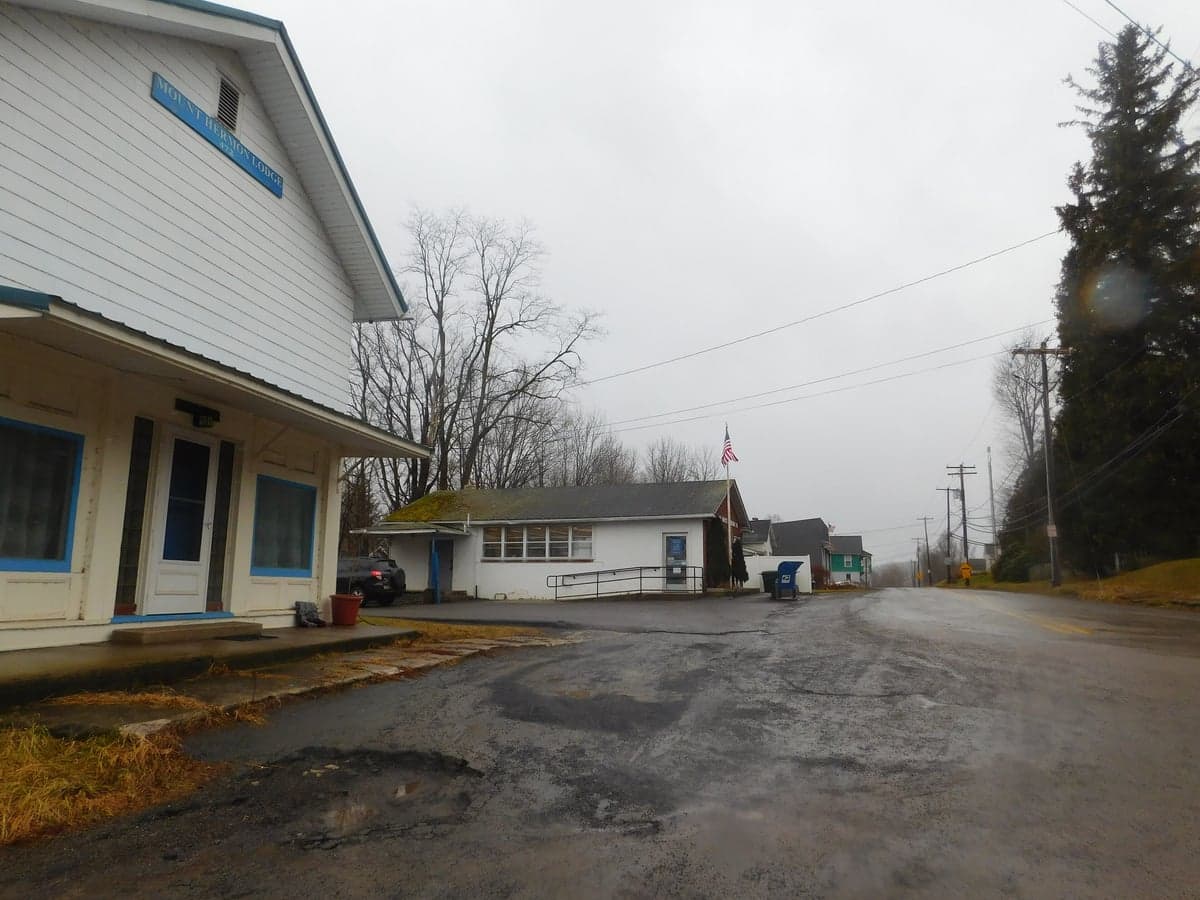
Photo: Wikipedia
Political ClimatePolitical Climate in Union Dale, PA
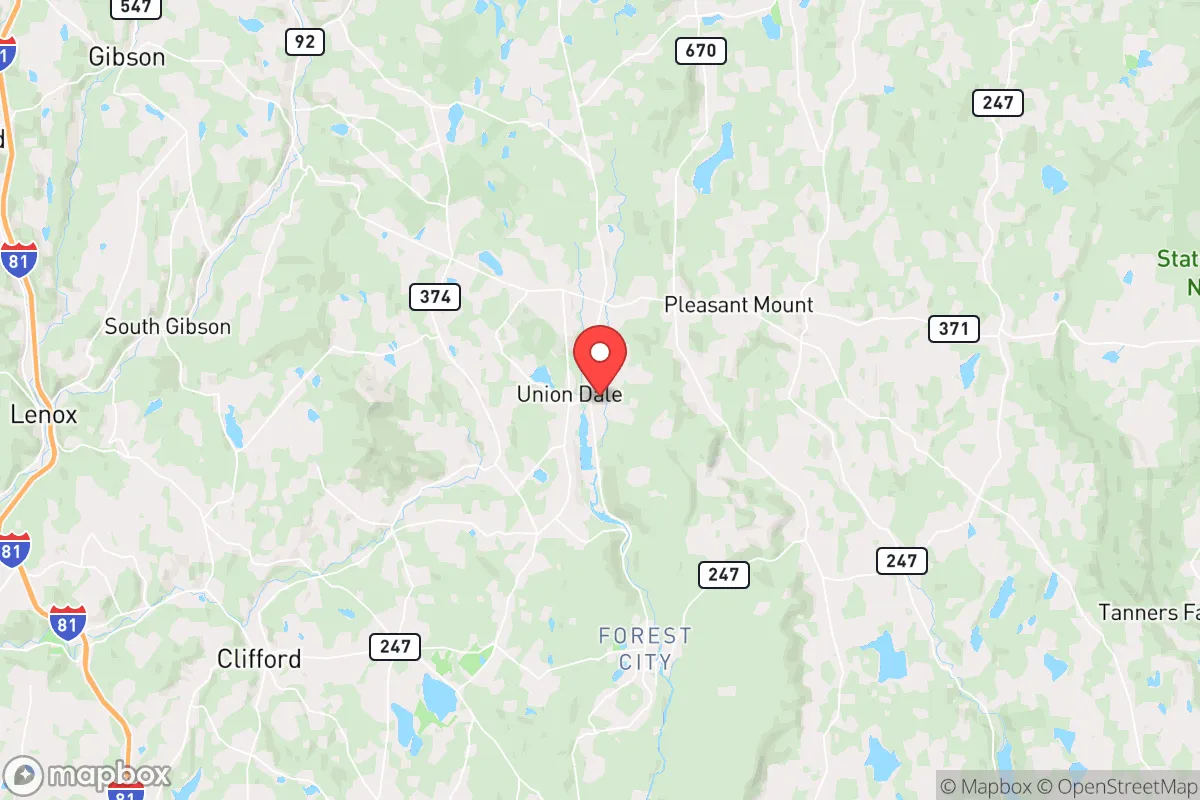
District shown is the primary district for this city’s centroid. Cities may span multiple districts.
Local Political AnalysisPolitical Analysis of Union Dale, PA
How it compares
The contrast with the rest of Pennsylvania is stark. While the state’s EVEN PVI makes it the ultimate swing state — decided by razor-thin margins in Philadelphia’s suburbs and the Lehigh Valley — Union Dale’s R+19 lean means local races are often decided in the primary, not the general. Head south to Scranton or Wilkes-Barre, about 30–40 minutes away, and you’ll find Democratic strongholds where union labor and urban issues dominate. Head east toward the Poconos and you’ll hit a mix of transplants from New York and New Jersey who’ve shifted some towns purple. But Union Dale itself? It’s surrounded by small boroughs like Forest City, Vandling, and Carbondale that share the same rural, working-class conservatism. The local economy has always leaned on farming, small manufacturing, and trades — the kind of work that breeds a practical, keep-government-out-of-it mindset. Even as Pennsylvania’s population centers grow bluer, this area has held its ground, and if anything, the rural-versus-urban divide has only hardened it.What this means for residents
For conservative residents, Union Dale is about as comfortable as it gets in the Northeast. You’re not going to get sideways looks for a Trump sign on your lawn, and local officials — from the county commissioners to the school board — generally reflect the area’s values. Taxes are lower than in the blue-leaning counties to the south, and gun rights are treated as a given, not a debate. For liberal residents, the reality is different but not hostile. You’ll be in the minority, and you’ll likely hear opinions you disagree with at the diner or the feed store, but the flip side is a genuine live-and-let-live culture. People here are more concerned with whether you’re a good neighbor than your party registration. That said, if you’re looking for progressive policy — think transit funding, renewable energy incentives, or strict land-use regulations — you won’t find much of it locally. The county’s approach is hands-off, and that’s exactly how most folks want it.Cultural and policy distinctions
One thing that sets Union Dale apart is its relationship with the Second Amendment — it’s not just a talking point here, it’s a way of life, with hunting and sport shooting woven into family traditions. The area also leans heavily into local control: zoning is minimal, and property rights are fiercely protected. You’ll notice fewer state-funded programs and more reliance on volunteer fire departments and church-based charity. The trajectory? If Pennsylvania stays a swing state, Union Dale will likely stay a red island within it, and that’s a dynamic both sides have learned to navigate. It’s not a place that changes fast, but for those who call it home, that’s the point.
State Political ClimatePolitical Climate in Pennsylvania
State Political AnalysisPolitical Environment in the State
Pennsylvania is the ultimate swing state — a true EVEN on the Cook PVI — and it has decided the last two presidential elections by margins of less than 1.5 points. The state’s political reality is a knife’s-edge balance between the urban Democratic strongholds of Philadelphia and Pittsburgh and the sprawling Republican exurbs and rural counties in between. Over the last 20 years, the Keystone State has drifted from a reliable blue anchor in the Northeast to the single most contested battleground in the country, with the 2024 race landing at roughly 50-49 in favor of the GOP after Donald Trump carried the state in 2016 and Joe Biden flipped it back in 2020.
Urban vs. rural divide
Pennsylvania’s political map is a textbook study in geographic polarization. The state’s two major metros — Philadelphia and Pittsburgh — anchor the Democratic coalition, but they do so in very different ways. Philadelphia County alone delivers roughly 500,000 Democratic votes, a margin that essentially requires Republicans to run up the score everywhere else. Pittsburgh’s Allegheny County has trended blue over the past decade, but the surrounding collar counties tell a more complex story.
The real battleground is the suburban ring around Philadelphia — the so-called "collar counties" of Bucks, Montgomery, Chester, and Delaware. These counties were reliably Republican as recently as 2012, but the Trump era triggered a dramatic realignment. Montgomery County, which Mitt Romney won by 4 points in 2012, went for Biden by 25 points in 2020. Bucks County, a perennial bellwether that has voted for the winner in every presidential election since 1992, flipped hard to the left in the suburbs while its rural northern half stayed deep red.
Meanwhile, the vast rural interior — places like Lancaster, York, Franklin, and the northern tier counties along the New York border — has become increasingly Republican. Lancaster County, home to a large Amish and Mennonite population, is now a GOP stronghold that routinely delivers 60%+ margins. The state’s "T" — the rural spine running from the northeast corner down through central Pennsylvania and into the southwest — is as Republican as any place in the country. The result is a state that is perpetually purple, with the outcome determined by whether Philadelphia’s margins can offset the rural red wave.
Policy environment
Pennsylvania’s policy environment is a study in divided government and moderate compromise. The state has a flat income tax rate of 3.07%, one of the lowest in the nation, and no tax on retirement income — a significant draw for retirees. The sales tax is 6% (with local add-ons in Philadelphia and Allegheny County), and groceries and clothing are exempt. Property taxes are notoriously high, particularly in the Philadelphia suburbs and Pittsburgh, which is a perennial complaint among homeowners.
The regulatory posture is mixed. Pennsylvania is a heavily unionized state — public-sector unions remain powerful, and the building trades hold significant sway in both parties. The state has a Democratic governor (Josh Shapiro, elected in 2022) and a Republican-controlled state Senate, with the House having flipped back and forth in recent cycles. This split has produced a moderate, deal-making environment rather than ideological purity. Election laws are relatively accessible — no-excuse mail-in voting was enacted on a bipartisan basis in 2019, though it has become a flashpoint since 2020. The state does not have voter ID laws beyond first-time voter requirements, which remains a contentious issue.
Recent policy direction
The last few years have seen Pennsylvania chart a distinctly moderate course, with Governor Shapiro positioning himself as a pragmatic centrist. On gun policy, Pennsylvania is a "shall-issue" state for concealed carry permits, and the state preempts local municipalities from enacting their own gun restrictions — a significant win for Second Amendment advocates. However, the state does have universal background checks for handguns and a 48-hour waiting period, and Philadelphia has repeatedly tried to enact local ordinances that get struck down by the courts.
On education, Pennsylvania enacted a landmark school funding reform in 2023 after the state Supreme Court ruled the current system unconstitutional. The state has also expanded school choice options, including the Educational Improvement Tax Credit (EITC) program that funds scholarships for low-income students. Parental rights in education have become a hot-button issue, with school boards across the state — particularly in the suburban counties — becoming battlegrounds over curriculum transparency and library content.
On energy, Pennsylvania is the nation’s second-largest natural gas producer, and the Marcellus Shale has created a massive economic engine in the western and northern parts of the state. The Shapiro administration has walked a careful line — supporting the industry while also joining the Regional Greenhouse Gas Initiative (RGGI), a carbon cap-and-trade program that has been challenged in court. On healthcare, the state expanded Medicaid under the Affordable Care Act and has some of the strongest patient protections in the country, including coverage for pre-existing conditions regardless of federal changes.
On voting and ballot access, the state has become a national flashpoint. The 2020 election saw intense scrutiny of mail-in ballots, and the Republican-controlled legislature has pushed for stricter ID requirements and earlier mail-in ballot deadlines. Act 77, the 2019 law that created no-excuse mail-in voting, remains in place, but its future is uncertain as litigation continues. The state has also seen controversy over its voter rolls, with periodic purges and disputes over the accuracy of registration data.
Civil unrest & political movements
Pennsylvania has been a focal point for political activism on both sides. The 2020 election integrity movement was particularly strong in the state, with Republican activists organizing large-scale ballot-watching operations in Philadelphia and challenging election procedures in court. The January 6th investigation had significant Pennsylvania connections, with several state residents facing charges. On the left, the Black Lives Matter protests in Philadelphia in 2020 were among the largest in the country, and the city has seen ongoing activism around police reform and defunding.
Immigration politics are less visible in Pennsylvania than in border states, but they have become more salient in recent years. Philadelphia is a designated sanctuary city, and the state has seen a significant influx of migrants from New York City under the busing program initiated by Mayor Eric Adams. This has created tensions in smaller communities like Reading and Allentown, which have seen their immigrant populations grow dramatically over the past two decades. The state’s agricultural sector relies heavily on immigrant labor, particularly in the mushroom industry in Chester County and the dairy farms in Lancaster County.
There is no serious secession or nullification movement in Pennsylvania, but the state does have a strong rural-urban cultural divide that occasionally flares into visible conflict. The most notable flashpoint in recent years was the 2022 controversy over the state’s response to the COVID-19 pandemic, when rural counties pushed back against the Wolf administration’s shutdown orders. Several counties declared themselves "Second Amendment sanctuaries" in response to proposed gun restrictions, though these declarations are largely symbolic.
Projection
Looking ahead 5-10 years, Pennsylvania’s trajectory is genuinely uncertain. The state’s population is aging and slowly declining in the rural areas, while the Philadelphia and Pittsburgh metros continue to attract younger, more diverse residents. The collar counties around Philadelphia are likely to continue their leftward drift, which favors Democrats. However, the state’s rural areas are becoming even more Republican, and the GOP has made significant inroads with working-class voters in the former coal and steel regions of the southwest and northeast.
The wildcard is in-migration. Pennsylvania has seen a modest but steady influx of residents from New York and New Jersey, particularly in the Lehigh Valley (Allentown, Bethlehem, Easton) and the Poconos. These newcomers tend to be more moderate than native Pennsylvanians, and they could tip the balance in close elections. The state’s low taxes and relatively affordable housing compared to the Northeast corridor make it an attractive destination for families priced out of New York and New Jersey.
The political environment is likely to remain highly competitive, with the state continuing to be a top-tier battleground in every national election. The divided government in Harrisburg is unlikely to change dramatically, as the state’s geographic polarization makes it difficult for either party to achieve a trifecta. Expect continued gridlock on major issues, with incremental progress on the margins.
For a new resident, the bottom line is that Pennsylvania offers a genuine mix of political cultures. If you’re conservative, you’ll find welcoming communities in the rural areas and exurbs, with low taxes and strong Second Amendment protections — but you’ll be living in a state where your vote is often canceled out by Philadelphia’s margins. If you’re liberal, you’ll find vibrant urban centers and increasingly blue suburbs, but you’ll be sharing the state with a powerful rural conservative bloc that shapes policy. The state’s moderate tax structure and pragmatic governance make it livable for both sides, but the constant political tension is something you’ll feel every election cycle. It’s a state where your vote genuinely matters — and where the outcome is never a foregone conclusion.
* Values derived from national, state, county, city and local statistics and may differ in a specific area. Last updated: 2026-11-01T22:27:26.000Z
Narrative content on this page is AI-generated and may contain mistakes. Verify any details that matter before acting on them.
ReloMaps may earn a commission from affiliate links at no extra cost to you.

