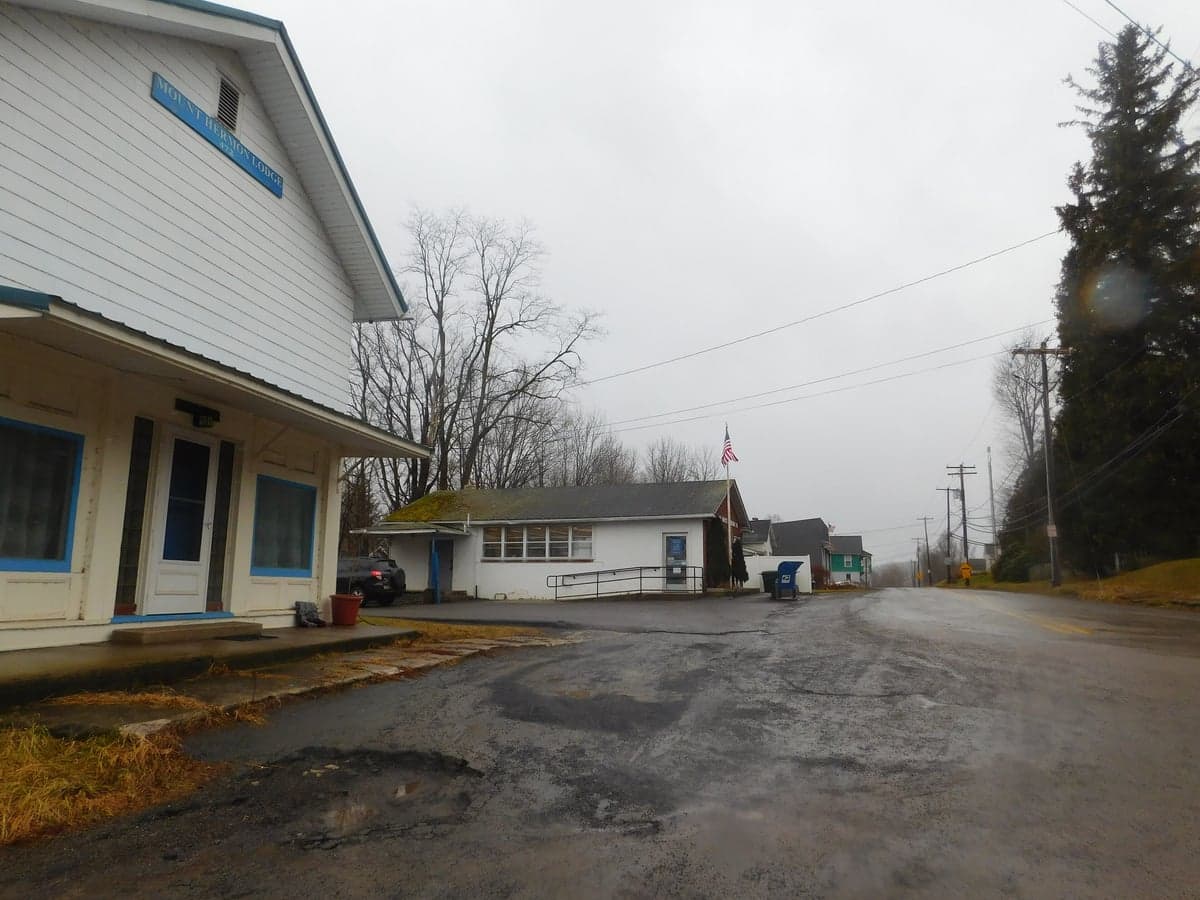
Photo: Wikipedia
Demographics of Union Dale, PA
Affluence Level in Union Dale, PA
A below-average socioeconomic profile. Incomes, home values, and educational attainment trail the U.S., with higher poverty and unemployment.
People of Union Dale, PA
Union Dale, Pennsylvania, is a tiny borough of roughly 212 residents in Susquehanna County, and its people are overwhelmingly white (95.3%) with a small Hispanic minority (4.7%). The borough has a 0.0% foreign-born population, meaning nearly everyone living here was born in the United States, and only 6.3% of adults hold a college degree. This is a working-class, rural community in the Endless Mountains region, defined by its small-town character, low density, and a population that has remained remarkably stable and homogeneous for generations.
How the city was settled and grew
Union Dale was never a city in the industrial sense; it is a rural borough that grew up around the railroad and small-scale agriculture in the mid-19th century. The area was originally part of the Connecticut Susquehanna Company's land claims, and the first permanent settlers were Yankees from Connecticut and New York who arrived in the 1790s and early 1800s. These early families—many of English and Scots-Irish descent—established small farms along the creek valleys, and the settlement that became Union Dale coalesced around the railroad depot built in the 1850s on the Delaware, Lackawanna and Western line. The borough was formally incorporated in 1904, and its early population was concentrated in the Depot District near the train station, where the railroad employed local men as brakemen, firemen, and track layers. The surrounding Hilltop Neighborhood, which sits on the higher ground east of the tracks, was built out by the same Yankee farming families, who constructed the modest frame houses and barns that still line the streets today. A second wave of settlement came in the 1880s and 1890s, when Irish and German immigrants arrived to work on railroad maintenance crews and in the region's small tanneries and sawmills. These families settled in the Lower Creek Area, near the water power that drove the mills, and their Catholic and Lutheran churches became the social anchors of that district. By 1900, the borough's population had reached its historical peak of roughly 400 residents, a number that has never been regained.
Modern era (post-1965)
Like most of rural northeastern Pennsylvania, Union Dale has experienced steady population decline since the mid-20th century. The railroad depot closed in the 1960s, eliminating the borough's primary employer, and the young people who grew up here largely left for Scranton, Binghamton, or points south in search of manufacturing and service jobs. The post-1965 immigration waves that transformed many American cities had virtually no impact on Union Dale; the borough's foreign-born population remains at 0.0%, and its white share of 95.3% reflects a community that has not attracted international migration. The small Hispanic population (4.7%) is a recent development, appearing in the last decade as a handful of Latino families moved into the area to work in the region's dairy industry and on the large poultry farms that have become a staple of Susquehanna County agriculture. These families have settled primarily in the Route 374 Corridor, the stretch of state highway that runs through the southern edge of the borough, where older farmhouses have been converted to rental properties. The West End, a cluster of about a dozen homes near the borough line, has also seen a few new residents arrive as remote workers and retirees from the New York City metro area have discovered the area's low property prices—the median home value in Union Dale is well under $150,000, a fraction of what comparable homes cost in the Hudson Valley. However, these newcomers remain a small minority; the borough's population has hovered between 200 and 250 for the past three decades, and the school-age population has shrunk as the local elementary school consolidated with neighboring districts.
The future
Union Dale's population is likely to remain small and predominantly white for the foreseeable future. The borough has no major employers, no new housing developments, and no infrastructure to attract significant in-migration; the 2020 Census recorded just 212 residents, down from 244 in 2010. The Hispanic share of the population may grow modestly as agricultural labor demand in Susquehanna County continues, but the absolute numbers are tiny—a 4.7% share represents roughly 10 people. The more significant demographic trend is aging: the median age in Union Dale is over 50, well above the national average, and the borough's death rate has exceeded its birth rate for most of the past decade. The Depot District and Hilltop Neighborhood are now home to many retired residents who have lived there for 40 or 50 years, and as these homes turn over, they are most likely to be purchased by out-of-state buyers seeking second homes or by young families priced out of the closer-in suburbs of Scranton. The cultural identity of Union Dale remains deeply rooted in its rural, working-class heritage—hunting, fishing, and church life are the dominant social institutions—and there is little sign that this character will change dramatically in the next 10 to 20 years.
For someone moving to Union Dale today, the bottom line is this: you are joining a small, stable, and overwhelmingly white community where nearly everyone knows everyone else, and where the pace of life is determined by the seasons rather than the clock. The borough offers very low housing costs and a safe, quiet environment, but it also offers limited employment opportunities, a long commute to any significant services, and a population that is slowly shrinking and aging. If you are looking for a place to raise a family in a traditional small-town setting, Union Dale can offer that—but you should expect to be one of the few newcomers in a community that has not changed its character in over a century.

* Values derived from national, state, county, city and local statistics and may differ in a specific area. Last updated: 2026-11-01T22:27:26.000Z
Narrative content on this page is AI-generated and may contain mistakes. Verify any details that matter before acting on them.
ReloMaps may earn a commission from affiliate links at no extra cost to you.

