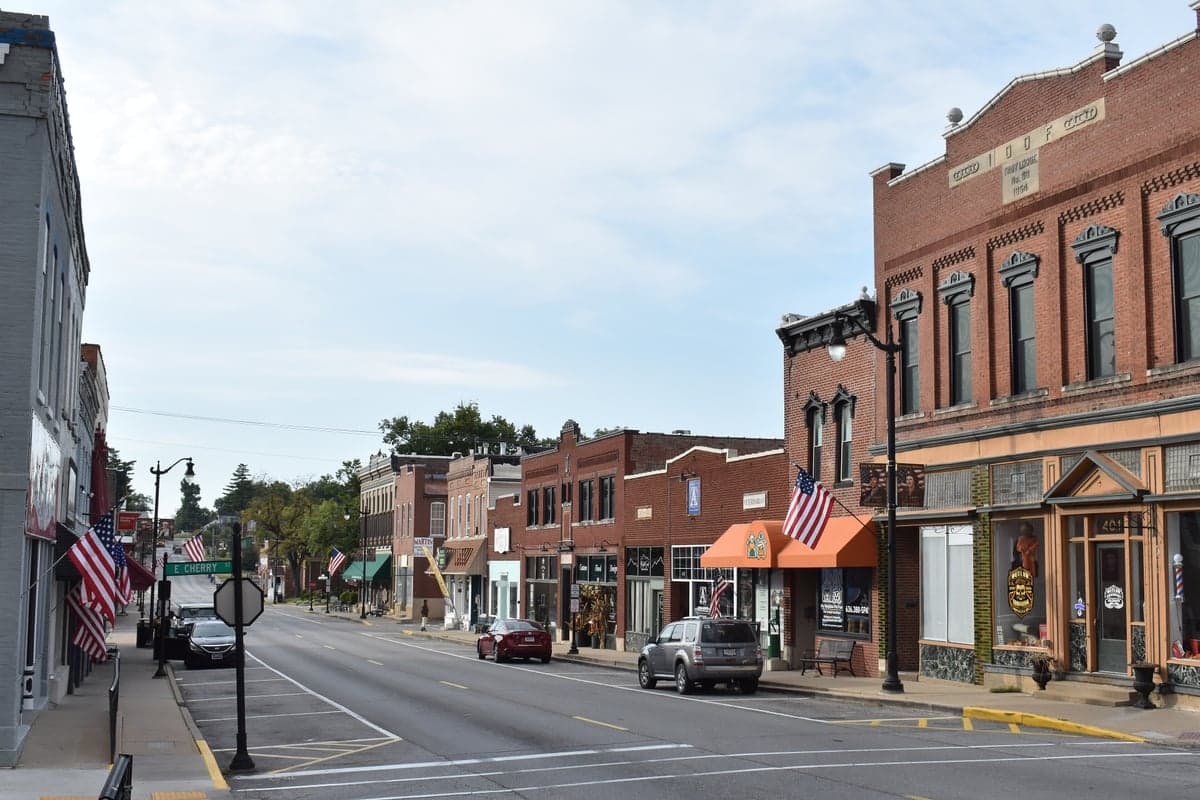
Photo: Wikipedia
Political ClimatePolitical Climate in Troy, MO
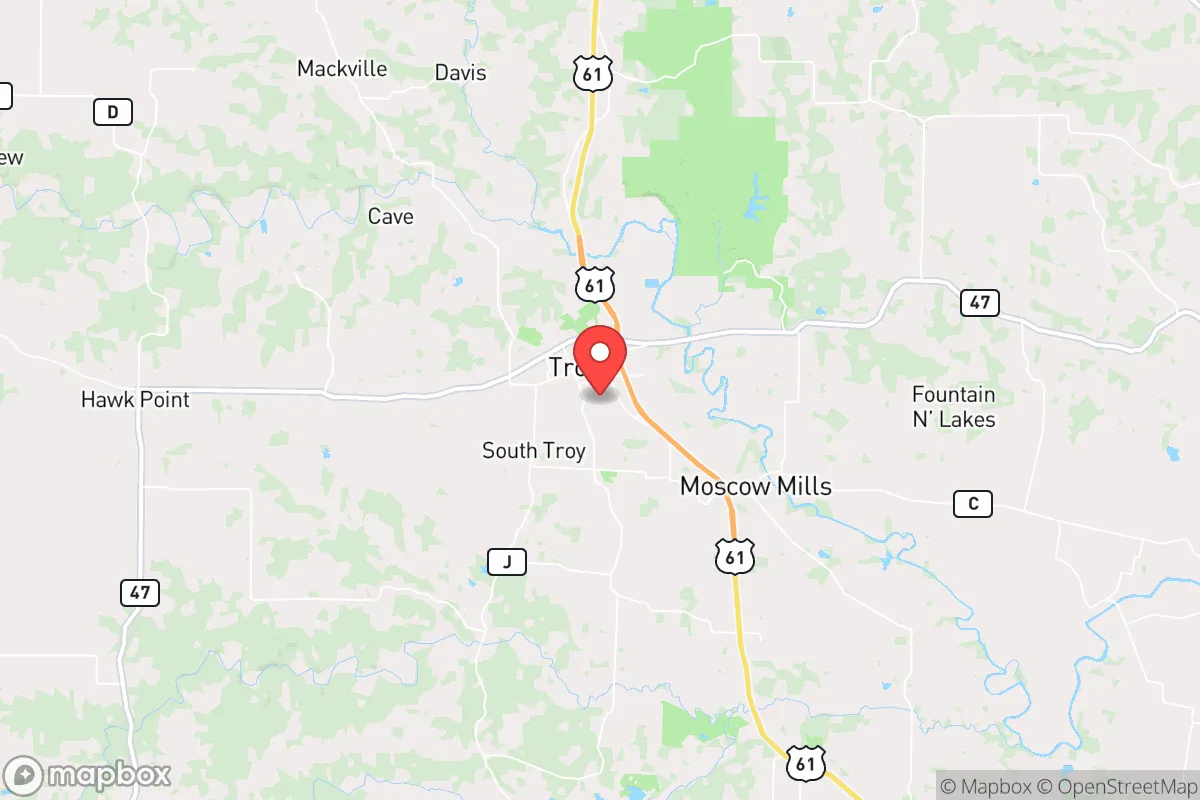
District shown is the primary district for this city’s centroid. Cities may span multiple districts.
Local Political AnalysisPolitical Analysis of Troy, MO
Troy, Missouri, is a reliably conservative stronghold, with a Cook Partisan Voting Index (PVI) of R+13, making it significantly more Republican than the state of Missouri as a whole, which sits at R+8. This isn't a recent shift; the area has long leaned red, but the margin has widened over the past decade as rural and exurban voters have become more consistently GOP. In practice, this means that in a typical election, Republican candidates can expect to win Troy by a comfortable double-digit margin, while Democratic candidates rarely compete seriously here.
How it compares
The R+13 rating puts Troy in a different political universe than the state's major urban centers. For context, St. Louis County, just 45 minutes east, has a PVI of D+15, meaning the political landscape flips dramatically as you drive toward the city. Even nearby Lincoln County, which includes Troy, is more conservative than the state average, but the contrast with St. Charles County (R+9) is telling—Troy is noticeably more Republican than its suburban neighbor to the south. The surrounding rural areas, like Pike County to the north, are even more deeply red, often pushing R+20 or higher. This isn't a purple zone; it's a solidly conservative enclave where local elections are often decided in the Republican primary.
What this means for residents
For conservative residents, Troy offers a political environment where their views are the clear majority. Local government, school boards, and county commissions are dominated by Republicans, and policy decisions—from tax rates to land use—tend to reflect small-government, pro-business priorities. For liberal residents, the reality is more isolating. You'll find few like-minded neighbors, and local political activism is largely confined to the GOP. That said, the area isn't hostile; most folks are polite and neighborly, but political discussions can feel one-sided. National issues like gun rights, abortion, and federal spending are generally viewed through a conservative lens, and local news coverage reflects that. The practical effect is that if you're liberal, you'll likely keep your politics private or engage primarily online or in nearby St. Louis.
Culturally, Troy's political lean shapes daily life in subtle but real ways. The local chamber of commerce and civic groups are heavily tied to Republican networks, and events like the annual Troy Fall Festival are apolitical but draw a crowd that leans right. There's a strong emphasis on self-reliance and local control, which shows in the town's resistance to regional planning efforts from St. Louis County. The school district, Troy R-III, has avoided the culture-war battles seen in some suburban districts, but curriculum and library materials tend to reflect conservative community standards. Looking ahead, as the St. Louis exurban sprawl creeps westward, Troy may see an influx of more moderate voters, but for now, the R+13 rating is a reliable snapshot of a place where Republican politics are the baseline, not the exception.

State Political ClimatePolitical Climate in Missouri
State Political AnalysisPolitical Environment in the State
Missouri has been a reliably Republican state for most of the past two decades, with a Cook Partisan Voting Index of R+8, meaning it votes about eight points more Republican than the nation as a whole. The state hasn't backed a Democrat for president since Bill Clinton in 1996, and the GOP has held supermajorities in both chambers of the General Assembly since 2014. But this wasn't always the case — as recently as the early 2000s, Missouri was considered the ultimate bellwether, voting for the winner in every presidential election from 1904 to 2004 except 1956. The shift has been driven by a combination of rural realignment, the collapse of the old "Missouri Democrat" tradition, and the rapid growth of conservative-leaning suburbs in the southwest part of the state.
Urban vs. rural divide
The political map of Missouri is a textbook study in the urban-rural split. The two major metro areas — St. Louis and Kansas City — are deep blue islands in a sea of red. St. Louis City and County together delivered over 600,000 votes for Joe Biden in 2020, while Kansas City's Jackson County added another 200,000. These two metros alone account for roughly 40% of the state's population, but they're surrounded by counties that vote 70-80% Republican. The real story, though, is the Springfield and Joplin corridor in the southwest, which has become the engine of the state's conservative majority. Greene County (Springfield) and Jasper County (Joplin) have been reliably red for decades, but their population growth has outpaced the rest of the state, giving the GOP an increasingly solid base. Meanwhile, the old Democratic strongholds in the Bootheel and the "Little Dixie" region along the Missouri River — places like Cape Girardeau and Columbia — have been trending right. Boone County (Columbia) is still a blue dot thanks to the University of Missouri, but it's shrinking relative to the rest of the state. The Lake of the Ozarks region, particularly Camden and Morgan counties, has seen an influx of retirees from the Midwest, further solidifying the rural conservative vote.
Policy environment
Missouri's policy environment is shaped by a low-tax, limited-government philosophy that has been in place for over a decade. The state has a flat income tax rate of 4.95%, which is scheduled to drop to 4.5% by 2027 under a 2022 law. There's no estate tax, and the corporate tax rate is 4%. Property taxes are among the lowest in the nation, averaging about 0.9% of assessed value, which is a major draw for families from high-tax states like Illinois and California. The regulatory posture is generally business-friendly, with a right-to-work law that was passed in 2017 but repealed by voters in 2018 — a rare defeat for the GOP's business agenda. Education policy is a flashpoint: Missouri has a robust school choice program, including charter schools in Kansas City and St. Louis, and a tax-credit scholarship program for private school tuition. The state also passed a "Parents' Bill of Rights" in 2022, which requires schools to notify parents about curriculum changes and allows them to opt their children out of certain materials. On healthcare, Missouri did not expand Medicaid until 2021, when voters approved it by ballot initiative — a move the legislature had resisted for years. Election laws have been tightened: a 2022 law requires photo ID to vote, bans ballot drop boxes, and limits early voting to two weeks. The state also has a "critical race theory" ban in public schools, though it's largely symbolic.
Recent policy direction
The last five years have seen Missouri move decisively in a conservative direction on nearly every front. On gun rights, the state passed a "Second Amendment Preservation Act" in 2021 that purports to nullify federal gun laws — a move that has led to a legal standoff with the Department of Justice. The law is currently tied up in court, but it signals the legislature's willingness to push the boundaries of state sovereignty. On abortion, Missouri became the first state to effectively ban the procedure after the Dobbs decision, with a trigger law that prohibits abortion at any stage of pregnancy except in medical emergencies. There are no exceptions for rape or incest. On education, the legislature passed a sweeping "Save Women's Sports Act" in 2023, barring transgender athletes from competing in girls' sports, and a "Parental Rights in Education" law that restricts classroom discussion of sexual orientation and gender identity. On property rights, the state has been aggressive in fighting federal land management, particularly in the Mark Twain National Forest, where local officials have pushed back against federal regulations. On taxes, the 2022 income tax cut was paired with a phase-out of the corporate franchise tax. On voting, the 2022 law also banned the private funding of election administration — a response to the "Zuckerbucks" controversy from 2020. The overall trajectory is toward a state that is increasingly assertive in asserting its own authority against federal mandates, particularly on guns, abortion, and education.
Civil unrest & political movements
Missouri has been a focal point for several high-profile political movements in recent years. The 2014 protests in Ferguson (a suburb of St. Louis) after the shooting of Michael Brown sparked a national conversation about policing and racial justice, and the city remains a symbol of that era. The "Ferguson effect" is still felt in local politics, with St. Louis County seeing a shift toward more progressive candidates in some suburban districts, though the state legislature has moved in the opposite direction. On the right, the "Patriot" movement is strong in rural areas, particularly around the Lake of the Ozarks and the Ozark Plateau. The Branson area has become a hub for conservative activism, with regular rallies and events. Immigration politics are less visible here than in border states, but there's been a push to restrict "sanctuary city" policies — St. Louis and Kansas City have both been targeted by state legislation that would penalize cities that don't cooperate with federal immigration enforcement. The 2020 election saw a brief controversy over ballot counting in St. Louis, but it didn't escalate to the level seen in other states. The most visible flashpoint for a new resident would likely be the constant tension between St. Louis City's progressive governance and the state legislature's conservative agenda — the city has been sued multiple times by the state over local ordinances on minimum wage, paid leave, and gun control.
Projection
Over the next 5-10 years, Missouri is likely to become even more Republican, but the nature of that conservatism may shift. The fastest-growing parts of the state are the conservative suburbs of St. Charles and Jefferson County (outside St. Louis) and the Springfield metro area, which are pulling the state further right. At the same time, the urban cores of St. Louis and Kansas City are losing population, which reduces the Democratic base. The in-migration from Illinois and California is mostly going to these conservative suburbs, not the cities, so the political balance will continue to tilt. However, there's a growing libertarian streak in the state, particularly among younger conservatives who are skeptical of both federal power and social conservatism. This could lead to a more "live and let live" flavor of Republicanism, especially on issues like marijuana (already legal for medical use, with a 2022 ballot initiative legalizing recreational use) and criminal justice reform. The biggest wild card is the St. Louis region: if the city continues to lose population and the suburbs continue to grow, the state could become as red as Arkansas or Oklahoma within a decade. Someone moving in now should expect a state that is increasingly conservative on social issues, but with a strong independent streak that resists being told what to do by either party.
For a new resident, the bottom line is that Missouri offers a low-cost, low-regulation environment that appeals to conservatives, but with enough urban diversity that liberals can find their communities in St. Louis, Kansas City, or Columbia. The political climate is not particularly volatile — most people go about their daily lives without much political friction, unless you're in a position where state preemption of local laws directly affects you. The practical takeaway is that if you're looking for a state where your vote will matter in a Republican primary, you'll have plenty of company. If you're a liberal, you'll be in a clear minority at the state level, but you'll have local control in the cities. Either way, the state's trajectory is clear: more conservative, more rural-driven, and more assertive in pushing back against federal authority.
* Values derived from national, state, county, city and local statistics and may differ in a specific area. Last updated: 2026-11-05T20:26:50.000Z
Narrative content on this page is AI-generated and may contain mistakes. Verify any details that matter before acting on them.
ReloMaps may earn a commission from affiliate links at no extra cost to you.

