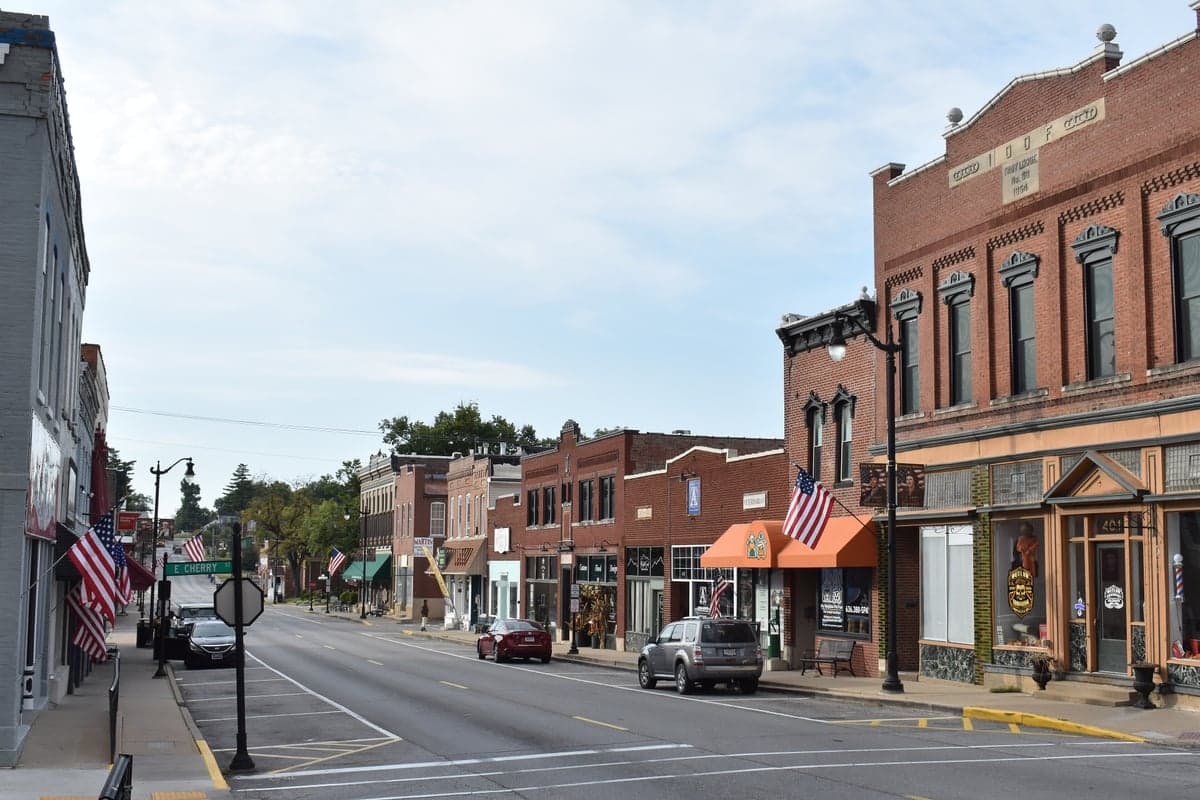
Photo: Wikipedia
Personal Sovereignty in Troy, MO
Strong independent fundamentals that actively favor personal liberty and low regulation.
What does Personal Sovereignty tell us?
Personal Sovereignty measures your capacity for self-reliance and independence with minimal government friction. Higher scores mean fewer barriers between you and the way you want to live... but it assumes you have the space you need and good neighbors.
What does this tell us?
Personal Sovereignty measures your capacity for self-reliance and independence with minimal government friction. Higher scores mean fewer barriers between you and the way you want to live... but it assumes you have the space you need and good neighbors.
State Policy
Energy independence: Importer (14% of energy produced in-state)
Personal Liberty
Homesteading

Personal Liberty Analysis
Troy, Missouri, offers a notably high degree of personal sovereignty, shaped by Missouri’s strong constitutional protections and a local culture that prizes self-reliance. The regulatory environment is light-touch, with low property taxes, permissive gun laws, and a county government that generally avoids overreach into daily life. For individuals and families who prioritize autonomy—whether in self-defense, medical choices, or property use—Troy provides a legal and cultural framework that supports independence without the friction found in more heavily regulated metro areas.
Tax burden and regulatory posture in Troy and Lincoln County
Missouri’s tax structure is among the most favorable in the nation for those seeking to keep more of their earnings. The state’s income tax is a flat 4.0% as of 2026, with no local income tax in Troy or Lincoln County. Property taxes are exceptionally low: the effective rate in Lincoln County hovers around 0.75% of assessed value, roughly half the national average. A $250,000 home carries an annual tax bill of about $1,875, a figure that gives homeowners significant financial breathing room. Sales tax in Troy totals 8.225% (state + county + city), which is moderate for Missouri but still below many coastal states. The regulatory posture of Lincoln County government is best described as hands-off. There is no county-wide zoning in unincorporated areas, and the city of Troy itself maintains only basic building codes and a modest planning department. Business licensing is straightforward—no occupational taxes or onerous permitting processes for most small operations. The county’s approach to environmental regulation is similarly light: no stormwater utility fees, no tree preservation ordinances, and no local pesticide or fertilizer restrictions. For a family wanting to run a home-based business, keep livestock, or modify their property without layers of bureaucracy, Troy’s regulatory climate is a clear asset.
Self-defense and gun law specifics in Troy and Missouri
Missouri is a constitutional carry state, meaning no permit is required to carry a concealed firearm for anyone legally allowed to possess one. Troy residents enjoy this right without local interference—the city has no additional firearm ordinances beyond state law. Open carry is legal without a permit, and there are no restrictions on magazine capacity or specific firearm features. The state’s “Stand Your Ground” law, codified in Missouri Revised Statutes §563.031, removes any duty to retreat before using deadly force in self-defense, provided the person is lawfully present and not engaged in criminal activity. Castle Doctrine protections extend to vehicles and occupied structures. For those who want a concealed carry permit for reciprocity with other states, Lincoln County issues permits with a relatively quick turnaround—typically under 30 days. The sheriff’s office is known for being pro-Second Amendment, and local gun ranges and training facilities are plentiful within a 20-minute drive. Importantly, Missouri law preempts local governments from enacting stricter gun ordinances than the state, so Troy cannot impose its own waiting periods or registration schemes. This preemption is a critical safeguard for personal sovereignty, ensuring that a change in city council composition cannot erode firearm rights.
Self-reliance and homesteading viability in Troy
Troy’s position at the edge of the St. Louis metro area means that rural homesteading is still very much viable, though suburban encroachment is slowly increasing. In unincorporated Lincoln County, minimum lot sizes are typically 1 to 3 acres for residential use, with no maximum. The city of Troy itself has more conventional subdivision lots (0.25–0.5 acres), but properties on the outskirts routinely offer 5–20 acres at prices well below national averages—raw land can be found for $5,000–$10,000 per acre. Zoning in unincorporated areas is essentially nonexistent; there are no restrictions on keeping chickens, goats, or even larger livestock like cattle or horses on parcels of sufficient size. Beekeeping and small-scale aquaculture are also unregulated at the county level. Off-grid living is legally feasible: Missouri has no state law requiring connection to municipal water or sewer, and private wells and septic systems are standard. Solar panels are permitted without special permitting beyond standard electrical inspection, and there are no HOA-style covenants in unincorporated areas that would restrict rainwater collection or composting toilets. However, Troy city limits do require connection to municipal water and sewer where available, so off-grid viability is strongest outside city boundaries. The county’s agricultural exemption for property taxes is generous—land used for farming or timber production can be assessed at a fraction of its market value, making larger acreage holdings financially sustainable.
Personal liberties in Troy: parental rights, medical autonomy, speech, and property
Missouri has some of the strongest parental rights protections in the country. The Missouri Parental Rights Act (RSMo §452.375) grants parents broad authority over their children’s education, healthcare, and upbringing. Troy’s school district, Lincoln County R-III, has a conservative school board that has resisted curriculum mandates from the state level and maintains transparent policies on instructional materials. Parents can opt their children out of any sex education or health curriculum without penalty. Medical autonomy is similarly robust: Missouri does not require COVID-19 or other adult vaccination mandates for employment or public accommodation, and the state’s 2023 law banning mask mandates in schools and government buildings remains in effect. The Missouri Human Rights Act does not include sexual orientation or gender identity as protected classes in housing or employment, which aligns with the local cultural preference for limited government intervention in private decisions. Free speech is protected under the Missouri Constitution’s Article I, Section 8, which is even more expansive than the First Amendment—it explicitly prohibits prior restraint and protects anonymous speech. Troy has no local noise ordinances that restrict political or religious speech, and public forums like the city park and county courthouse square are regularly used for rallies and gatherings without permit requirements for small groups. Property rights are strongly protected: Missouri’s “right to farm” amendment (Article I, Section 35) prohibits any law that would “abridge the right of farmers and ranchers to employ agricultural technology and practices,” and eminent domain for private economic development is banned under state law. For a homeowner, this means no risk of losing property to a private developer’s condemnation.
Overall, Troy offers a sovereignty profile that ranks among the strongest in the Midwest for those who value low taxes, minimal regulation, and robust personal liberties. Compared to neighboring St. Charles County, which has more suburban-style zoning and higher property taxes, Lincoln County remains a refuge for the self-reliant. The combination of constitutional carry, Stand Your Ground, parental rights, and agricultural exemptions creates an environment where an individual or family can live largely unbothered by government—provided they stay outside city limits for maximum off-grid flexibility. For a relocation-minded reader who prioritizes autonomy over amenities, Troy represents a strategic choice: close enough to St. Louis for employment and healthcare, but legally and culturally distinct in its commitment to personal sovereignty.

* Values derived from national, state, county, city and local statistics and may differ in a specific area. Last updated: 2026-11-05T20:26:50.000Z
Narrative content on this page is AI-generated and may contain mistakes. Verify any details that matter before acting on them.
ReloMaps may earn a commission from affiliate links at no extra cost to you.

