Photo: Wikipedia
Political ClimatePolitical Climate in Tomahawk, WI
District shown is the primary district for this city’s centroid. Cities may span multiple districts.
Inherited from parent county — no local data available.
* Lean and PVI are calculated from Tomahawk, WI’s own 2020 presidential results (precinct returns summed to the city), with 2024 estimated from the surrounding county’s 2020–2024 shift, Cook-style. Sources: state election offices; VEST 2020 precinct results (CC BY 4.0).
Political rankings in Wisconsin
- Most Conservative Cities in Wisconsin
- Most Liberal Cities in Wisconsin
- Best Liberal-Leaning Towns in the Midwest
- Safest Liberal-Leaning Towns in the Midwest
- Safest Conservative-Leaning Towns in the Midwest
- Affordable Small Towns for Conservatives
- Most Affordable Liberal-Leaning Small Towns in the U.S.
- Safest Conservative-Leaning Cities in the U.S.
- Most Conservative Counties in Wisconsin
- Most Liberal Counties in Wisconsin
Local Political AnalysisPolitical Analysis of Tomahawk, WI
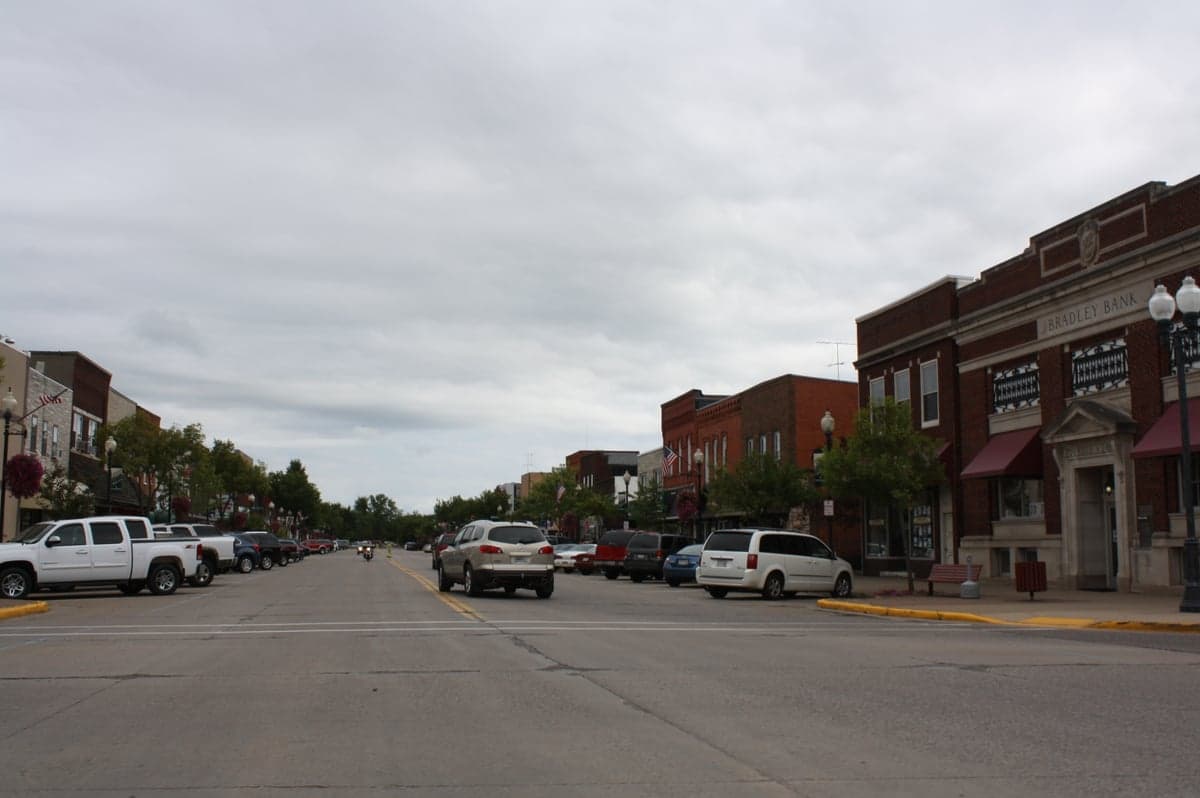
Tomahawk is a solidly conservative town in a deeply red part of Wisconsin, with a Cook Partisan Voting Index (PVI) of R+13—meaning it votes about 13 points more Republican than the national average. That’s a stark contrast to the state of Wisconsin as a whole, which sits at a Cook PVI of EVEN, reflecting its perennial swing-state status. In practice, this means Tomahawk’s politics are more reliably Republican than most of the state, and the town has been trending further right over the past decade, even as the broader state remains closely divided.
How it compares
Wisconsin’s statewide PVI of EVEN masks a deep urban-rural divide. Tomahawk’s R+13 lean puts it in the same camp as other Northwoods communities like Rhinelander (R+16) and Minocqua (R+14), while Milwaukee (D+28) and Madison (D+35) anchor the liberal side. The contrast is sharp: a Tomahawk voter is far more likely to see Republican yard signs than Democratic ones, whereas in Dane County, the opposite is true. The town’s trajectory has been toward the right, driven by a growing population of retirees and second-home owners from more liberal areas who often bring conservative fiscal views, plus a local economy tied to timber and tourism that leans culturally traditional. Meanwhile, the state’s overall EVEN rating means Tomahawk’s influence is diluted by the populous, liberal-leaning cities—so while the town votes red, it doesn’t swing statewide elections alone.
What this means for residents
For conservative residents, Tomahawk’s political climate feels like a natural fit. Local government, school board meetings, and county commissions tend to reflect conservative priorities—lower taxes, Second Amendment rights, and limited regulation. You’ll find strong support for the Lincoln County GOP, and events like the annual Tomahawk Republican Party picnic draw solid crowds. For liberal residents, it’s a different story. They’re a clear minority, and while they’re not ostracized, they often feel their views are underrepresented in local discourse. There’s no active Democratic Party office in town, and progressive candidates rarely win local races. That said, the town’s small size (around 3,300 people) means most political disagreements stay civil—neighbors still help each other plow driveways regardless of party. The real friction comes during statewide elections, when Tomahawk’s red vote is pitted against the blue votes of Milwaukee and Madison, creating a sense that the town’s voice is drowned out by the cities.
Culturally, Tomahawk’s politics show up in everyday life. The local paper, the Tomahawk Leader, covers national politics sparingly, but when it does, the editorial slant is conservative. Gun rights are a given—open carry is common, and the annual Tomahawk Gun Show is a big draw. Social issues like abortion or LGBTQ+ rights rarely dominate local conversation, but when they do, the prevailing sentiment is traditional. Policy-wise, the town benefits from Republican-led state budgets that keep property taxes relatively low (the median effective rate is about 1.5%), but it also feels the pinch of state funding cuts to rural schools and roads. Looking ahead, Tomahawk’s political trajectory seems locked in: as long as the Northwoods economy stays stable and the population doesn’t shift dramatically, the R+13 lean will likely hold or even deepen. For anyone moving here, the takeaway is simple: if you’re conservative, you’ll feel at home; if you’re liberal, you’ll find a quiet, respectful community where your vote is a minority but your voice is still heard.

State Political ClimatePolitical Climate in Wisconsin
State Political AnalysisPolitical Environment in the State
Wisconsin is the ultimate swing state, and I mean that in the most literal sense. With a Cook PVI of EVEN, it’s been decided by less than a point in the last two presidential elections—Trump won it in 2016 by 0.7%, Biden flipped it back in 2020 by 0.6%. Over the last 20 years, the state has shifted from a reliably blue-leaning battleground (voting for Democrats from 1988 to 2012) to a pure toss-up, driven by a realignment of its rural and suburban voters. The dominant coalitions are the Democratic stronghold in Milwaukee and Dane County (Madison) versus a growing Republican base in the WOW counties (Waukesha, Ozaukee, Washington) and the vast rural north and west. What you’ll find is a state that’s deeply polarized but still capable of surprise—think of it as a political knife’s edge where every election feels like a recount waiting to happen.
Urban vs. rural divide
The political map of Wisconsin is a study in contrasts. Milwaukee County, home to the state’s largest city, votes about 70% Democratic, driven by a diverse urban core and strong union roots. Dane County, anchored by Madison and the University of Wisconsin, is even more lopsided—often hitting 75% Democratic, fueled by a highly educated, progressive population. These two counties alone can nearly offset the Republican margins from the rest of the state. On the flip side, the WOW counties—Waukesha, Ozaukee, and Washington—are among the most Republican suburban areas in the country, regularly delivering 60-65% of the vote for GOP candidates. The rural northwoods, from Vilas County down to Marathon County, have trended hard red over the past decade, flipping from blue-dog Democratic to solid Republican as cultural and economic concerns shifted. A key example: Brown County (Green Bay) went from a bellwether to a reliably Republican county in 2020, while Kenosha County, just south of Milwaukee, has become a true swing county—Biden won it by 0.2% in 2020 after Trump won it by 0.7% in 2016. The divide isn’t just urban vs. rural; it’s also about the exurbs and small cities like Eau Claire and La Crosse, which have become competitive as college towns and healthcare hubs.
Policy environment
Wisconsin’s policy environment is a mixed bag that reflects its divided government. The state has a flat income tax rate of 4.4% (down from 7.65% in 2011), and property taxes are moderate—about 1.6% of home value, which is slightly above the national average. There’s no estate tax, and sales tax is 5% statewide, with local options pushing it to 5.5-5.6% in most places. The regulatory posture is generally business-friendly, with a right-to-work law passed in 2015 and a tort reform cap on noneconomic damages. Education policy is a flashpoint: the state has a robust school choice program (vouchers and charter schools) that’s been expanded under Republican control, but public schools in Madison and Milwaukee remain heavily funded and unionized. Healthcare is a patchwork—Wisconsin did not expand Medicaid under the Affordable Care Act, but it has a state-based marketplace and a high rate of employer-sponsored insurance. Election laws are strict: voter ID is required, absentee ballot drop boxes were effectively banned by the state Supreme Court in 2022, and the state has a 28-day residency requirement for voting. For a conservative relocator, the tax and regulatory environment is appealing; for a liberal one, the voting restrictions and lack of Medicaid expansion are sticking points.
Recent policy direction
The last five years have seen Wisconsin lurch rightward on several fronts, though with some notable exceptions. In 2023, the Republican-controlled legislature passed a flat tax reduction, cutting the top rate from 5.3% to 4.4% by 2026. On gun rights, Wisconsin is a shall-issue state for concealed carry (no permit required since 2011), and in 2023, the legislature passed a bill allowing school staff to carry firearms with training—though Governor Tony Evers vetoed it. Parental rights got a boost with a 2023 law requiring schools to notify parents if a student requests a name or pronoun change, and a 2024 law banning gender-affirming care for minors (currently blocked by a court order). On education, the state expanded its school choice program to universal eligibility in 2023, meaning any family can use a voucher regardless of income. Privacy and surveillance: Wisconsin has no comprehensive data privacy law, but a 2023 bill to restrict warrantless cell phone tracking by law enforcement stalled. Medical autonomy: abortion is legal up to 20 weeks after a 2023 state Supreme Court ruling struck down an 1849 ban, but the court is now 4-3 liberal, so further protections are likely. Property rights: the state has strong eminent domain protections, and a 2024 law limited local governments from banning natural gas hookups in new construction. Voting access: the 2022 state Supreme Court ruling banning ballot drop boxes was a major restriction, and a 2023 law shortened the absentee ballot return window. For a conservative, the direction is broadly positive on taxes, guns, and school choice; for a liberal, the erosion of voting access and the ban on gender-affirming care are major concerns.
Civil unrest & political movements
Wisconsin has been a flashpoint for political movements on both sides. The 2011 Act 10 protests in Madison, which drew over 100,000 people to the Capitol to oppose collective bargaining restrictions, were a defining moment for the state’s labor movement. In 2020, the Kenosha protests following the shooting of Jacob Blake led to two nights of rioting and the killing of two protesters by Kyle Rittenhouse, which became a national flashpoint for self-defense and Second Amendment debates. The state has a strong grassroots conservative movement, particularly in the WOW counties and the rural north, where groups like the Wisconsin Family Action and the Wisconsin Institute for Law & Liberty are active. On the left, the Wisconsin Democratic Party is heavily influenced by the progressive wing in Madison and Milwaukee, with groups like the Wisconsin Working Families Party pushing for Medicare for All and rent control. Immigration politics are relatively muted compared to border states—Wisconsin has no sanctuary cities, and a 2023 law requires local law enforcement to cooperate with ICE detainers. Election integrity remains a live issue: the 2020 election saw Trump’s legal challenges fail, but the state’s Republican-controlled legislature launched a $2 million investigation (the Michael Gableman probe) that found no widespread fraud but recommended abolishing the state elections commission. A new resident would notice the political energy at the local level—town hall meetings in places like Waukesha or Green Bay can get heated, and yard signs are a year-round fixture.
Projection
Over the next 5-10 years, Wisconsin is likely to remain a toss-up, but with a slight rightward tilt driven by demographic shifts. The state’s population is aging and growing slowly (about 0.2% annually), with the biggest gains in the WOW counties and the Fox Valley (Appleton, Oshkosh), while Milwaukee and Dane County are growing more slowly. In-migration is modest, mostly from Illinois and Minnesota, and tends to be conservative-leaning—people moving from Chicago to the WOW suburbs or from the Twin Cities to western Wisconsin. The state Supreme Court flipped to a 4-3 liberal majority in 2023, which will likely protect abortion rights and could lead to new voting access laws, but the legislature is gerrymandered to favor Republicans (the state Assembly map was just redrawn in 2024 to be more competitive, but the Senate map remains GOP-friendly). The key wildcard is the 2024 presidential election—if Trump wins Wisconsin again, the state’s political trajectory will likely harden around conservative policies; if Biden holds it, expect continued gridlock. For a relocator, the practical takeaway is that Wisconsin will remain a place where your vote matters, but the policy environment will be a tug-of-war—taxes will stay low, but social issues will be litigated in court. A decade from now, expect a state that’s slightly more Republican in the exurbs and rural areas, with Milwaukee and Madison becoming even more blue, and the suburbs of Green Bay and Eau Claire becoming the new battlegrounds.
Bottom line for a new resident: Wisconsin is a state where your political experience depends heavily on where you live. If you’re a conservative moving to Waukesha or the Fox Valley, you’ll find low taxes, strong school choice, and a community that shares your values. If you’re a liberal settling in Madison or Milwaukee, you’ll have a vibrant urban environment with progressive policies, but you’ll be in a blue island surrounded by a red state. The practical reality is that state-level policy will continue to swing between the two poles—expect more fights over abortion, voting, and education funding. For families, the school choice options are a real plus regardless of your politics, and the property taxes are manageable if you’re coming from Illinois or Minnesota. Just be prepared for the political intensity—Wisconsinites care deeply about their state, and that passion shows up in every election, every town hall, and every conversation at the local diner.
* Values derived from national, state, county, city and local statistics and may differ in a specific area. Last updated: 2026-11-22T19:01:05.000Z
Narrative content on this page is AI-generated and may contain mistakes. Verify any details that matter before acting on them.
ReloMaps may earn a commission from affiliate links at no extra cost to you.

