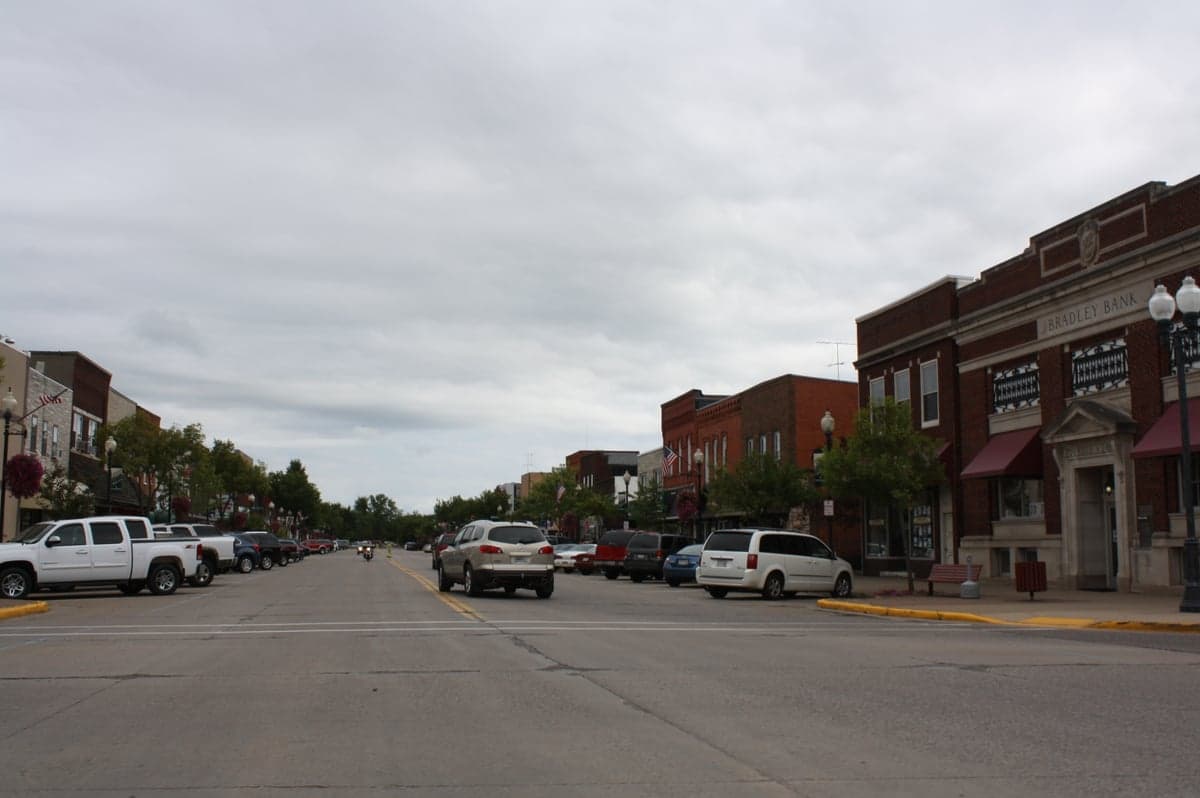
Photo: Wikipedia
Demographics of Tomahawk, WI
Affluence Level in Tomahawk, WI
A below-average socioeconomic profile. Incomes, home values, and educational attainment trail the U.S., with higher poverty and unemployment.
People of Tomahawk, WI
The people of Tomahawk, Wisconsin today form a small, tight-knit community of 3,416 residents, overwhelmingly white (93.9%) and native-born, with a foreign-born population of just 1.0%. The city carries a distinctively rural, working-class character shaped by its history as a lumber and paper mill town, where family roots often run several generations deep. With a college attainment rate of 17.8%, the population leans toward trades, manufacturing, and outdoor recreation lifestyles, and the community retains a strong sense of local identity centered on the Wisconsin River and the surrounding Northwoods.
How the city was settled and grew
Tomahawk was founded in the 1880s as a railroad and lumber boomtown, carved directly out of the Northwoods wilderness. The Wisconsin Central Railroad reached the area in 1886, and the city was platted the following year, drawing a first wave of settlers that was almost entirely of Northern European stock — primarily German, Polish, and Scandinavian immigrants. These early arrivals built the first neighborhoods near the railroad depot and the Tomahawk River, an area now known as Historic Downtown Tomahawk, where many of the original wood-frame workers' cottages still stand. The lumber industry dominated until the early 1900s, when the last of the old-growth white pine was cut, and the economy pivoted to paper manufacturing. The Owen Park neighborhood, just south of downtown along the Wisconsin River, was developed in the 1910s and 1920s to house mill workers and their families, many of whom were second-generation German and Polish Americans. A smaller wave of Italian immigrants arrived in the 1910s to work on railroad construction and settled in the East Side district, near the rail yards. By 1950, Tomahawk's population had reached roughly 3,500, and the city was almost entirely white, with a small number of Native American families from the nearby Lac du Flambeau and Sokaogon Chippewa communities living in the broader county.
Modern era (post-1965)
After the 1965 Hart-Cellar Act, Tomahawk saw virtually no new immigration. The foreign-born share has remained below 1.5% for decades, and the city's racial composition has stayed overwhelmingly white. The major demographic shift of the modern era has been domestic out-migration of younger adults seeking college and jobs in larger cities, combined with a modest inflow of retirees and second-home buyers from the Milwaukee and Chicago areas. These newcomers have concentrated in newer subdivisions on the city's western edge, particularly the West Ridge area along County Road D, where ranch-style homes and lake-adjacent lots have been developed since the 1990s. The Bradley Park neighborhood, near the high school and the Tomahawk Sports Center, has absorbed most of the families with school-age children, while the older Historic Downtown and East Side districts have seen population decline and aging housing stock. The Hispanic population, at 1.9%, is the only minority group with a measurable presence, consisting mostly of a few families employed in seasonal agriculture and food processing in the broader Lincoln County area. The Black, East/Southeast Asian, and Indian-subcontinent populations are all recorded at 0.0%, reflecting the city's continued lack of diversity.
The future
Tomahawk's population is projected to remain stable or decline slightly over the next 10–20 years, mirroring trends across rural northern Wisconsin. The city's age profile is skewing older, with a median age near 47, and the school district has seen enrollment drop by roughly 15% since 2010. There is no indication of significant new immigration or domestic in-migration from diverse populations; the city's cultural identity will likely remain rooted in its German-Polish-Scandinavian heritage and its working-class, outdoor-recreation ethos. The West Ridge area may see continued infill development as retirees and remote workers from the Twin Cities and Milwaukee discover the area's lower cost of living and lake access, but this will be a slow, small-scale trend. The Historic Downtown district is undergoing a modest revitalization effort, with a few new small businesses and a renovated riverwalk, but it is unlikely to attract significant new population. The city's demographic future is one of slow aging and gradual thinning, not transformation.
For someone moving in now, Tomahawk offers a stable, safe, and deeply rooted community where neighbors know each other and the pace of life is slow. The trade-off is clear: you will be joining a population that is nearly 94% white, with minimal racial or ethnic diversity, and a local economy that depends heavily on paper manufacturing, healthcare, and seasonal tourism. If you value quiet, familiarity, and the Northwoods lifestyle, Tomahawk will feel like home. If you seek a diverse, fast-growing, or cosmopolitan environment, you will need to look elsewhere.

* Values derived from national, state, county, city and local statistics and may differ in a specific area. Last updated: 2026-11-22T19:01:05.000Z
Narrative content on this page is AI-generated and may contain mistakes. Verify any details that matter before acting on them.
ReloMaps may earn a commission from affiliate links at no extra cost to you.

