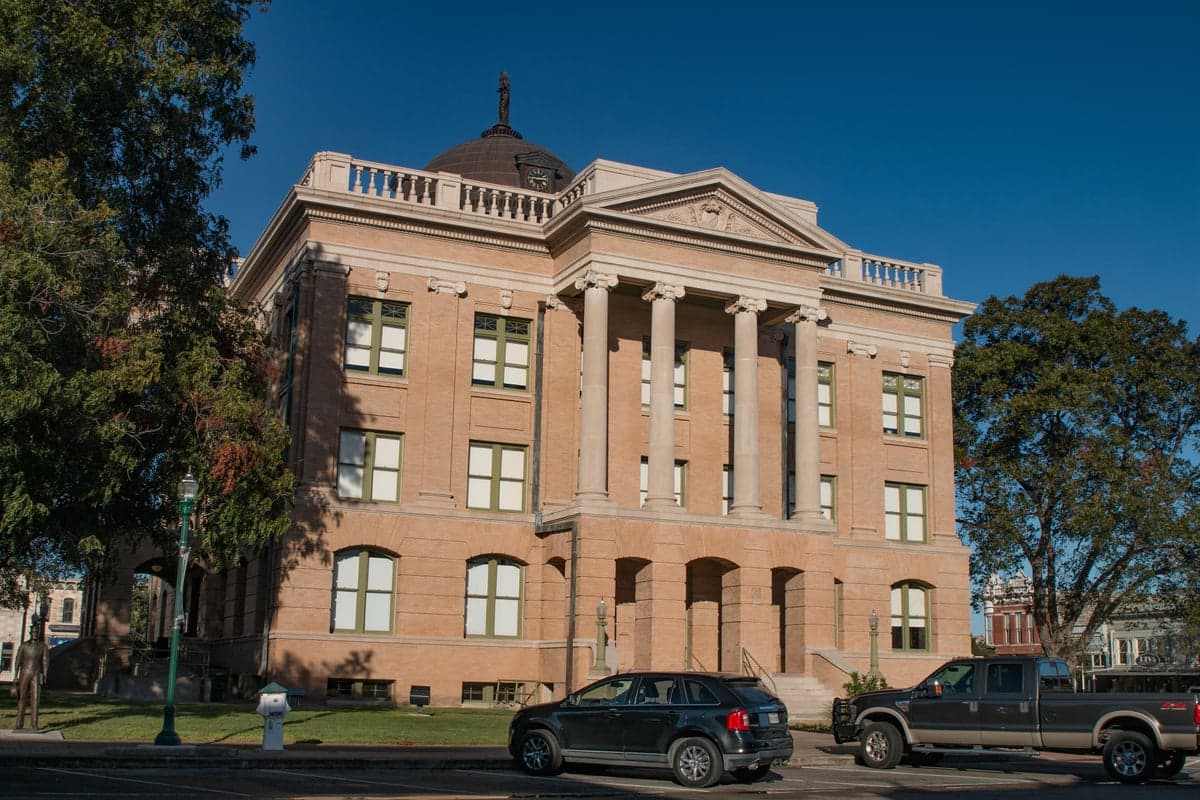
Photo: Wikipedia
Political ClimatePolitical Climate in Williamson County
Showing district-level results — no local-only data available.
Local Political AnalysisPolitical Analysis of Williamson County
Williamson County has undergone a dramatic political transformation over the past two decades, shifting from a reliably conservative stronghold to a more nuanced battleground that still leans right but shows clear signs of suburban drift. The Cook Partisan Voting Index (PVI) currently rates the county at R+11, meaning it votes about 11 points more Republican than the national average. That's a significant rightward tilt, but it's notably less extreme than the county's reputation from the early 2000s, and it sits well to the right of Texas as a whole, which carries a PVI of R+4. The real story, however, is the internal variation: the explosive growth along the I-35 corridor has created a patchwork of precincts that no longer vote as a monolith.
How it compares
Compared to Texas statewide, Williamson County is about 7 points more Republican on the PVI scale, but that gap is narrowing. In the 2020 presidential election, Donald Trump carried Williamson County by roughly 13 points, while he won Texas by about 5.5 points. The difference is driven by the county's suburban character—historically, suburban counties in Texas have been more Republican than the state's rural or urban cores. But the comparison gets interesting when you zoom in. Round Rock and Cedar Park, the county's largest cities, have seen their margins tighten significantly. In 2020, Trump won Round Rock by only about 4 points, down from a 15-point margin in 2016. Georgetown, the county seat, remains a conservative anchor, with Trump winning it by roughly 18 points in 2020, driven by its large retiree population and slower growth. Meanwhile, Taylor and Hutto are emerging as swing areas—Taylor, once a reliably red farming town, has seen an influx of Austin commuters and now votes closer to a 50-50 split in local races. Leander leans red but is trending purple, with its fast-growing subdivisions bringing in younger families who often split tickets. The most liberal pocket is Brushy Creek and parts of Round Rock West, where precincts have voted Democratic in recent cycles, though they remain outliers in a county that still elects Republicans to most countywide offices.
What this means for residents
For conservative residents, Williamson County remains a comfortable place to live politically. The county commissioners court is Republican-controlled, and local school boards in Georgetown and Leander lean right. Property taxes are a perennial issue, and conservative voters here tend to focus on fiscal restraint and school curriculum debates. For liberal residents, the picture is more mixed. You'll find plenty of like-minded neighbors in Round Rock and the newer subdivisions near the Travis County line, but you'll also encounter a county Republican Party that is still well-organized and active. Democratic candidates do win local races in some precincts, but countywide offices like sheriff and district attorney have remained in Republican hands. The practical effect is that progressive residents often feel their votes matter most in state and federal races, where the county's growing diversity can tip the balance in close contests. Both sides agree on one thing: traffic and growth are the dominant local issues, and they tend to transcend party lines in city council meetings.
Culturally, Williamson County retains a distinct identity from both Austin to the south and the more rural counties to the north. You'll see more pickup trucks and church marquees than in Travis County, but also more Tesla charging stations and craft breweries than in Bell County. The county's rapid growth—it was the fastest-growing county in the U.S. for several years in the 2010s—has brought a mix of tech workers, retirees, and families that keeps the political conversation grounded in practical concerns like school capacity and water availability. Policy-wise, the county is a stronghold for Second Amendment rights and low-tax governance, but it has also invested heavily in parks and trails, reflecting a moderate streak on quality-of-life issues. The long-term trajectory points toward a continued purple shift, especially as the population ages and the suburbs mature, but Williamson County is unlikely to flip blue anytime soon—it's more likely to settle into a competitive lean-Republican pattern, much like other fast-growing Texas suburbs.

State Political ClimatePolitical Climate in Texas
State Political AnalysisPolitical Environment in the State
Texas has been a solidly Republican state for decades, carrying a Cook Partisan Voting Index of R+4, but the last 10-20 years have seen a dramatic shift from a deep-red monolith to a competitive battleground. The dominant coalition is still conservative, anchored by the suburbs, rural areas, and the Panhandle, but explosive growth in the urban crescent from Dallas-Fort Worth down through Austin to Houston and San Antonio is steadily pulling the state toward purple. In 2020, Donald Trump still won Texas by 5.6 points, but that was the narrowest margin for a Republican presidential candidate since 1996, and down from his 9-point win in 2016. The long-term trajectory is unmistakable: Texas is trending leftward, but the pace is slower than many national headlines suggest, and the state’s political machinery remains firmly in GOP hands for now.
Urban vs. rural divide
The political map of Texas is a study in extremes. The big four metros — Houston (Harris County), Dallas-Fort Worth (Dallas, Tarrant, Collin, Denton counties), San Antonio (Bexar County), and Austin (Travis County) — are the Democratic engine rooms. Travis County, home to Austin, is one of the most liberal counties in the South, routinely voting 70%+ Democratic. Harris County, the third-most populous county in the nation, flipped blue in 2018 and has stayed there. Meanwhile, the rural and exurban areas are overwhelmingly Republican. The Panhandle, West Texas, and East Texas piney woods are deep red; Lubbock and Midland-Odessa are GOP strongholds. The real story is the suburbs: places like Collin County (north of Dallas) and Fort Bend County (southwest of Houston) were once reliably red but are now competitive. Collin County, home to Plano and Frisco, voted for Trump by only 3 points in 2020 after going for Romney by 27 points in 2012. That’s a 24-point swing in eight years, driven by educated, affluent transplants and a diversifying population. The Rio Grande Valley, historically Democratic, has also shifted rightward, with counties like Zapata flipping to Trump in 2020, complicating the simple urban-rural narrative.
Policy environment
Texas’s policy environment is defined by its small-government ethos. There is no state income tax, funded instead by high property taxes and a 6.25% state sales tax (localities can add up to 2%). The regulatory posture is famously business-friendly: no state-level occupational licensing for many fields, weak environmental regulations, and a tort reform system that caps non-economic damages in medical malpractice cases. Education policy is dominated by the school choice debate; the Texas Legislature has not yet passed a universal voucher program, but Gov. Greg Abbott has made it a priority for 2025. Healthcare is a gap: Texas has the highest uninsured rate in the nation at roughly 17%, having refused Medicaid expansion under the Affordable Care Act. Election laws have tightened: the 2021 Senate Bill 1 restricted mail-in voting, added ID requirements, and banned 24-hour and drive-through voting. Abortion is effectively banned after the 2021 trigger law and the 2023 ruling in Zurawski v. State of Texas, with no exceptions for rape or incest. Gun laws are permissive: permitless carry was enacted in 2021, and the state has strong preemption laws preventing local gun ordinances.
Recent policy direction
The last five years have seen Texas lurch sharply right on cultural and social issues while maintaining its business-friendly posture. On guns, the 2021 permitless carry law (HB 1927) allows most adults to carry a handgun without a license or training, and the 2023 "constitutional carry" expansion reinforced that. On parental rights and education, the 2023 "Parental Bill of Rights" (HB 900) requires schools to get parental consent for library materials and restricts instruction on sexual orientation and gender identity, effectively banning diversity, equity, and inclusion programs in public schools. On speech, the 2021 "social media censorship" law (HB 20) attempts to prevent platforms from deplatforming users based on viewpoint, though it has been tied up in court. On privacy and surveillance, Texas passed a consumer data privacy law (HB 4390) in 2023, giving residents the right to opt out of data collection, but it’s weaker than California’s. On medical and bodily autonomy, the near-total abortion ban has no exceptions for rape or incest, and the state has aggressively pursued out-of-state abortion pill providers. On property rights, Texas has strong eminent domain protections for landowners, but the 2023 "taking" bill (SB 2037) made it harder for local governments to restrict property use through zoning. On voting, SB 1 (2021) added strict ID requirements for mail ballots, banned unsolicited mail-in ballot applications, and gave partisan poll watchers more access. The overall direction is toward maximum individual liberty on guns and property, maximum government restriction on abortion and LGBTQ+ issues, and a skeptical posture toward corporate speech on social media.
Civil unrest & political movements
Texas has been a flashpoint for political movements on both sides. The 2020 Black Lives Matter protests in Austin, Houston, and Dallas were among the largest in the country, with Austin alone seeing over 50 consecutive nights of demonstrations. The state’s immigration politics are a constant source of tension: the 2023 "Operation Lone Star" border security initiative, launched by Gov. Abbott, has bused over 100,000 migrants to Democratic-led cities like New York and Chicago, and the state has installed razor wire and buoys along the Rio Grande, leading to legal battles with the Biden administration. Sanctuary city policies are banned statewide since 2017 (SB 4), but liberal cities like Austin and San Antonio have declared themselves "welcoming cities" and limit cooperation with federal immigration enforcement. Secession rhetoric flares up periodically — the Texas Nationalist Movement has pushed for a 2024 referendum on secession, but it remains a fringe position with no serious legislative path. Election integrity controversies have been persistent: the 2020 election saw Trump’s legal challenges in Texas fail, but the 2021 SB 1 was explicitly framed as a response to "election security" concerns. A new resident will notice the visible presence of both "Don’t Tread on Me" flags and "Black Lives Matter" signs in equal measure, depending on which part of town they’re in.
Projection
Over the next 5-10 years, Texas will continue to trend purple, but the pace depends on who moves in and where they settle. The state is adding roughly 1,000 new residents per day, most of them from California and other blue states, and they tend to cluster in the urban and suburban counties that are already shifting left. If current trends hold, Texas could be a true swing state by 2032, with Democrats competitive in statewide races for the first time since the 1990s. However, the GOP has a structural advantage: the state’s political map is gerrymandered at the congressional and legislative levels, and the rural vote is overrepresented in the Texas Senate. The 2024 election will be a key test — if Trump wins Texas by less than 3 points, the 2026 gubernatorial race will be a toss-up. For a new resident, the practical reality is that Texas will remain a conservative-led state for the near term, but the culture wars will intensify as the demographic balance shifts. Someone moving in now should expect to see more competitive elections, more ballot initiatives (if the state ever allows them), and a continued battle over the state’s identity between its rural, conservative roots and its urban, diversifying future.
For a new resident, the bottom line is that Texas offers a low-tax, low-regulation environment with strong gun rights and a conservative social agenda, but the political landscape is changing fast. If you’re conservative, you’ll find a state government that largely shares your values, but you’ll also see your political dominance eroding in the cities and suburbs. If you’re liberal, you’ll find blue cities where your views are the majority, but you’ll face a state government that is actively hostile to many of your priorities. The key is to choose your location carefully — the difference between living in Austin versus Lubbock is not just cultural but political, and that gap is only widening. Texas is still a red state, but it’s a red state in transition, and the next decade will determine whether it stays that way or becomes the nation’s next great battleground.
* Values derived from national, state, county, city and local statistics and may differ in a specific area. Last updated: 2026-06-15T19:32:56.000Z
Narrative content on this page is AI-generated and may contain mistakes. Verify any details that matter before acting on them.
ReloMaps may earn a commission from affiliate links at no extra cost to you.

