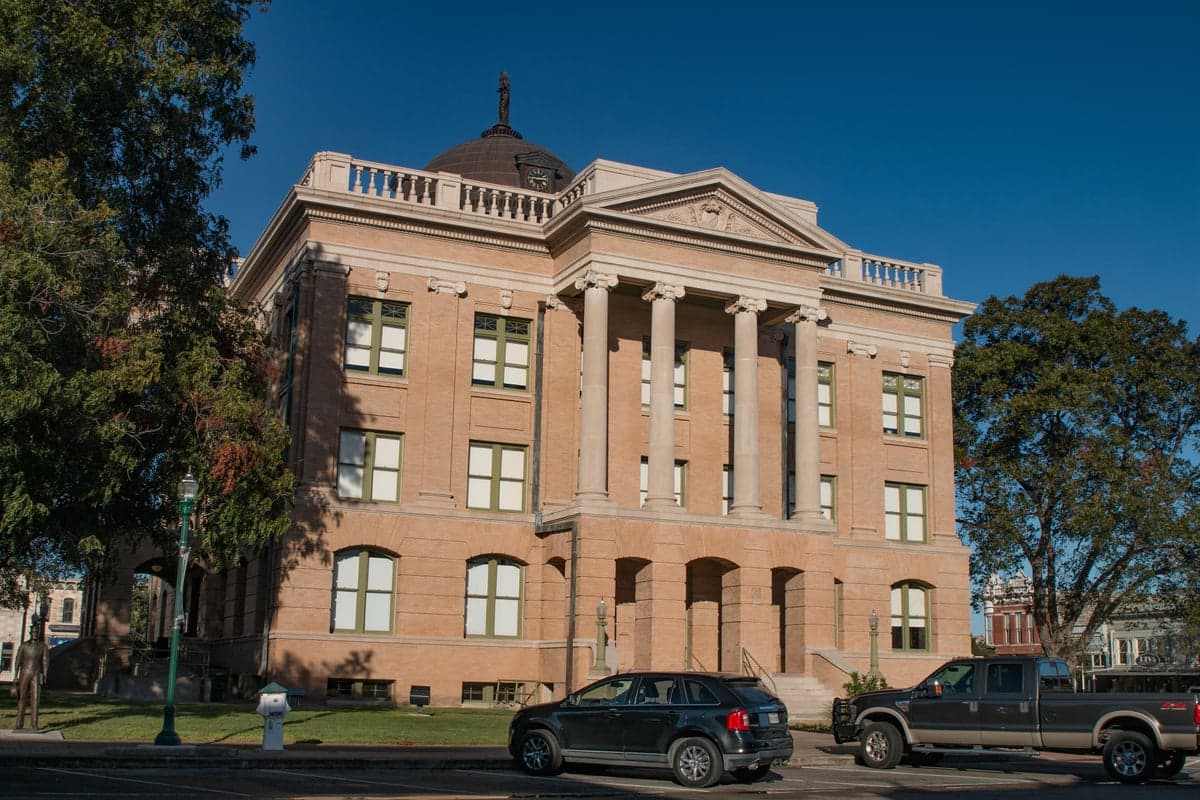
Photo: Wikipedia
Personal Sovereignty in Williamson County
Strong independent fundamentals that actively favor personal liberty and low regulation.
What does Personal Sovereignty tell us?
Personal Sovereignty measures your capacity for self-reliance and independence with minimal government friction. Higher scores mean fewer barriers between you and the way you want to live... but it assumes you have the space you need and good neighbors.
What does this tell us?
Personal Sovereignty measures your capacity for self-reliance and independence with minimal government friction. Higher scores mean fewer barriers between you and the way you want to live... but it assumes you have the space you need and good neighbors.
State Policy
Energy independence: Net exporter (220% of energy produced in-state)
Personal Liberty
Homesteading

Personal Liberty Analysis
Williamson County, Texas, offers a notably high degree of personal sovereignty compared to many urban and suburban counties in the United States, driven by Texas state preemption laws that limit local government overreach in areas like firearms, property rights, and taxation. While the county is growing rapidly and some municipalities impose their own regulatory layers, the overall environment leans heavily toward individual autonomy, with a tax burden that is moderate by national standards and a legal framework that prioritizes self-defense and self-reliance. For single individuals and families who value independence, the key is choosing the right city within the county, as the regulatory posture varies significantly from the more urbanized southern end to the rural northern reaches.
Tax burden and regulatory posture across Williamson County cities
Williamson County benefits from Texas’s lack of a state income tax, but property taxes are the primary revenue source and can vary noticeably by municipality. The county’s total property tax rate typically falls between 2.0% and 2.5% of assessed value, depending on the city and school district. Round Rock and Cedar Park, the two largest cities, have relatively higher tax rates due to their robust municipal services and school systems, while Georgetown and Taylor tend to be slightly lower, especially in older neighborhoods. The regulatory posture is generally light-touch: Williamson County has no countywide zoning, leaving land-use decisions to individual cities. This means that in unincorporated areas, property owners face fewer restrictions on home-based businesses, accessory dwelling units, and livestock. However, cities like Round Rock and Cedar Park enforce standard suburban zoning codes that limit commercial activity in residential zones and require permits for major renovations. For those seeking the least regulatory friction, the unincorporated areas near Liberty Hill or Florence offer the most freedom, with minimal building codes and no city-level property taxes.
Self-defense and gun law specifics in Williamson County
Texas is a constitutional carry state, and Williamson County fully embraces that framework. No permit is required to carry a handgun openly or concealed for anyone 21 or older who is legally allowed to possess a firearm. The county sheriff’s office is known for issuing License to Carry (LTC) permits efficiently, though the permit is now optional. Georgetown, the county seat, has a strong gun-friendly culture, with multiple gun ranges and firearms retailers. Importantly, Texas law preempts local governments from enacting their own gun ordinances, meaning cities like Round Rock and Cedar Park cannot ban carry in parks, libraries, or other public spaces—though they can restrict firearms in city-owned buildings with security measures. Stand-your-ground and castle doctrine laws apply statewide, giving residents broad legal protection for using deadly force in self-defense. For those prioritizing self-defense rights, Williamson County is one of the most accommodating suburban counties in Texas, with no local restrictions beyond state law.
Self-reliance and homesteading viability: lot sizes, zoning, and off-grid feasibility
Homesteading viability varies dramatically across Williamson County. In the southern cities like Round Rock and Cedar Park, standard lot sizes are 0.1 to 0.25 acres, and zoning ordinances restrict livestock, large gardens, and alternative energy systems. Moving north, Liberty Hill and Florence offer much larger parcels—often 1 to 10 acres—with more permissive zoning. Unincorporated areas of the county have no countywide zoning, allowing for chickens, goats, and even small-scale farming on properties as small as one acre. Off-grid feasibility is limited by state and local building codes: all habitable structures must meet Texas’s minimum energy code, and rainwater collection is legal but regulated for potable use. Solar panels are widely permitted, but net metering policies vary by electric provider. Taylor and Hutto have more rural pockets where residents successfully maintain semi-off-grid lifestyles, though full independence from the grid is rare due to utility easements and financing requirements. For serious homesteaders, the northern half of the county—particularly near Florence—offers the best balance of affordable land, minimal regulation, and proximity to Austin’s markets.
Personal liberties: parental rights, medical autonomy, speech, and property
Texas law strongly protects parental rights, including the right to direct a child’s education, medical care, and religious upbringing. Williamson County school districts, including Round Rock ISD and Georgetown ISD, generally defer to parental authority on issues like curriculum objections and opt-outs, though some parents report friction over library materials and health education. Medical autonomy is robust: Texas does not require COVID-19 vaccinations for school attendance, and there are no county-level mask or vaccine mandates. Freedom of speech is protected under the First Amendment, and Williamson County has no local ordinances restricting public expression beyond state trespassing laws. Property rights are strong, with Texas’s private property rights laws limiting eminent domain and requiring just compensation. However, homeowners’ associations (HOAs) are common in newer subdivisions in Cedar Park and Round Rock, and they can impose restrictions on landscaping, parking, and exterior modifications. Buyers who prioritize property autonomy should seek homes in unincorporated areas or older neighborhoods without HOAs, particularly in Georgetown’s historic district or rural Taylor.
Overall, Williamson County ranks among the most sovereignty-friendly suburban counties in Texas, especially for those who choose its northern and rural municipalities. The combination of no state income tax, constitutional carry, strong parental rights, and limited county-level regulation creates an environment where individuals and families can exercise significant control over their lives. The trade-off is that the southern, more urbanized cities impose standard suburban restrictions, while the northern areas offer greater freedom at the cost of longer commutes and fewer services. For a conservative-leaning reader seeking a balance of personal liberty and economic opportunity, Williamson County delivers a level of autonomy that is difficult to find in comparable counties in Colorado, California, or the Northeast.

* Values derived from national, state, county, city and local statistics and may differ in a specific area. Last updated: 2026-06-15T19:32:56.000Z
Narrative content on this page is AI-generated and may contain mistakes. Verify any details that matter before acting on them.
ReloMaps may earn a commission from affiliate links at no extra cost to you.

