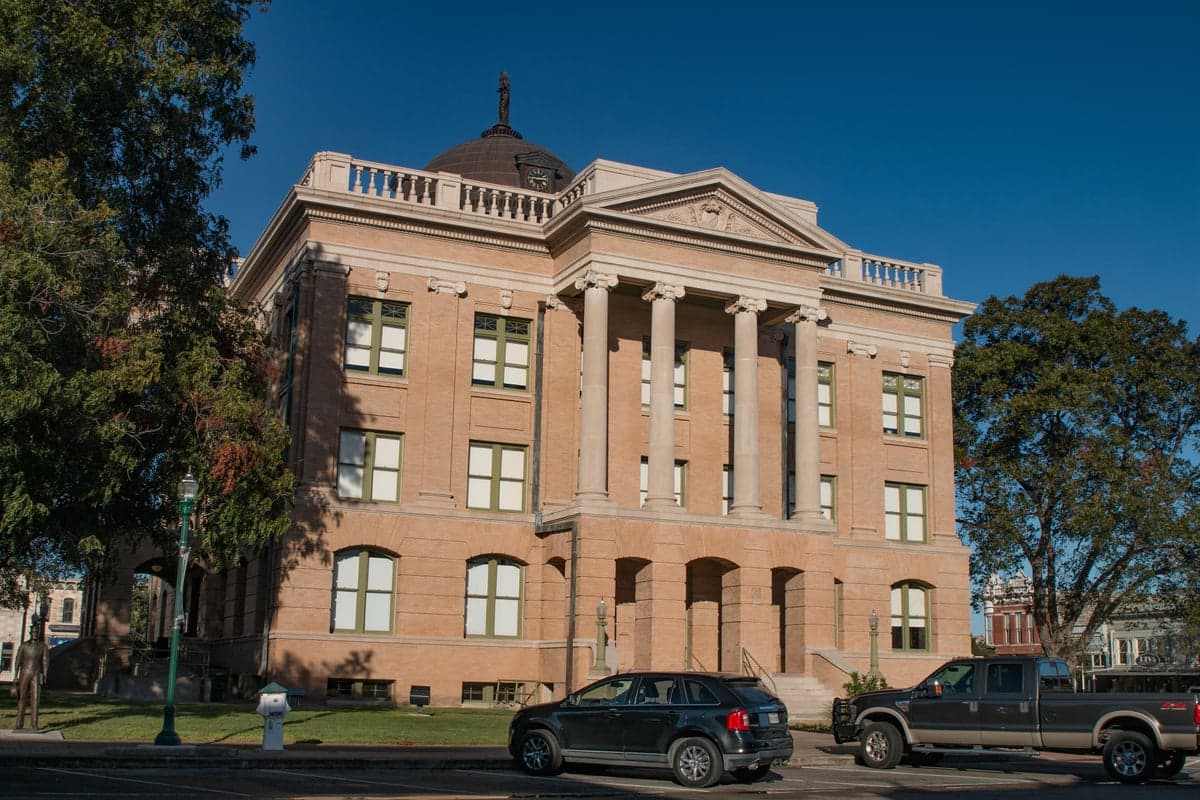
Photo: Wikipedia
Demographics of Williamson County
Affluence Level in Williamson County
An upper-middle-class area. Household wealth, education levels, and homeownership run ahead of national benchmarks.
People of Williamson County
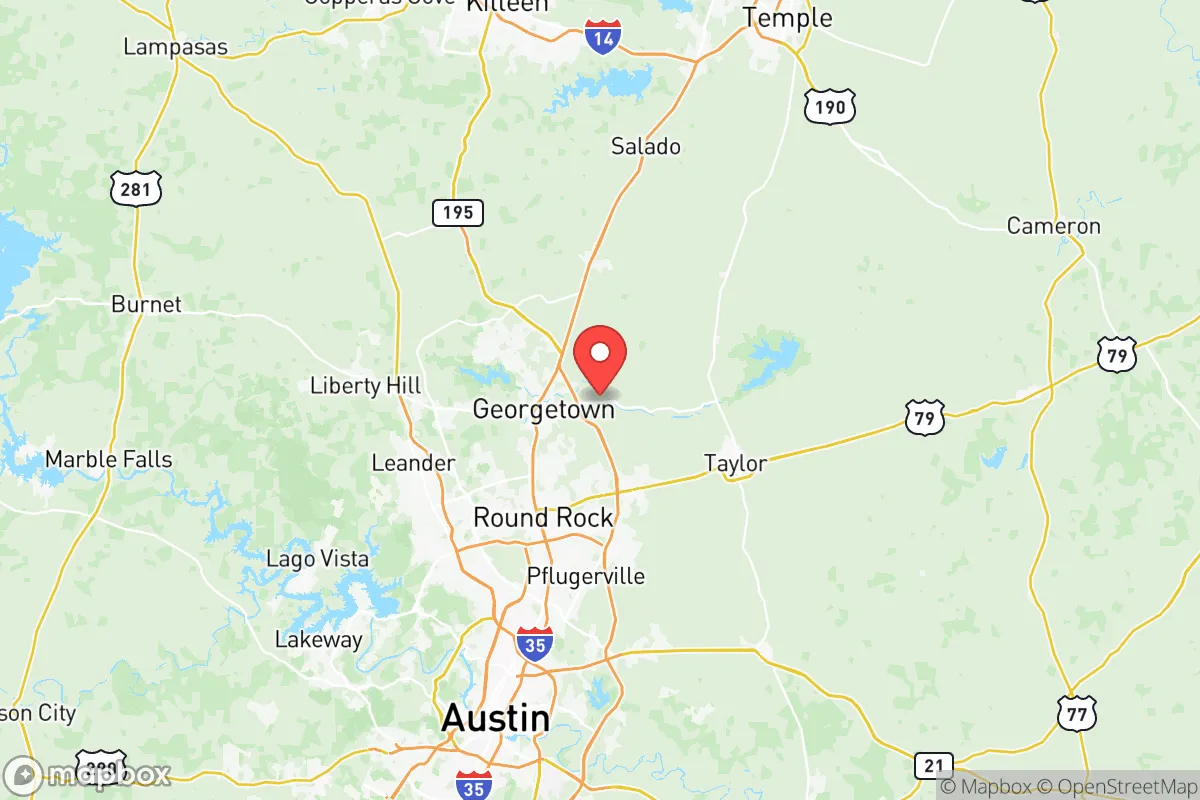
Today, Williamson County, Texas, is a rapidly growing suburban powerhouse of 643,889 residents, characterized by a predominantly white (55.1%) and increasingly diverse population that is highly educated (47.4% college-educated) and family-oriented. The county’s identity is a blend of historic small-town roots—anchored by the county seat of Georgetown and the city of Round Rock—and a modern, tech-driven economy fueled by the Austin metro’s expansion. Its people are notably more conservative than neighboring Travis County, with a strong sense of local community, low crime rates, and a growing presence of Asian and Indian professionals drawn to the area’s schools and job opportunities.
Settlement & growth (pre-1960)
Before American settlement, the land now called Williamson County was inhabited by the Tonkawa and Comanche peoples, who used the area for hunting and seasonal camps. Spanish and Mexican land grants in the early 1800s brought a few ranching families, but significant Anglo-American colonization began after Texas independence in 1836. The first major wave of settlers were primarily Anglo-Americans from the U.S. South—Tennessee, Kentucky, and Missouri—who arrived in the 1840s and 1850s, drawn by cheap land grants under the Texas Republic’s Peters Colony program. These early settlers founded the county’s first towns, including Georgetown (established 1848), Round Rock (1851), and Taylor (1876), building an agricultural economy based on cotton and corn.
After the Civil War, the county saw a small but significant influx of freed African Americans, who established rural communities and later concentrated in the eastern parts of the county, particularly around Granger and Thrall. By 1900, the population was overwhelmingly native-born white and Black, with a tiny foreign-born share. The arrival of the International-Great Northern Railroad in the 1870s spurred growth in Hutto and Liberty Hill, turning them into cotton-shipping hubs. The Dust Bowl and Great Depression of the 1930s brought a modest wave of displaced farmers from Oklahoma and Arkansas—often called “Okies”—who settled in rural areas and worked as tenant farmers. However, Williamson County remained a quiet, rural, and overwhelmingly Anglo region through the 1950s, with a population of just 38,853 in 1950.
Modern era (post-1965)
The 1965 Hart-Cellar Act fundamentally reshaped Williamson County’s demographics, though the effects were delayed compared to coastal metros. The county’s modern transformation began in earnest in the 1980s and 1990s, driven by two forces: the explosive growth of Austin’s technology sector (Dell Technologies’ headquarters in Round Rock opened in 1984) and the construction of Interstate 35, which made the county a commuter suburb for Austin workers. Domestic migration from the Rust Belt and California—families seeking lower taxes, better schools, and affordable housing—flooded the area. Between 1990 and 2020, the population grew from 139,551 to over 600,000, making it one of the fastest-growing counties in the United States.
This growth brought dramatic ethnic diversification. The Hispanic population, historically small, surged from under 10% in 1990 to 24.5% today, concentrated in Round Rock, Georgetown, and Taylor, where many work in construction, services, and agriculture. The Black population grew to 6.6%, with newer arrivals settling in Round Rock and Cedar Park, drawn by professional jobs. The most striking shift has been the rise of Asian and Indian communities. East and Southeast Asian residents (3.4%)—primarily Chinese, Vietnamese, and Korean—began arriving in the 1990s, clustering in Round Rock and Austin’s northern suburbs. Indian-subcontinent residents (5.4%)—from India, Pakistan, and Bangladesh—arrived even more rapidly after 2000, drawn by tech and healthcare jobs, and now form visible communities in Round Rock and Georgetown, with Indian-owned businesses and cultural centers. The foreign-born share is 7.8%, lower than the national average but rising quickly.
The future
Williamson County is projected to become more diverse over the next 10–20 years, though it will likely remain majority-white for the foreseeable future. The Hispanic share is expected to climb toward 30% by 2040, driven by both domestic migration and higher birth rates. The Indian and East/Southeast Asian populations will continue to grow as tech and healthcare sectors expand, with new communities dispersing beyond Round Rock into Georgetown, Cedar Park, and Leander. The Black population is growing more slowly but steadily. The county’s cultural identity is evolving from a conservative, Anglo-dominated small-town ethos into a more suburban, multi-ethnic conservatism—still family-focused and tax-conscious, but increasingly shaped by immigrant entrepreneurs and professionals. New master-planned communities in Hutto and Liberty Hill are attracting young families from across the U.S., while the county’s political leanings remain reliably Republican, though with growing Hispanic and Asian conservative blocs.
For someone moving in now, Williamson County offers a fast-growing, safe, and highly educated environment where the old rural character is giving way to a diverse, suburban future. The people are increasingly a mix of native Texans, domestic transplants from the Midwest and West Coast, and immigrants from Asia and Latin America—all drawn by economic opportunity and a quality of life that balances proximity to Austin with a more affordable, family-oriented setting. The county is becoming a model of Sun Belt suburban diversity, where traditional values coexist with a rapidly changing population.

* Values derived from national, state, county, city and local statistics and may differ in a specific area. Last updated: 2026-06-15T19:32:56.000Z
Narrative content on this page is AI-generated and may contain mistakes. Verify any details that matter before acting on them.
ReloMaps may earn a commission from affiliate links at no extra cost to you.

