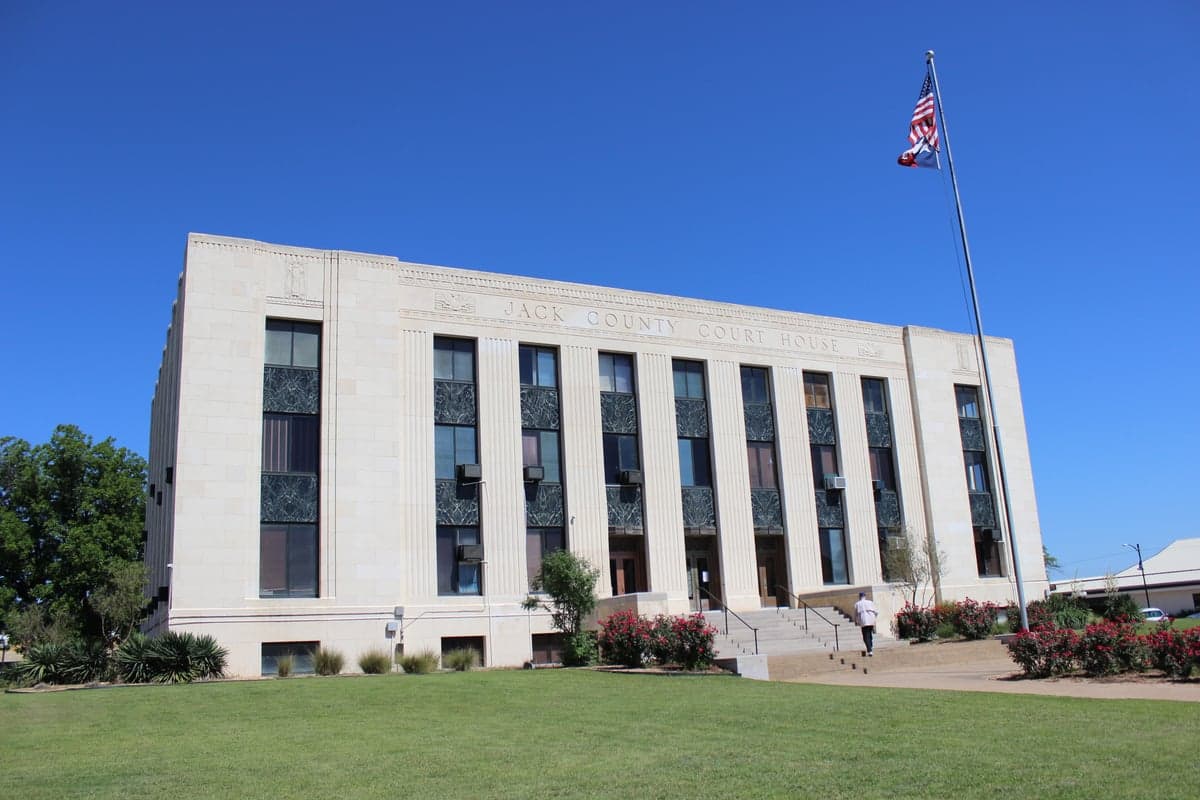
Photo: Wikipedia
Political ClimatePolitical Climate in Jack County
Showing district-level results — no local-only data available.
Local Political AnalysisPolitical Analysis of Jack County
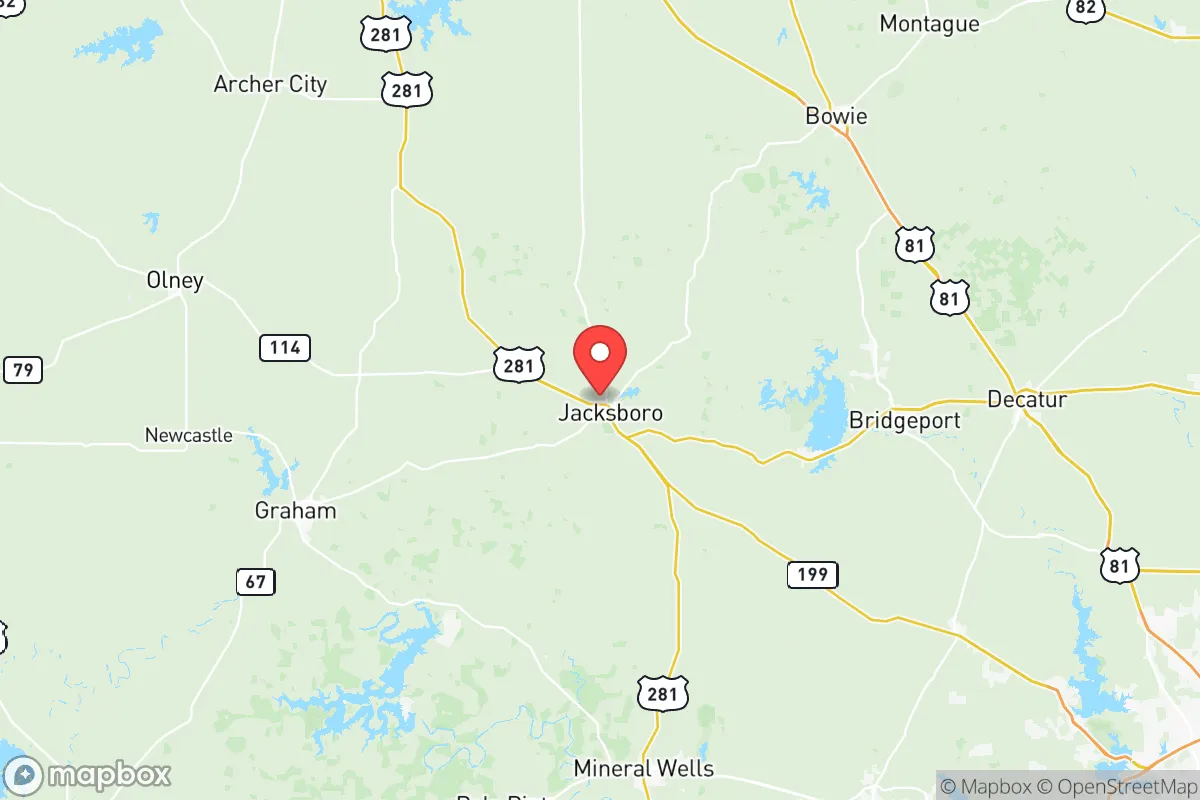
Jack County is a deeply conservative area in North Texas, anchored by the county seat of Jacksboro, and it has only gotten redder over the last decade. The Cook PVI of R+18 puts it well to the right of the state of Texas as a whole, which sits at R+4, and that gap has widened in recent cycles. In 2024, Donald Trump carried the county with over 80% of the vote, a margin that would have been unthinkable even in the Bush years. The shift is most visible in the rural precincts outside of Jacksboro, where straight-ticket Republican voting is now the norm, while the town itself still shows a small but persistent Democratic presence in local races.
How it compares
The R+18 rating means Jack County is roughly 14 points more Republican than the state average, a gap that has grown as rural Texas has moved right faster than the suburbs and cities. In 2020, the county voted for Trump by a 77-point margin, compared to the statewide margin of about 5.5 points. The only real variation within the county is between Jacksboro and the unincorporated areas. Jacksboro, with its small downtown and older housing stock, occasionally elects a Democrat to the city council or school board, but those are nonpartisan races. The precincts around Bryson and Jermyn are reliably Republican, while the area around Perrin, closer to the Wise County line, has shown some swing tendencies in primary elections but is solidly red in general elections. The comparison to Texas is stark: while the state has become more competitive in presidential races due to growth in the suburbs and the I-35 corridor, Jack County has moved in the opposite direction, becoming a one-party county in practice.
What this means for residents
For conservative residents, the political climate is comfortable and affirming. Local elected officials, from the county judge to the sheriff, are Republicans, and the county GOP is active and well-organized. There is little need to moderate positions on issues like gun rights, property taxes, or energy policy, as the local consensus aligns with the party line. For liberal residents, the reality is more isolating. There is no organized Democratic party presence in the county, and progressive viewpoints are rarely voiced in public forums. A liberal resident in Jacksboro might find common ground with neighbors on local issues like road maintenance or school funding, but national politics are a minefield. The practical effect is that many residents who lean left simply avoid political discussions in public, and some have moved to the larger cities in the region, like Wichita Falls or Fort Worth, where they feel less out of step.
The cultural and policy distinctions between Jack County and the rest of Texas are most visible in the areas of land use and local governance. The county has no zoning ordinances to speak of, and property rights are treated as nearly absolute, which is a point of pride for many longtime residents. There is also a strong independent streak when it comes to state mandates: during the COVID-19 pandemic, the county openly resisted mask mandates and business closures, and the local school district in Jacksboro was one of the last in the region to adopt any masking requirements. This libertarian-leaning conservatism is a hallmark of the area, and it sets Jack County apart even from more moderate parts of Texas. Looking ahead, the county is likely to stay deeply red, as the population is aging and there is little in-migration from more diverse areas. The only wildcard is the potential for wind and solar development, which could bring new residents and a slightly different political mix, but for now, Jack County remains one of the most reliably Republican places in the state.

State Political ClimatePolitical Climate in Texas
State Political AnalysisPolitical Environment in the State
Texas has been a solidly Republican state for decades, with a Cook Partisan Voting Index of R+4, but that label masks a far more complex and rapidly shifting political reality. The dominant coalition is still conservative, powered by the sprawling suburbs, rural West Texas, and the Panhandle, but the margins have been shrinking in every election cycle since 2012. In 2024, Donald Trump carried the state by about 9 points, down from 15 points in 2020 and 16 points in 2016, a clear sign that the long-term trajectory is toward competitiveness as the population booms and diversifies.
Urban vs. rural divide
The political map of Texas is a study in extremes. The big metros — Houston, Dallas-Fort Worth, San Antonio, and Austin — are the engine of Democratic growth, with Harris County (Houston) and Dallas County now reliably blue in presidential races. Travis County (Austin) is one of the most liberal counties in the South. Meanwhile, rural and exurban counties vote Republican by margins of 70-80% or more. The real battleground is the fast-growing suburban ring around these cities, places like Collin County (north of Dallas), Fort Bend County (southwest of Houston), and Williamson County (north of Austin). Collin County, once a GOP stronghold, voted for Trump by only 10 points in 2024 after giving him 20 points in 2020. Fort Bend County flipped to Biden in 2020 and stayed blue in 2024. The state's political future will be decided in these suburbs, not in the rural counties or the urban cores.
Policy environment
Texas operates under a conservative policy framework that has been in place for decades. There is no state income tax, which is the single biggest draw for relocators. Property taxes are high to compensate, averaging around 1.6-1.8% of assessed value, but there is no tax on wages. The regulatory posture is famously business-friendly, with minimal zoning in many cities and a right-to-work law that limits union power. On education, the state funds public schools through a Robin Hood system that redistributes property tax revenue from wealthier districts to poorer ones, but per-pupil spending remains below the national average. School choice via vouchers has been a major political fight, with rural Republicans joining Democrats to block it in 2023. Healthcare policy is marked by the state's refusal to expand Medicaid under the Affordable Care Act, leaving roughly 18% of residents uninsured, the highest rate in the nation. Election laws have been tightened since 2021, with new voter ID requirements, restrictions on drive-through and 24-hour voting, and a ban on unsolicited mail-in ballot applications.
Recent policy direction
The last few legislative sessions have pushed Texas sharply to the right on several fronts. On guns, the state became a permitless carry state in 2021, meaning anyone 21 or older who can legally possess a firearm can carry it in public without a license or training. On abortion, Texas enacted SB 8 in 2021, which banned abortion after roughly six weeks and created a private enforcement mechanism, followed by a near-total ban in 2022 after Roe v. Wade was overturned. On parental rights and education, the state passed laws requiring schools to notify parents of curriculum changes related to sexual orientation and gender identity, and banned certain books from school libraries. On speech, the state passed a law in 2023 that prohibits social media platforms from moderating content based on viewpoint, though it has been challenged in court. On property rights, Texas has strong eminent domain protections and no statewide zoning, but cities like Austin have enacted local land-use regulations that have been preempted by the state legislature. On voting, the 2021 SB 1 law made it a crime for election officials to send unsolicited mail-in ballot applications and imposed new ID requirements for mail voting. The overall direction is toward maximizing individual liberty in the traditional conservative sense — gun rights, property rights, low taxes — while restricting abortion and certain LGBTQ+ rights.
Civil unrest & political movements
Texas has seen its share of political flashpoints in recent years. The 2020 protests in Austin over police brutality were among the largest and most sustained in the country, leading to a state law in 2021 that defunded Austin's police budget and imposed penalties on cities that cut law enforcement funding. Immigration politics are a constant presence, with the state launching Operation Lone Star in 2021, deploying state troopers and National Guard to the border, and busing migrants to Democratic-led cities like New York and Chicago. The state has also sued the Biden administration repeatedly over border policies. Secession rhetoric, often called "Texit," is a fringe movement but has a vocal online presence; a 2022 Texas Republican Party platform included a call for a referendum on secession, though it has no serious political momentum. Election integrity remains a live issue, with the state conducting a controversial forensic audit of the 2020 election in four counties, which found no evidence of widespread fraud. A new resident would notice the political polarization most visibly in yard signs, bumper stickers, and the tone of local news coverage, but daily life is generally civil and unremarkable.
Projection
Over the next 5-10 years, Texas is likely to become more politically competitive, but not necessarily Democratic. The in-migration from California and other blue states is often cited as a Democratic trend, but many of those relocators are conservatives or moderates fleeing high taxes and regulation. The suburbs will continue to be the key battleground, and both parties are investing heavily in them. The state's growing Hispanic population, long assumed to be a Democratic voting bloc, has shifted rightward in recent cycles, particularly among working-class men in border communities like El Paso and the Rio Grande Valley. The Republican Party is likely to maintain control of the state legislature and statewide offices through 2030 due to gerrymandering and the concentration of Democratic voters in a few urban counties, but presidential margins will continue to tighten. A new resident moving in now should expect a state that remains conservative in its policy orientation but is increasingly divided along geographic and demographic lines, with the suburbs becoming the decisive political terrain.
For a new resident, the bottom line is that Texas offers a low-tax, business-friendly environment with strong protections for gun rights and property rights, but also high property taxes, limited public services, and a healthcare system that leaves many uninsured. Conservatives will find a state that largely aligns with their values, especially on fiscal and Second Amendment issues. Liberals will find a state where their votes are increasingly competitive in the suburbs and urban areas, but where state policy will remain conservative for the foreseeable future. The practical takeaway is that where you live within Texas matters enormously — a move to Lubbock or Midland is a very different political experience than a move to Austin or El Paso, and the suburbs of Dallas-Fort Worth and Houston are the places where the state's political future is being decided.
* Values derived from national, state, county, city and local statistics and may differ in a specific area. Last updated: 2026-07-03T21:30:21.000Z
Narrative content on this page is AI-generated and may contain mistakes. Verify any details that matter before acting on them.
ReloMaps may earn a commission from affiliate links at no extra cost to you.

