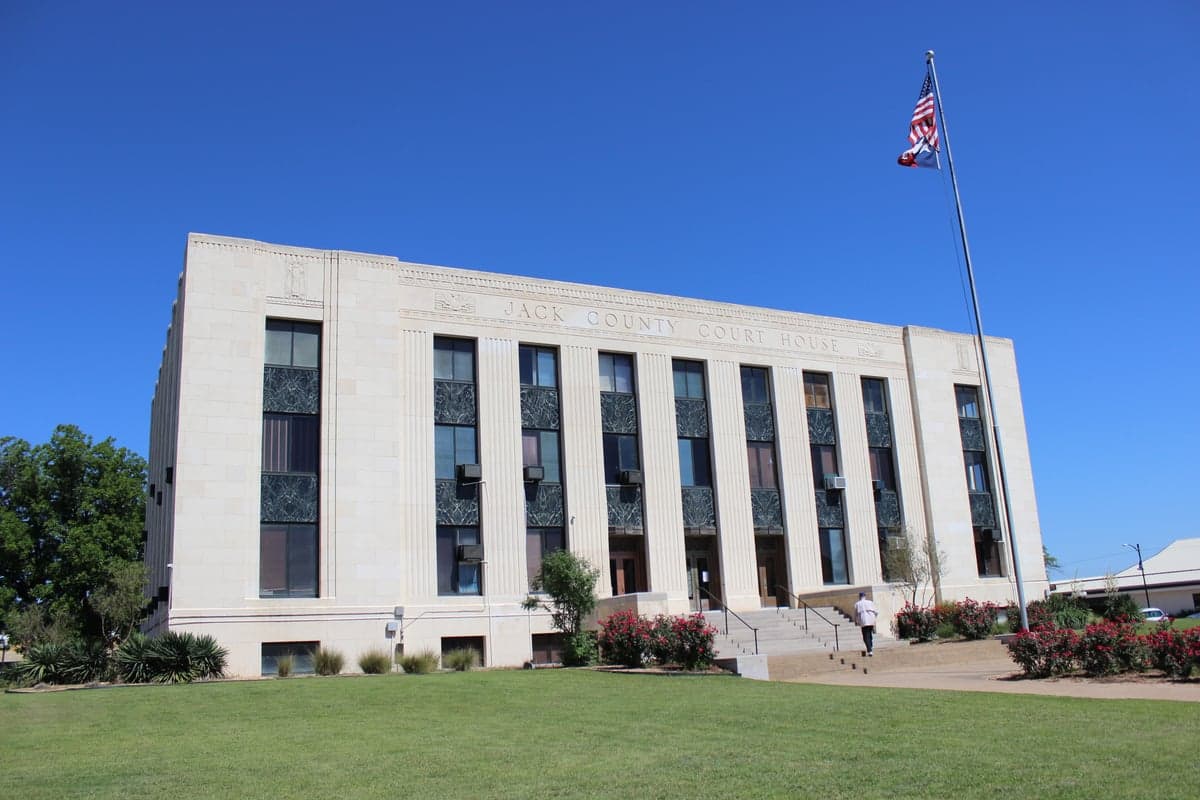
Photo: Wikipedia
Demographics of Jack County
Affluence Level in Jack County
A middle-class area roughly in line with national averages across income, home values, education, and employment.
People of Jack County
Jack County, Texas, is a deeply rural, predominantly white community of 8,623 residents where a strong sense of local heritage and self-reliance defines daily life. The population is notably less diverse than the state average, with 75.6% identifying as white and a Hispanic share of 18.4% that is growing but remains below the Texas norm. With only 15.6% of adults holding a college degree and a foreign-born population of just 3.9%, the county reflects a working-class, native-born character rooted in its agricultural and energy history. The people of Jack County today are a blend of old-stock Anglo-American families, a modest but established Hispanic community, and a small Black population, all concentrated in the county seat of Jacksboro and the smaller towns of Bryson, Jermyn, and Perrin.
Settlement & growth (pre-1960)
Before Anglo-American settlement, the area now known as Jack County was part of the traditional territory of the Comanche and Kiowa nations, who used the region's rolling prairies and wooded creek bottoms for bison hunting and seasonal camps. Spanish and Mexican claims to the land were largely nominal, with no permanent European settlements established in the area during the colonial period. The first significant non-Native presence came in the 1850s, when the Texas state legislature created Jack County in 1856 and named it after two brothers who died at the Alamo. The earliest Anglo settlers were primarily Scots-Irish and English stock from the Upper South and Deep South, drawn by cheap land grants and the promise of cotton farming and cattle ranching. They founded Jacksboro as the county seat in 1858, building a courthouse and a handful of stores along Lost Creek, and by 1860 the county's population had reached roughly 1,000.
The post-Civil War period brought a second wave of settlers, including freed slaves who established small farming communities, though their numbers remained small due to the area's limited plantation economy. The arrival of the Fort Worth and Denver City Railway in 1879 transformed Jack County's economy and settlement pattern, linking Jacksboro to regional markets and spurring the founding of Bryson (originally called "Bison") and Jermyn as railroad stops. The railroad enabled the shipment of cattle, cotton, and later wheat, attracting additional Anglo-American farmers from the Midwest and the South during the 1880s and 1890s. By 1900, the population had grown to over 10,000, with small hamlets like Perrin and Postoak serving as trading centers for surrounding ranches and farms.
The early 20th century saw the discovery of oil in the region, with the Bowie Field and other small pools bringing a brief boom of roughnecks and speculators to Jack County during the 1920s and 1930s. This oil activity, combined with continued agricultural settlement, kept the population relatively stable through the Great Depression and World War II. However, the mechanization of farming and the decline of small-scale cotton production after 1945 led to a steady outmigration of younger residents to urban centers like Fort Worth and Dallas. By 1960, the county's population had fallen to roughly 7,000, a trend that would continue for decades as the agricultural economy contracted and the oil industry became more capital-intensive.
Modern era (post-1965)
The 1965 Hart-Cellar Act had a minimal direct impact on Jack County, as the area's lack of urban job opportunities and ethnic enclaves did not attract the post-1965 immigrant waves that transformed Texas's major cities. Instead, the county's demographic story since the 1970s has been one of domestic outmigration and a gradual, slow diversification driven primarily by natural increase among the existing Hispanic population. The Hispanic share of the population, which was negligible in 1960, grew to 18.4% by the 2020s, largely through the children and grandchildren of Mexican-American families who had worked in the region's ranching and oil industries for generations. These families are concentrated in Jacksboro and Bryson, where they form a visible but integrated part of the community, with many working in construction, oilfield services, and local government.
The Black population, at 3.4%, is small but historically rooted, descending from the post-Civil War freedmen's communities that persisted through the 20th century. Most Black residents live in Jacksboro, where they have maintained a presence through churches and family networks, though the lack of economic opportunity has led many younger Black residents to leave for the Dallas-Fort Worth metroplex. The East/Southeast Asian population (0.6%) and Indian subcontinent population (0.0%) are negligible, reflecting the county's isolation from the professional and tech-driven immigration that has reshaped suburban Texas. The white population, at 75.6%, remains overwhelmingly Anglo-American, with many families tracing their roots in the county back five or more generations. The college-educated share of just 15.6% underscores the county's working-class character, with most adults holding high school diplomas and working in agriculture, energy, manufacturing, or local services.
Suburbanization has largely passed Jack County by, as the county lacks a major highway connection or commuter rail link to the Dallas-Fort Worth metroplex, which is roughly 70 miles southeast. The population has remained flat or declined slightly since 2000, with Jacksboro (population roughly 4,500) serving as the only incorporated town of any size. The unincorporated communities of Jermyn, Perrin, and Postoak have seen their populations dwindle as younger residents leave for college or jobs in larger cities, leaving behind an aging population that is among the oldest in North Texas by median age.
The future
Jack County's population is projected to remain stable or decline slightly over the next 10-20 years, with little prospect of the rapid growth seen in nearby counties like Wise or Parker. The Hispanic share is likely to continue its slow increase through natural growth, potentially reaching 22-25% by 2040, but the county will remain predominantly white and Anglo-American in character. The lack of new housing construction, limited job growth outside of oil and gas extraction, and the absence of major infrastructure investments mean that the county is unlikely to attract significant domestic or international migration. The aging white population, combined with the outmigration of young adults, will continue to push the median age upward, potentially straining local services and school enrollment in Jacksboro and Bryson.
One potential wildcard is the expansion of wind energy and solar farms in the region, which could bring a small influx of construction workers and technicians, though these jobs are often temporary and do not lead to permanent settlement. The county's cultural identity is likely to remain rooted in its ranching and oil heritage, with a conservative, self-sufficient ethos that values local control and traditional social structures. For someone moving in now, Jack County offers a quiet, affordable, and deeply connected rural lifestyle, but it is not a place of demographic dynamism or rapid change. The people who live here are those who value continuity over novelty, and the county's future will look much like its past: small, stable, and shaped by the land and the families who have worked it for generations.
For a relocating individual or family, Jack County represents a choice to live in a place where community ties are strong, the pace is slow, and the population is homogeneous by Texas standards. The county is not becoming more diverse in any meaningful way, and its future is one of gentle decline in numbers but persistence in character. New residents will find a welcoming but insular society where fitting in means respecting the local ways and contributing to the small-town institutions—the churches, the school sports teams, the volunteer fire departments—that hold the community together. It is a place for those seeking roots, not for those seeking a melting pot.

* Values derived from national, state, county, city and local statistics and may differ in a specific area. Last updated: 2026-07-03T21:30:21.000Z
Narrative content on this page is AI-generated and may contain mistakes. Verify any details that matter before acting on them.
ReloMaps may earn a commission from affiliate links at no extra cost to you.

