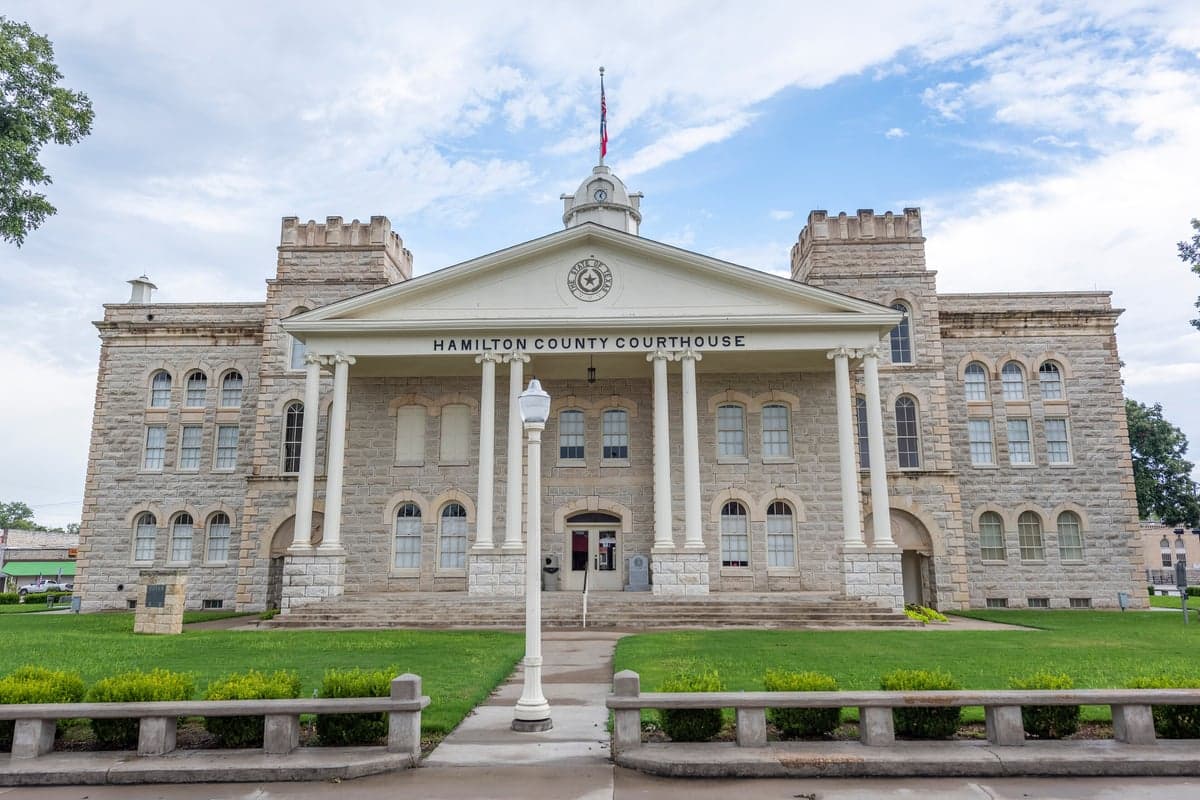
Photo: Wikipedia
Political ClimatePolitical Climate in Hamilton County
Showing county-level results — no local-only data available.
Lean and PVI are calculated from this county’s 2020 and 2024 presidential results, Cook-style.
Political rankings in Texas
- Most Conservative Cities in Texas
- Most Liberal Cities in Texas
- Best Liberal-Leaning Towns in the South
- Safest Liberal-Leaning Towns in the South
- Safest Conservative-Leaning Towns in the South
- Affordable Small Towns for Conservatives
- Most Affordable Liberal-Leaning Small Towns in the U.S.
- Safest Conservative-Leaning Cities in the U.S.
- Most Conservative Counties in Texas
- Most Liberal Counties in Texas
Local Political AnalysisPolitical Analysis of Hamilton County
Hamilton County is a reliably Republican stronghold with a Cook PVI of R+11, meaning it votes about 11 points more conservative than the national average. The county has trended even redder in recent cycles, driven by rural cultural values and a growing distrust of state-level Democratic policies among local voters. While the county seat of Hamilton and smaller towns like Evant and Hico are deeply conservative, the tiny community of Pottsville has shown occasional swing tendencies in local races, though it still votes heavily Republican in presidential elections. The overall trajectory is steady red, with no signs of a blue shift anytime soon.
How it compares
Compared to Texas as a whole, Hamilton County is notably more conservative. The state of Texas has a Cook PVI that is not publicly assigned, but statewide elections typically lean Republican by a smaller margin—around R+5 to R+7 in recent cycles. In Hamilton County, Republican candidates routinely win by 20-30 points in presidential races, while statewide GOP candidates like Ted Cruz or Greg Abbott carry the county by similar margins. The difference is most visible in local races: in Hamilton, school board and commissioner elections are often decided in the Republican primary, with Democrats rarely fielding candidates. In contrast, urban Texas counties like Travis (Austin) or Harris (Houston) are blue or purple, creating a sharp urban-rural divide that Hamilton County exemplifies on the conservative side.
What this means for residents
For conservative residents, the political climate means their values are reflected in local policy—low taxes, limited regulation, and a strong emphasis on Second Amendment rights and religious freedom. School board meetings in Hamilton and Hico rarely see the culture-war battles common in suburban districts, as the community is largely unified on issues like curriculum and library content. For liberal residents, life is more isolating. There are no Democratic clubs or visible progressive organizing groups in the county; the nearest active Democratic precinct is in Stephenville (Erath County) or Waco (McLennan County). That said, most residents report that political disagreements are handled with neighborly civility—people may disagree on national politics but still help each other with hay baling or church fundraisers. The practical impact is that liberal residents often keep their views private to avoid social friction, especially in smaller towns like Evant or Pottsville.
Culturally, Hamilton County stands apart from Texas’s booming metros by maintaining a slower, agrarian pace. The county has no zoning laws in unincorporated areas, allowing residents to keep livestock or hunt on their property without city interference—a policy distinction that reflects the local preference for personal freedom over government oversight. Politically, the county is a bastion of the "Texas independence" sentiment, with many residents expressing skepticism of both federal authority and the state’s growing urban influence. This manifests in local opposition to state-mandated property tax appraisal caps and support for secessionist rhetoric, though such views remain fringe in practice. For anyone moving here, the key takeaway is that Hamilton County offers a predictable, conservative environment where community ties are strong and political change is slow—a deliberate contrast to the fast-evolving politics of Texas’s cities.

State Political ClimatePolitical Climate in Texas
State Political AnalysisPolitical Environment in the State
Texas has been a reliably Republican state for over three decades, with the GOP holding every statewide office and both chambers of the legislature since the mid-1990s. The dominant coalition is a mix of suburban professionals, rural conservatives, and evangelical voters, but the margin has been shrinking—Donald Trump won the state by 9 points in 2016, 5.6 points in 2020, and 13.7 points in 2024, a rebound driven by massive turnout in the exurbs and border counties. The long-term trajectory is a slow squeeze: the big metros of Austin, Dallas, Houston, and San Antonio are trending bluer, while the rural and mid-sized cities like Lubbock, Midland, and Tyler are digging in deeper red.
Urban vs. rural divide
The political map of Texas is a tale of two geographies. The urban cores—Austin, Houston, Dallas, and San Antonio—are solidly Democratic, with Austin’s Travis County delivering roughly 75% of its vote to Democrats in recent cycles. But the real action is in the suburbs and exurbs. Collin County north of Dallas, once a GOP stronghold, has shifted from a 30-point Republican margin in 2012 to a single-digit one in 2020, though it snapped back somewhat in 2024. Meanwhile, the fast-growing exurbs like Comal County (New Braunfels) and Hays County (south of Austin) are now battlegrounds, with Comal still firmly red and Hays flipping blue in 2020 before narrowly returning to the GOP column in 2024. The border cities—El Paso, Laredo, and Brownsville—remain Democratic but with shrinking margins, as Hispanic voters, particularly working-class men, have moved toward the GOP in noticeable numbers. The rural Panhandle and West Texas, anchored by Lubbock and Midland-Odessa, are among the most Republican areas in the country, routinely voting 80%+ for the GOP.
Policy environment
Texas has no state income tax, which is the single biggest draw for relocators from high-tax states like California and New York. The trade-off is a heavy reliance on property taxes and sales taxes, which can hit homeowners harder than expected—effective property tax rates average around 1.6% of home value, among the highest in the nation. The regulatory posture is aggressively pro-business, with no state-level rent control, minimal zoning in most cities, and a right-to-work law that keeps union influence low. Education policy is a flashpoint: the state funds public schools through a Robin Hood system that redistributes property tax revenue, but per-pupil spending ranks near the bottom nationally. School choice is expanding, with a voucher-like program passed in 2023 that provides up to $8,000 per student for private school tuition. Healthcare is a mixed bag—Texas has the highest uninsured rate in the country at around 17%, having refused Medicaid expansion under the Affordable Care Act, but it also has a robust network of major medical centers in Houston’s Texas Medical Center and Dallas’s UT Southwestern. Election laws are strict: voter ID is required, early voting runs for two weeks, and mail-in voting is limited to those 65 and older or with a qualifying disability.
Recent policy direction
The last few legislative sessions have pushed Texas decisively in a conservative direction on nearly every front a relocator might weigh. On guns, Texas became a permitless carry state in 2021, allowing any adult who can legally possess a firearm to carry it openly or concealed without a license or training. On education and parental rights, the 2023 session passed a ban on gender-transition procedures for minors and required school libraries to restrict books deemed sexually explicit, while also mandating that teachers use the restroom matching their biological sex. On speech and privacy, the state passed a law in 2021 prohibiting social media platforms with over 50 million users from banning users based on political viewpoint, though it’s currently tied up in litigation. Property rights are strongly protected—there’s no statewide zoning, and the state has preempted local ordinances that would restrict oil and gas activity, short-term rentals, or tree removal. On taxation, the 2023 session delivered a $18 billion property tax cut, the largest in state history, which raised the homestead exemption to $100,000. Voting access is tightening: the 2021 election law added new ID requirements for mail ballots, limited drive-through voting, and gave partisan poll watchers more authority. Abortion is effectively banned after about six weeks, with a near-total ban passed in 2021 and no exceptions for rape or incest.
Civil unrest & political movements
Texas has seen its share of political flashpoints in recent years. The 2020 protests following George Floyd’s murder were concentrated in Austin and Houston, with the Austin Police Department’s budget becoming a local political football that ultimately led to a state takeover of the city’s public safety funding. The border is a perpetual flashpoint: Governor Greg Abbott launched Operation Lone Star in 2021, deploying state troopers and National Guard to the border, installing razor wire along the Rio Grande, and busing migrants to Democratic-run cities like New York and Chicago. This has created a visible, ongoing standoff with the Biden administration over federal immigration authority, with the state winning several court rulings allowing it to maintain barriers. Secession rhetoric is mostly performative—the Texas Nationalist Movement exists but has no real electoral traction, and a 2022 Republican primary ballot proposition asking whether Texas should secede from the United States if the federal government continues to overreach passed among GOP voters, though it’s non-binding and widely seen as a protest vote. Election integrity remains a live issue: the 2020 and 2022 cycles saw Republican activists push for audits of Harris County’s results, and the state legislature passed laws criminalizing ballot harvesting and limiting drop boxes. A new resident would notice the political intensity mostly through yard signs, bumper stickers, and the sheer volume of political advertising in any even-numbered year.
Projection
Over the next five to ten years, Texas is likely to remain Republican but with a narrowing edge. The state is adding roughly 1,000 new residents a day, and the fastest-growing counties—Comal, Hays, and Montgomery—are a mix of conservative retirees and younger, more moderate families fleeing expensive coastal cities. The Hispanic vote is the wild card: if the 2024 trend holds, where Trump won roughly 45% of Hispanic voters statewide, the GOP’s coalition actually strengthens. But the suburban shift in places like Fort Bend County (Houston’s southwest suburbs) and Williamson County (north of Austin) suggests the ceiling on Republican margins is real. The state’s political future will be decided in the suburbs of Dallas, Houston, and Austin, not in the rural counties that are already maxed out. A relocator moving in now should expect a state that remains conservative on taxes, guns, and regulation, but with a growing, noisy Democratic minority concentrated in the cities that will keep statewide races competitive—probably in the 5-10 point range—for the foreseeable future.
For a new resident, the bottom line is that Texas delivers on its promises: low taxes, limited regulation, and a government that generally stays out of your business on property and guns. The trade-off is a fraying social safety net, a public education system that’s underfunded by national standards, and a political environment where the culture war is a permanent feature of daily life. If you’re conservative, you’ll find a state that’s actively fighting your battles. If you’re liberal, you’ll find islands of blue in Austin, Houston, and Dallas where you can live comfortably, but you’ll be voting in a state where your ballot rarely tips the statewide outcome. Either way, the cost of living is lower, the economy is booming, and the political temperature is something you’ll learn to live with—like the summer heat, it’s intense, but you adapt.
* Values derived from national, state, county, city and local statistics and may differ in a specific area. Last updated: 2026-10-30T19:29:37.000Z
Narrative content on this page is AI-generated and may contain mistakes. Verify any details that matter before acting on them.
ReloMaps may earn a commission from affiliate links at no extra cost to you.

