Photo: Wikipedia
Demographics of Hamilton County
Affluence Level in Hamilton County
A below-average socioeconomic profile. Incomes, home values, and educational attainment trail the U.S., with higher poverty and unemployment.
People of Hamilton County
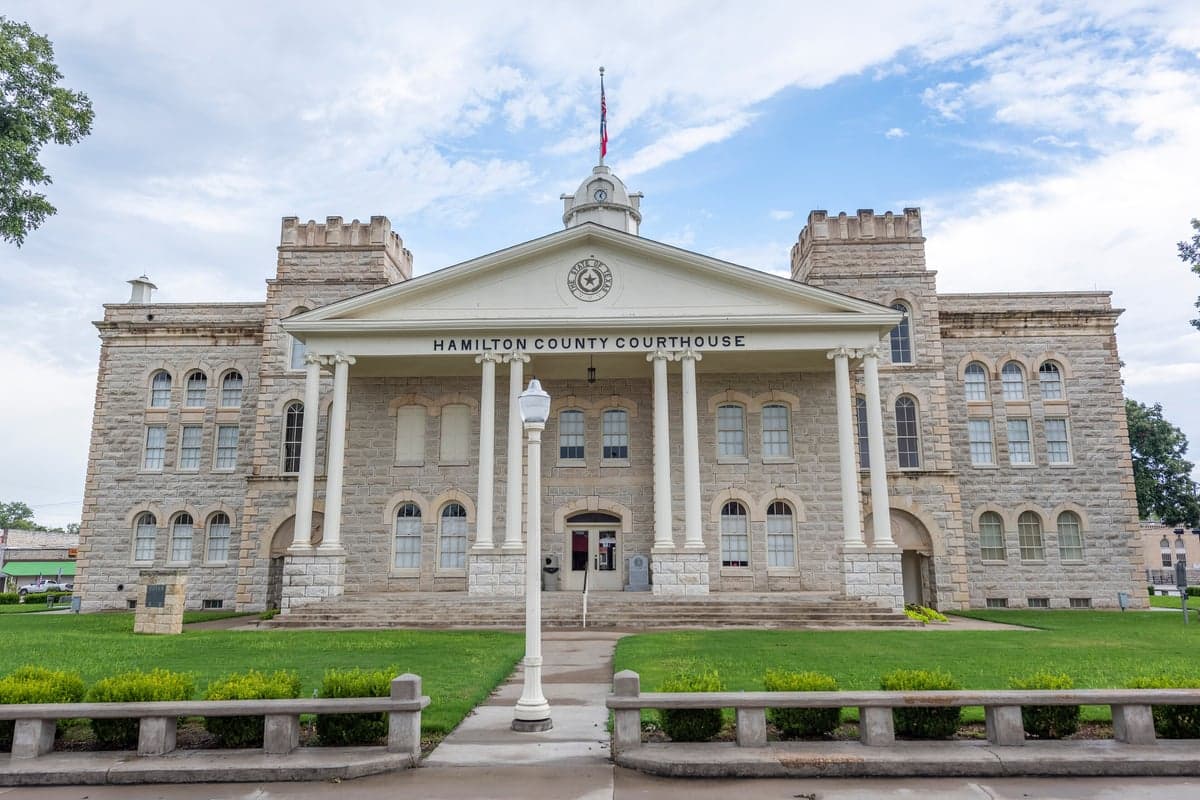
Hamilton County, Texas, is a deeply rural, predominantly white community of 8,320 residents where the population has remained remarkably stable for over a century. The county’s identity is rooted in its agricultural heritage, with a population that is 82.9% white, 13.6% Hispanic, and 1.9% Black, while only 4.1% of residents are foreign-born. This is a place where family names trace back to the original Anglo-American settlers, and the county seat of Hamilton and the smaller communities of Hico, Evant, and Pottsville still anchor a way of life centered on ranching, farming, and local churches.
Settlement & growth (pre-1960)
Before Anglo-American settlement, the area now known as Hamilton County was part of the traditional territory of the Comanche and Wichita peoples, who used the region for hunting bison and seasonal camps. Spanish and Mexican authorities claimed the land but established no permanent settlements here, leaving the area as a frontier buffer zone. The first permanent non-Native settlers arrived in the 1850s, primarily Anglo-American families from the southern United States—Tennessee, Alabama, and Mississippi—who were drawn by the promise of cheap, fertile land under the Texas land grant system. These early settlers established the town of Hamilton in 1858, naming it after a local politician, and the county was formally organized in 1858.
The post-Civil War period saw a steady influx of farmers and ranchers, many of them veterans seeking a fresh start. By the 1870s, the community of Hico was founded, and it quickly became a trading center for cotton and livestock. The arrival of the Gulf, Colorado and Santa Fe Railway in the 1880s spurred growth, connecting Hamilton and Hico to regional markets and attracting a small number of German and Czech immigrants who settled as tenant farmers and craftsmen. These European-origin families largely assimilated into the existing Anglo culture, and their descendants remain in the county today. The population peaked at around 15,000 in the early 1900s, but the boll weevil infestation, the Great Depression, and the Dust Bowl drove many families off the land, causing a steady decline. By 1960, the population had fallen to roughly 8,000, a figure it has hovered near ever since. The communities of Evant and Pottsville, both founded as farming hamlets, saw their populations shrink as mechanization reduced the need for farm labor.
Modern era (post-1965)
The 1965 Hart-Cellar Act had almost no direct impact on Hamilton County. Unlike urban Texas or the Rio Grande Valley, the county did not experience significant immigration from Latin America, Asia, or the Indian subcontinent. The foreign-born population today stands at just 4.1%, and the Asian population is a negligible 0.1%, with no measurable Indian-subcontinent population. The Hispanic population, at 13.6%, is the county’s largest minority group, and it has grown gradually since the 1990s, primarily through domestic migration from other parts of Texas rather than direct immigration. Many Hispanic residents work in agriculture, construction, and service industries in Hamilton and Hico, and they have integrated into the community without forming distinct ethnic enclaves.
The most significant demographic shift since 1965 has been the outmigration of young adults seeking education and employment in larger cities like Waco, Fort Worth, and Austin. This has left an aging population: the median age in Hamilton County is over 45, well above the state average. The county has also seen a modest influx of retirees and second-home buyers drawn by the low cost of living and the rural lifestyle, particularly around the lakes and hills near Hico. However, the overall population has remained flat—8,320 in the 2020 census, virtually unchanged from 1960. The Black population, at 1.9%, has been stable and is concentrated in Hamilton itself, reflecting the legacy of post-Reconstruction settlement by freed slaves who worked as sharecroppers and later as small landowners.
The future
Hamilton County’s population is projected to remain stable or decline slightly over the next 10–20 years. The county is not on a major growth corridor, and it lacks the employment base to attract large numbers of new residents. The Hispanic share of the population is likely to continue its slow increase, potentially reaching 18–20% by 2040, driven by higher birth rates and continued domestic migration from other parts of Texas. The white population will likely shrink in absolute terms as older residents pass away and younger families move away. The county will not become more diverse in the sense of attracting Asian, Indian, or Black immigrants; its future diversity will be almost entirely a story of Hispanic growth.
Culturally, Hamilton County will remain a conservative, rural, and religiously observant place. The communities of Hamilton, Hico, Evant, and Pottsville will continue to revolve around agriculture, local schools, and churches. The county may see some growth in tourism and recreation, particularly around the Leon River and the historic downtowns, but this will not fundamentally alter the demographic character. For someone moving in now, the county offers a stable, low-cost, and safe environment where neighbors know each other and the pace of life is slow—but it is not a place of rapid change or increasing diversity.
Hamilton County is becoming a quieter, older version of its 20th-century self, with a slowly growing Hispanic minority and a shrinking white majority. For a family or individual seeking a traditional rural Texas lifestyle with strong community ties and minimal demographic upheaval, it remains a consistent choice. The county’s future is not one of transformation, but of gentle continuity.

* Values derived from national, state, county, city and local statistics and may differ in a specific area. Last updated: 2026-10-30T19:29:37.000Z
Narrative content on this page is AI-generated and may contain mistakes. Verify any details that matter before acting on them.
ReloMaps may earn a commission from affiliate links at no extra cost to you.

