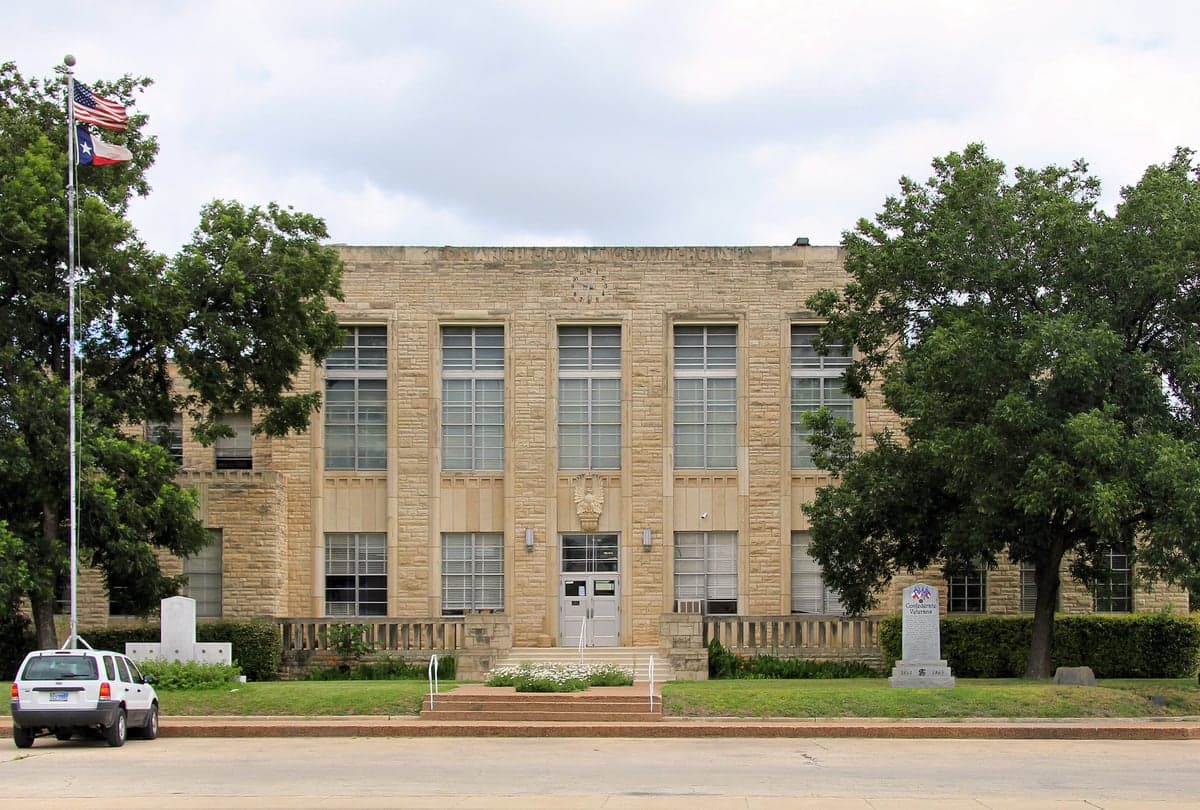
Photo: Wikipedia
Demographics of Comanche County
Affluence Level in Comanche County
A middle-class area roughly in line with national averages across income, home values, education, and employment.
People of Comanche County
Comanche County, Texas, is home to 13,786 residents, a population that remains predominantly White (66.7%) with a significant and growing Hispanic community (29.0%). The county’s character is defined by its rural, small-town roots, with the city of Comanche serving as the economic and cultural hub, while towns like De Leon and Gustine retain distinct identities shaped by early settlers. The population is notably less diverse in terms of Black (0.5%), East/Southeast Asian (0.3%), and Indian subcontinent (0.2%) residents, and the foreign-born share stands at 6.3%, reflecting a community built primarily on domestic migration and a steady Hispanic influx over recent decades.
Settlement & growth (pre-1960)
Before American settlement, the area now known as Comanche County was part of the traditional homeland of the Comanche people, who dominated the region through the 18th and early 19th centuries. Spanish and Mexican claims to the land were largely nominal, with no permanent European settlements established until after Texas independence. The first Anglo-American settlers arrived in the 1850s, drawn by the promise of cheap land and the expansion of cotton farming. The Texas Legislature created Comanche County in 1856, and the town of Comanche was established as the county seat, quickly becoming a center for trade and government.
The early population was overwhelmingly of Scots-Irish and English descent, migrating from the Upper South and Deep South states. These settlers were subsistence farmers and ranchers, and the county’s economy revolved around cotton, cattle, and corn. The arrival of the Texas Central Railroad in the 1880s spurred growth, connecting Comanche to larger markets and attracting new residents. Towns like De Leon (founded 1881) and Gustine (founded 1890) sprang up along the rail lines, each serving as a shipping point for local agriculture. By 1900, the county’s population had swelled to over 23,000, its peak, driven by cotton’s boom-and-bust cycles and the promise of open range.
The early 20th century brought a significant wave of German and Czech immigrants, who settled primarily in the northern and eastern parts of the county. These groups established tight-knit farming communities around Proctor and Sidney, bringing with them distinct religious traditions (Lutheran and Catholic) and a strong work ethic that shaped the region’s agricultural identity. African American residents, though a small share of the population historically, were present as freedmen and sharecroppers, with a notable community forming near Comanche in the “Freedmantown” area. The Dust Bowl and Great Depression hit the county hard, causing a steady population decline as families left for urban centers or California. By 1960, the population had fallen to roughly 11,000, a pattern of rural depopulation that continued for decades.
Modern era (post-1965)
The post-1965 era brought gradual demographic change, driven less by international immigration and more by domestic migration and natural increase. The 1965 Hart-Cellar Act had a muted direct effect on Comanche County, as the foreign-born population remains low at 6.3%. However, the broader shift in Texas’s economy—away from agriculture and toward energy, healthcare, and services—reshaped the county’s labor force. The opening of the Comanche Peak Nuclear Power Plant in neighboring Somervell County in the 1990s brought some new residents, but the county’s population remained relatively stable, hovering around 13,000-14,000 since 2000.
The most significant modern demographic shift has been the growth of the Hispanic population, which rose from roughly 15% in 1990 to 29.0% today. This growth is primarily driven by Mexican-American families moving from larger Texas cities like Dallas-Fort Worth and Houston, seeking lower housing costs and a slower pace of life. Many of these new residents settle in Comanche and De Leon, where they work in construction, agriculture, and service industries. The Hispanic community is largely integrated into the county’s social fabric, with bilingual signage and services becoming more common in local businesses and schools.
Domestic migration from other parts of Texas and the Rust Belt has been modest but steady. Retirees and remote workers are increasingly drawn to the county’s low cost of living and proximity to outdoor recreation at Proctor Lake, a U.S. Army Corps of Engineers reservoir completed in 1963. The lake has spurred some second-home development and tourism, particularly around the unincorporated community of Energy. The county’s racial and ethnic composition remains overwhelmingly White and Hispanic, with the Black population declining to just 0.5% and East/Southeast Asian and Indian subcontinent communities remaining negligible. Suburbanization has been limited, with no major subdivisions or master-planned communities, preserving the county’s rural character.
The future
Comanche County’s population is projected to remain stable or grow slowly, with the Hispanic share likely continuing its upward trend. The county’s school districts, particularly in Comanche and De Leon, are seeing increasing numbers of Hispanic students, a trend that will reshape the county’s cultural identity over the next generation. The White population, while still the majority, is aging, and younger White families are often leaving for urban job markets, a pattern common across rural Texas. The foreign-born share may rise slightly as immigrant workers fill gaps in agriculture and construction, but the county is unlikely to see the rapid diversification of Texas’s metropolitan areas.
New residential development is concentrating around Proctor Lake and along the Highway 36 corridor, where lakefront lots and acreage are attracting retirees and telecommuters from the Dallas-Fort Worth metroplex. This influx could slowly increase the county’s college-educated share (currently 20.0%) and bring more political and cultural diversity. However, the county’s conservative lean—rooted in its rural, agricultural history—is likely to persist, as most newcomers are drawn by the same values of low taxes, limited government, and a slower pace of life.
Over the next 10-20 years, Comanche County will likely become more bilingual and bicultural, with Hispanic residents playing an increasingly prominent role in local politics, business, and civic life. The county’s identity will evolve from a purely Anglo-Texan ranching culture to a more layered Texan-Mexican one, similar to trends seen in other rural Texas counties. The challenge will be balancing growth with preservation of the open spaces and small-town character that define the area.
For someone moving in now, Comanche County offers a stable, affordable, and safe rural environment with a strong sense of community. The population is slowly becoming more diverse, but the core identity remains rooted in its agricultural past and conservative values. New residents will find a place where change comes gradually, and where the biggest draw is the land itself—wide-open spaces, a low cost of living, and a pace of life that feels a world away from the booming Texas cities.

* Values derived from national, state, county, city and local statistics and may differ in a specific area. Last updated: 2026-07-13T15:01:40.000Z
Narrative content on this page is AI-generated and may contain mistakes. Verify any details that matter before acting on them.
ReloMaps may earn a commission from affiliate links at no extra cost to you.

