
Photo: Wikipedia
Strategic Assessment of Anderson County
Workable tactical position. Some exposure to population density or targets, but generally defensible in a crisis.
What does the Strategic Assessment tell us?
Our Strategic Assessment grades tactical survivability of an area. Major population centers, military targets, fallout zones, natural disasters, and border exposure all drive risk — lower exposure means a more defensible position in a crisis.
This is heavily inspired by Joel Skousen's Strategic Relocation book. Highly recommended you checkout the book ($)What does this tell us?
Our Strategic Assessment grades tactical survivability of an area. Major population centers, military targets, fallout zones, natural disasters, and border exposure all drive risk — lower exposure means a more defensible position in a crisis.
This is heavily inspired by Joel Skousen's Strategic Relocation book. Highly recommended you checkout the book ($)Strategic Pillars

Key Distances
Strategic Assessment Analysis
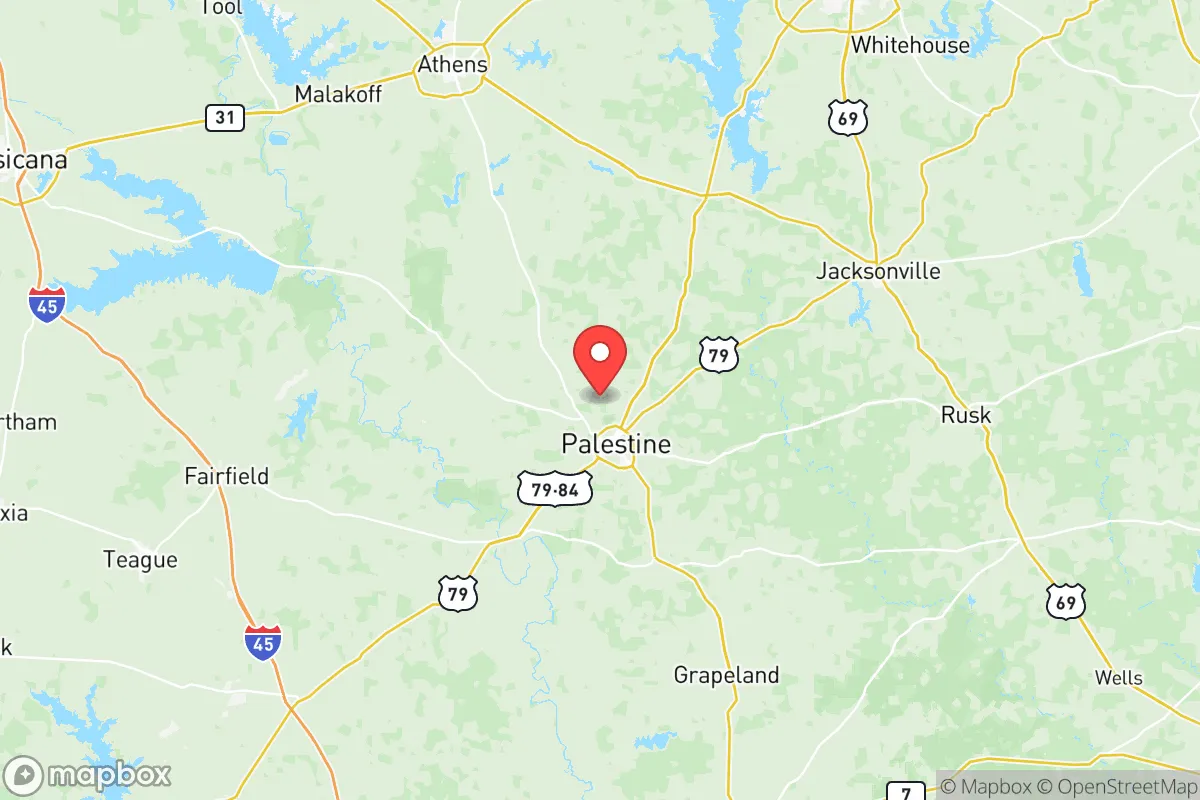
For the relocation researcher focused on long-term stability and self-sufficiency, Anderson County, Texas presents a compelling mix of geographic insulation and practical resilience. Located roughly 100 miles southeast of Dallas and 120 miles north of Houston, the county offers a strategic middle-ground—close enough to major urban job markets and supply chains, yet far enough to avoid the immediate fallout zones and congestion of those metropolitan cores. The county seat, Palestine, serves as the primary population and commercial hub, while smaller communities like Elkhart, Frankston, and Cayuga anchor a largely rural landscape defined by piney woods, rolling hills, and the Neches River corridor.
Geographic position and natural advantages for long-term stability
Anderson County sits at the western edge of the Piney Woods region, a landscape that provides abundant timber, reliable rainfall, and a temperate climate that supports year-round agriculture. The county receives roughly 45 inches of rain annually, well above the Texas average, which translates to dependable surface water and groundwater recharge. The Neches River forms the county's eastern boundary, while numerous creeks and the engineering of the Palestine Lake (also known as Lake Palestine) provide a significant freshwater reservoir. This water security is a major strategic asset—unlike much of West or Central Texas, Anderson County is not in chronic drought territory. The terrain itself offers natural defensibility: dense forest cover, rolling hills, and a low population density (roughly 58,000 residents across 1,078 square miles) mean that a relocator can find significant privacy and buffer from neighbors. The county's position along U.S. Highway 287 and State Highway 19 provides reliable ground access without being a major interstate corridor that would attract evacuation traffic or become a chokepoint during a crisis.
Risks, exposures, and proximity to fallout-relevant landmarks
No strategic assessment is complete without a clear-eyed look at vulnerabilities. Anderson County's most significant risk exposure comes from its position within the Houston-to-Dallas industrial and energy corridor. To the south, roughly 90 miles away, lies the Houston Ship Channel and the massive refinery complex of Baytown and Texas City—a primary target in any large-scale conflict scenario. To the southwest, approximately 100 miles, is the Strategic Petroleum Reserve at Bryan Mound, and to the west, about 120 miles, is Fort Cavazos (formerly Fort Hood), one of the largest military installations in the world. While these distances provide meaningful buffer, prevailing wind patterns from the south and southwest could carry particulate or chemical fallout into the county depending on the event. Additionally, the county itself hosts critical energy infrastructure: the Cayuga natural gas power plant and numerous natural gas pipelines running through the region. These are not likely primary targets, but they represent secondary risks. On the natural disaster front, the area is not hurricane-prone (far enough inland), but severe thunderstorms, tornadoes, and occasional ice storms are real hazards. The 2021 winter storm (Uri) exposed grid fragility here as it did across Texas, with extended power outages being the primary concern. Flooding along the Neches River and its tributaries is a localized risk, particularly in low-lying areas near Palestine.
Practical resilience for a relocator: food, water, energy, and defensibility
For the reader serious about self-sufficiency, Anderson County offers strong fundamentals. Water is the single most important factor, and the county has it in abundance. Lake Palestine, a 25,000-acre reservoir, provides a reliable surface water source, and groundwater from the Carrizo-Wilcox Aquifer is accessible via private wells in most rural areas. The county's agricultural heritage means that local food production is viable—the growing season stretches from March to November, and the soil, while sandy in places, supports gardens, orchards, and small livestock operations. The Palestine Farmers Market and local producers in Elkhart and Frankston offer existing networks for a relocator to tap into. Energy resilience is more mixed. The county is served by Oncor Electric Delivery, and the grid is vulnerable to the same winterization issues that plague Texas. However, the rural character means that solar and backup generation are practical and common—many rural properties already have propane tanks, generators, or well pumps independent of the grid. Wood for heating is abundant, given the forestry industry. Defensibility is a standout feature: the combination of low population density, forest cover, and limited through-roads means that a property with a long driveway and good sightlines can be highly secure. The county's crime rate is low relative to urban Texas, and the local sheriff's office in Palestine maintains a visible presence. That said, the county is not a remote fortress—Palestine itself has a population of around 18,000, with typical small-town amenities including a Walmart, a regional hospital, and multiple grocery stores. A relocator can be self-sufficient without being isolated.
The overall strategic picture for Anderson County is one of balanced, practical resilience. It lacks the extreme remoteness of far West Texas or the deep Piney Woods, but that very accessibility is a double-edged advantage: you can stock supplies, build infrastructure, and maintain a low profile while still being within a few hours of major medical centers (Tyler, Dallas, Houston) and supply chains. The water security, agricultural viability, and low population density make it a strong candidate for a family or individual looking to establish a long-term, self-reliant homestead. The primary trade-offs are the residual risk from proximity to Texas's energy and military infrastructure and the need to invest in independent power and water systems to hedge against grid failures. For the relocator who wants a defensible, resource-rich base within striking distance of urban amenities—and who is willing to put in the work on preparedness—Anderson County deserves serious consideration.

* Values derived from national, state, county, city and local statistics and may differ in a specific area. Last updated: 2026-06-27T21:06:56.000Z
Narrative content on this page is AI-generated and may contain mistakes. Verify any details that matter before acting on them.
ReloMaps may earn a commission from affiliate links at no extra cost to you.

