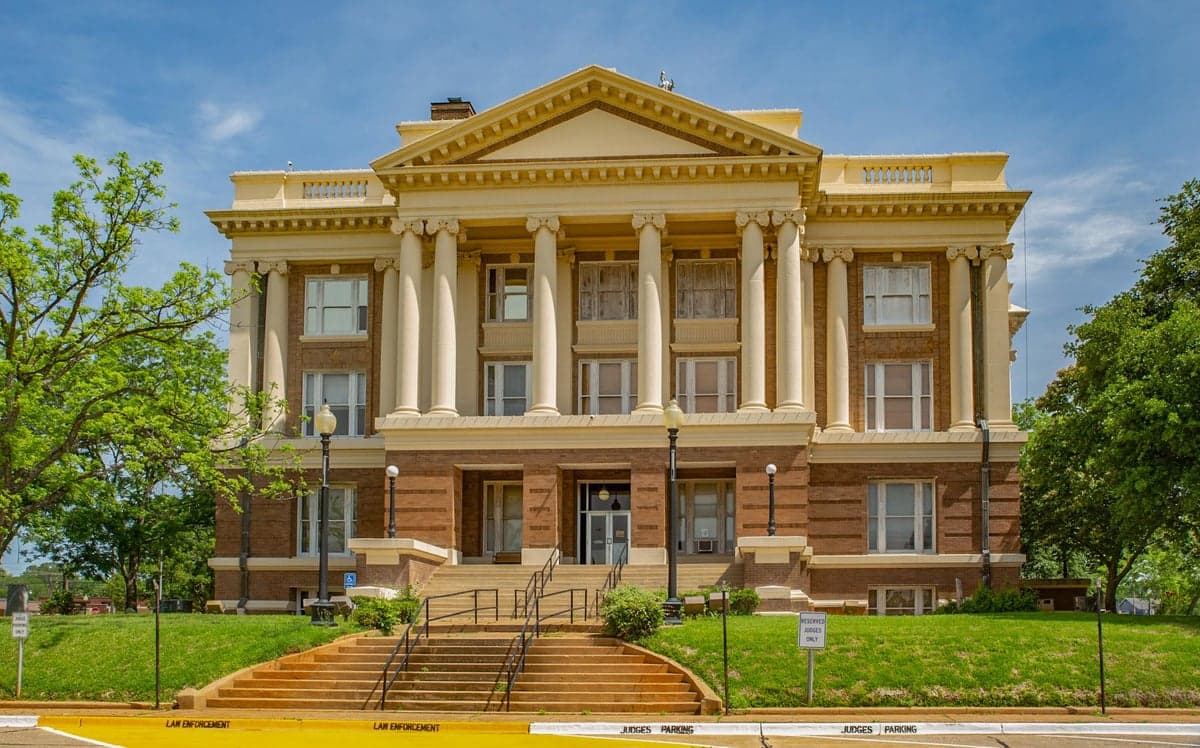
Photo: Wikipedia
Demographics of Anderson County
Affluence Level in Anderson County
A below-average socioeconomic profile. Incomes, home values, and educational attainment trail the U.S., with higher poverty and unemployment.
People of Anderson County
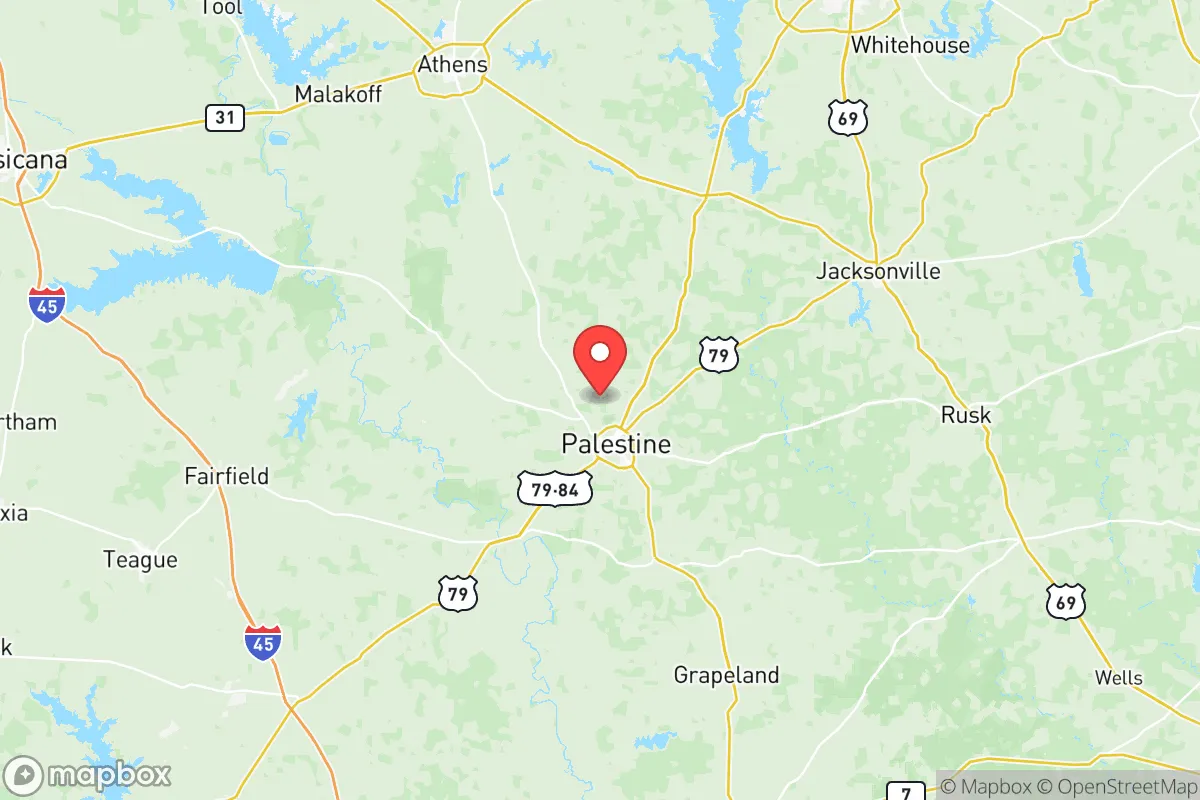
Today, Anderson County, Texas, is home to 57,825 residents, a population that reflects a deeply rooted Southern and rural character with a growing Hispanic presence. The county is notably less diverse than the state as a whole, with a population that is 55.8% White, 19.3% Hispanic, and 18.2% Black, and a very low foreign-born share of just 3.9%. Its identity is shaped by the legacy of cotton, timber, and the railroad, and its people are concentrated in the county seat of Palestine, the small towns of Elkhart and Frankston, and the unincorporated communities of Cayuga and Tennessee Colony. The county remains predominantly native-born, with only 14.5% of adults holding a college degree, marking it as a place where traditional, working-class values and a slower pace of life still dominate.
Settlement & growth (pre-1960)
Before Anglo-American settlement, the area now known as Anderson County was inhabited by the Caddo and, later, the Cherokee and other displaced tribes who moved into East Texas after being pushed from their ancestral lands. Spanish and French explorers passed through, but no permanent European colonies were established here. The county was formally created in 1846 from Houston County, named after Kenneth Lewis Anderson, the last vice president of the Republic of Texas.
The first major wave of settlers were Anglo-Americans from the Lower South—primarily Tennessee, Alabama, and Mississippi—who arrived in the 1840s and 1850s. These were small-scale cotton farmers and slaveholders who brought enslaved Black laborers with them. The county's economy was built on cotton and timber, and the population grew steadily through the antebellum period. The town of Palestine, founded in 1846, became the county seat and a regional trading hub. By 1860, enslaved people made up roughly 40% of the county's population, a share that would shape the region's racial dynamics for generations.
After the Civil War and Emancipation, many freed Black families remained in the county as sharecroppers and tenant farmers, settling in rural communities like Elkhart and Frankston, as well as in the southern and eastern parts of Palestine. The arrival of the International-Great Northern Railroad in the 1870s spurred a second wave of growth, bringing merchants, railroad workers, and a small number of European immigrants—mostly German and Czech families—who settled in Palestine and the surrounding farmlands. These immigrants were never numerous enough to form distinct ethnic enclaves, but they contributed to the county's small but lasting German Lutheran and Catholic presence.
The early 20th century brought the oil boom to East Texas, and Anderson County saw a modest influx of workers during the 1930s and 1940s, particularly around the Cayuga and Tennessee Colony oil fields. This period also saw the construction of the Texas State Railroad, which connected Palestine to Rusk and brought additional industrial jobs. However, the county's population remained overwhelmingly rural and agricultural through the 1950s, with little in-migration from outside the South. The Dust Bowl and Great Depression had less impact here than in the Plains states, as the county's timber and cotton economy, though depressed, provided a buffer against total collapse.
Modern era (post-1965)
The 1965 Hart-Cellar Act had a minimal direct effect on Anderson County. Unlike major Texas cities such as Houston or Dallas, the county did not attract significant numbers of new immigrants from Asia, Africa, or Latin America during the late 20th century. The foreign-born population today stands at just 3.9%, far below the Texas average of about 17%. The small immigrant community that does exist is primarily Hispanic, with a handful of East/Southeast Asian families (0.5%) and virtually no Indian-subcontinent residents (0.0%).
The most significant demographic shift since 1965 has been the growth of the Hispanic population, which rose from a negligible share in 1970 to 19.3% today. This growth has been driven by domestic migration from South Texas and Mexico, as well as by higher birth rates among Hispanic families. Most Hispanic residents have settled in Palestine, where they work in construction, manufacturing, and the service industry, and in the rural areas around Elkhart, where agricultural labor remains a draw. The Black population, which was roughly 25% in the mid-20th century, has declined slightly to 18.2%, as younger Black residents have moved to larger cities for education and employment.
Domestic migration from the Rust Belt and California has been modest compared to other parts of Texas. Anderson County has not experienced the explosive suburban growth seen in Collin or Williamson counties. Instead, it has attracted a steady trickle of retirees and remote workers seeking lower housing costs and a quieter lifestyle, particularly around the Lake Palestine area and the Texas State Railroad corridor. The county's population has grown slowly but steadily, from about 47,000 in 1990 to 57,825 in 2024, a pace that reflects its limited economic diversification and its distance from major metropolitan job centers.
The future
Anderson County is projected to continue its slow, steady growth over the next 10-20 years, likely reaching 65,000-70,000 residents by 2040. The Hispanic share of the population will continue to rise, probably approaching 25-30%, driven by natural increase and continued migration from South Texas. The White share will decline gradually, while the Black share is expected to remain stable or decline slightly, as out-migration of younger Black residents continues to offset births.
The county is unlikely to become significantly more diverse in terms of immigrant origins. The foreign-born share may rise to 5-6% but will remain far below state and national averages. New residents will continue to be primarily domestic migrants—retirees, remote workers, and families seeking affordable housing—who are drawn to the Palestine area and the lake communities around Tennessee Colony. The county's cultural identity will remain rooted in its Southern, rural, and evangelical Christian character, though the growing Hispanic population will add a bilingual and bicultural layer, particularly in public schools and local churches.
For someone moving in now, Anderson County offers a stable, affordable, and culturally traditional environment. It is not a place of rapid change or high diversity, but rather a community where the rhythms of small-town life and family-centered values still hold sway. The county's future is one of gradual demographic evolution, not transformation, and its appeal will continue to lie in its low cost of living, its natural landscapes, and its distance from the congestion and cost of Texas's largest cities.

* Values derived from national, state, county, city and local statistics and may differ in a specific area. Last updated: 2026-06-27T21:06:56.000Z
Narrative content on this page is AI-generated and may contain mistakes. Verify any details that matter before acting on them.
ReloMaps may earn a commission from affiliate links at no extra cost to you.

