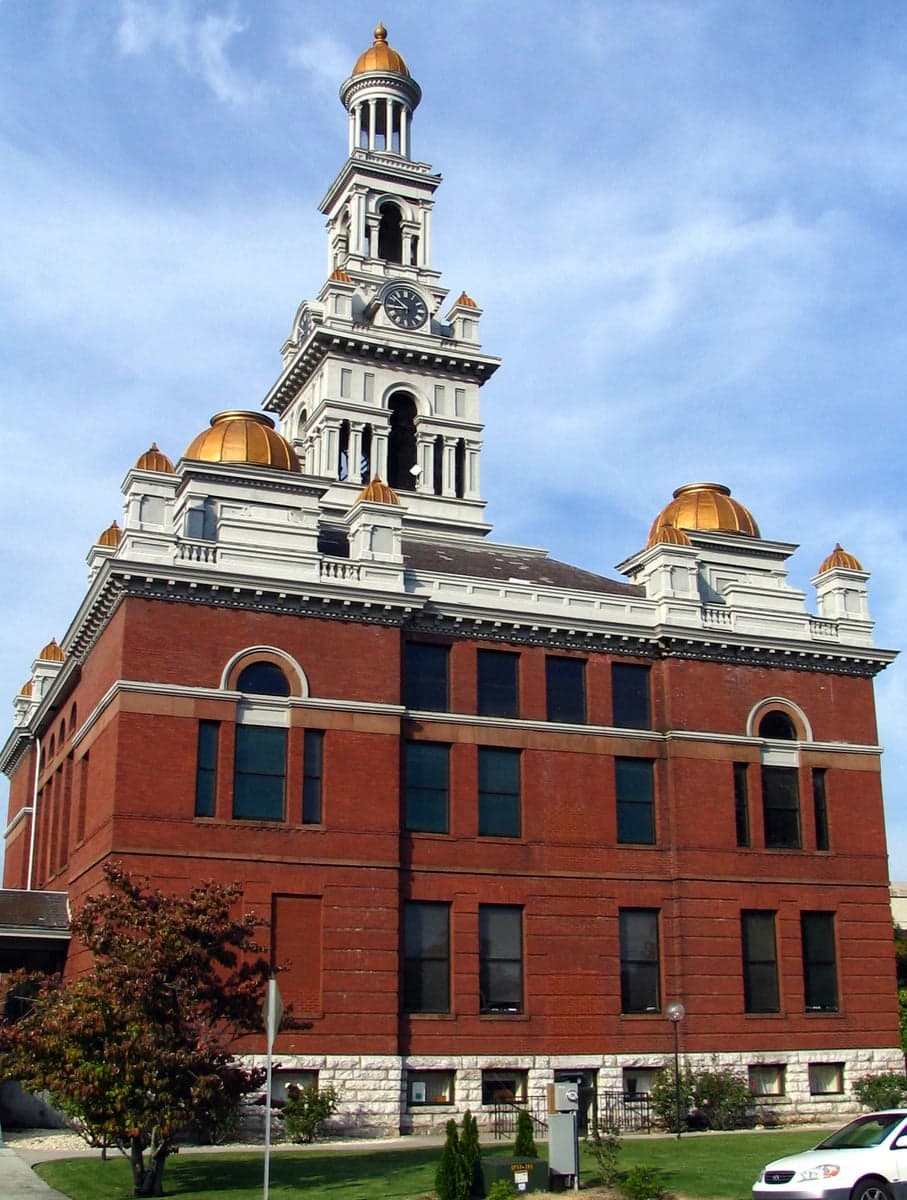
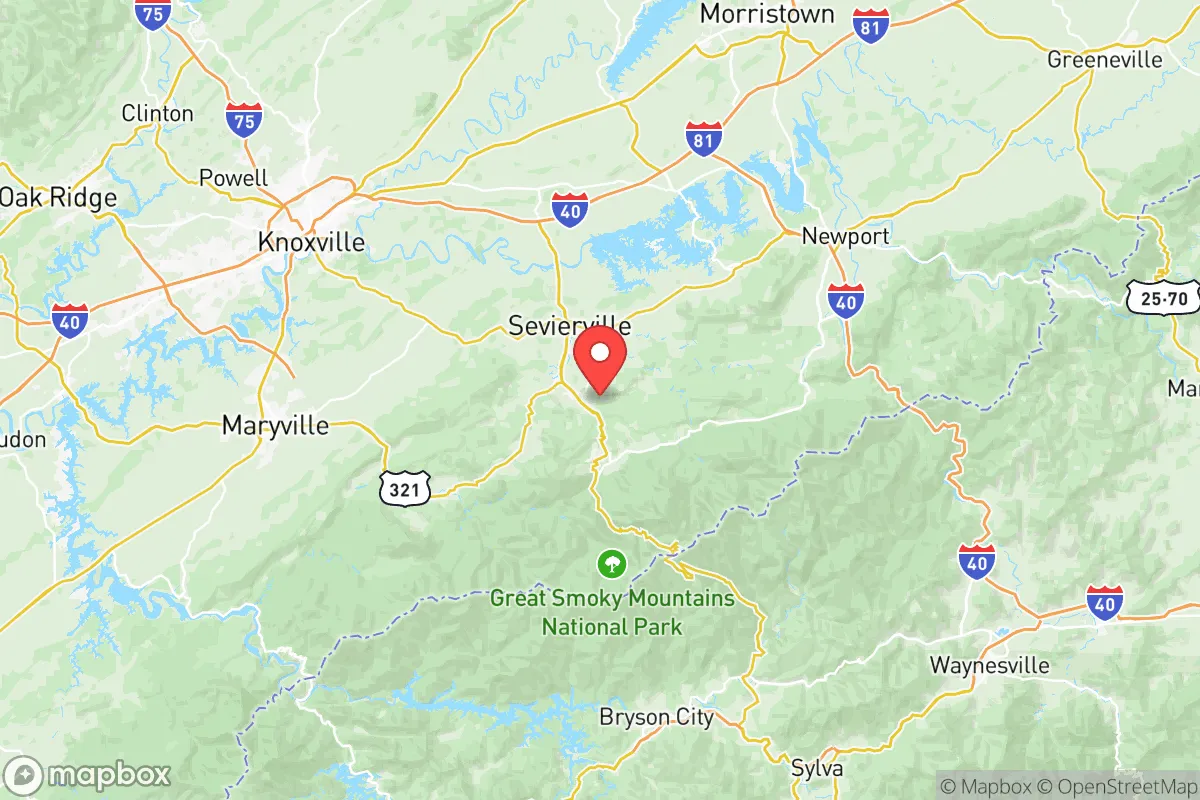
Photo: Wikipedia
Demographics of Sevier County
Affluence Level in Sevier County
A middle-class area roughly in line with national averages across income, home values, education, and employment.
People of Sevier County
The people of Sevier County, Tennessee today number 98,802, forming a predominantly white (86.0%) and native-born population with a small but growing Hispanic minority (8.9%). The county’s identity is deeply rooted in Appalachian mountain culture, evangelical Christianity, and a tourism-driven economy centered on Pigeon Forge and Gatlinburg, which together draw millions of visitors annually to Dollywood and the Great Smoky Mountains National Park. Despite its rural character, the population is increasingly suburbanizing along the I-40 corridor, with a foreign-born share of just 5.3% and a college attainment rate of 21.4% that trails state and national averages.
Settlement & growth (pre-1960)
Long before European settlement, the land that is now Sevier County was part of the traditional territory of the Cherokee Nation, whose towns and hunting grounds stretched across the southern Appalachians. The Cherokee maintained a significant presence in the region until the late 18th century, when Euro-American settlers began crossing the mountains from North Carolina and Virginia. The first permanent white settlement in what became Sevier County was established around 1785 at the confluence of the Little Pigeon River and its forks, an area that would later grow into the modern city of Sevierville, the county seat. These early settlers were overwhelmingly of Scots-Irish and English descent, migrating down the Great Wagon Road from Pennsylvania and the Shenandoah Valley, drawn by cheap land grants offered to Revolutionary War veterans and the promise of fertile bottomland in the river valleys.
By the early 1800s, the county’s population had spread into the foothills and coves, with small farming communities taking root at Pigeon Forge (originally a forge on the Little Pigeon River), Gatlinburg (then called White Oak Flats), and Kodak, a later railroad stop. The population remained overwhelmingly rural and agricultural through the 19th century, with subsistence farming, timber, and small-scale livestock production forming the economic backbone. The Civil War divided the county, as it did much of East Tennessee, with Union sentiment strong among the small farmers of the hills and Confederate loyalty concentrated among slaveholding families in the richer bottomlands near Sevierville. After the war, the timber industry boomed, and logging camps drew a modest influx of workers from neighboring counties, but the population remained almost entirely native-born white, with a tiny Black population (0.8% today) that never exceeded a few hundred due to the region’s lack of plantation agriculture.
The 20th century brought two transformative events. The creation of the Great Smoky Mountains National Park in 1934 displaced hundreds of families from the high coves and forced a shift from subsistence farming to tourism. The park’s establishment also spurred the development of Gatlinburg as a resort town, while Pigeon Forge began its slow transition from a rural crossroads to a tourist strip. The second event was the completion of Interstate 40 through the county in the 1960s, which connected Sevier County to Knoxville and the broader national highway system, setting the stage for explosive growth in the decades to come. By 1960, the county’s population stood at roughly 24,000, still overwhelmingly white, native-born, and rural, with the largest concentrations in Sevierville, Gatlinburg, and the surrounding unincorporated areas.
Modern era (post-1965)
The post-1965 era in Sevier County has been defined not by international immigration but by domestic migration and suburbanization. The 1965 Hart-Cellar Act, which reshaped American immigration nationwide, had a minimal direct effect here: the county’s foreign-born share remains just 5.3%, well below the national average of roughly 14%. Instead, the population boom since the 1970s has been driven overwhelmingly by white domestic migrants from other parts of Tennessee and the broader U.S., attracted by the tourism industry’s low-skill job market, relatively low cost of living, and the scenic appeal of the Smoky Mountains. The county’s population more than doubled between 1970 and 2000, from 28,000 to 71,000, and has continued growing steadily since, reaching 98,802 by the most recent estimate.
The Hispanic population, now 8.9% of the total, represents the most significant ethnic shift of the modern era. This growth began in the 1990s and accelerated in the 2000s, driven by immigrants from Mexico and Central America who came to work in the tourism and hospitality sectors — hotels, restaurants, construction, and landscaping in Pigeon Forge and Gatlinburg. Many of these workers initially arrived as seasonal laborers and later settled permanently, forming small but visible communities in the apartment complexes and mobile home parks along the Parkway corridor. The Hispanic population is now the fastest-growing demographic group in the county, though it remains dispersed rather than concentrated in a single ethnic enclave. The East/Southeast Asian population (0.5%) and Indian-subcontinent population (0.7%) are tiny, consisting largely of professionals and business owners serving the tourist economy, with no significant enclave formation.
Suburbanization has reshaped the county’s settlement patterns dramatically since the 1990s. The unincorporated area around Seymour, in the county’s northwestern corner near Knox County, has seen the most intense residential development, as commuters from Knoxville seek cheaper land and lower taxes. The town of Pigeon Forge has transformed from a rural hamlet into a dense, commercialized tourist strip of hotels, dinner theaters, and outlet malls, while Gatlinburg has become a high-density resort town with a permanent population dwarfed by its visitor numbers. Sevierville has grown as a commercial and residential hub, absorbing much of the county’s retail and service-sector expansion. The Black population remains negligible at 0.8%, a figure that has barely changed in a century, reflecting the county’s lack of historical Black settlement and limited modern in-migration from other racial groups.
The future
Sevier County’s population is projected to continue growing, likely reaching 110,000–120,000 by 2040, driven primarily by domestic migration from other parts of Tennessee and the broader Sun Belt. The Hispanic share is expected to rise gradually, potentially reaching 12–15% over the next two decades, as existing families grow and new immigrant workers continue to arrive for tourism-related jobs. The white share, while still dominant, will decline slowly as a share of the total, though the county will remain far less diverse than Tennessee as a whole. The East/Southeast Asian and Indian populations are likely to remain small, with growth concentrated among professionals in hospitality management and healthcare rather than through chain migration.
The most significant demographic trend is the continued suburbanization of the county’s northwestern edge, particularly around Seymour and along the I-40 corridor near Kodak, where new subdivisions and commercial development are spreading rapidly. This area is attracting younger families and retirees from Knoxville and beyond, drawn by lower home prices and the scenic environment, but it is also creating new pressures on infrastructure, schools, and water resources. The county’s cultural identity — rooted in Appalachian heritage, evangelical Christianity, and a tourism economy that prizes a sanitized, family-friendly version of mountain life — is likely to persist, though it may become more politically and culturally contested as the Hispanic population grows and new suburbanites bring different values and expectations.
For someone moving to Sevier County now, the region offers a low-cost, family-oriented environment with strong community ties and abundant outdoor recreation, but it also presents a relatively homogeneous social landscape with limited racial or ethnic diversity. The economy is heavily dependent on tourism, which provides ample low-skill employment but limited opportunities for college-educated professionals outside of hospitality management, healthcare, and a small number of remote-work positions. The county is becoming more suburban and more connected to the Knoxville metropolitan area, but it remains, at its core, a place where the old Appalachian ways — church, family, and a deep attachment to the land — still shape daily life for the majority of its residents.

* Values derived from national, state, county, city and local statistics and may differ in a specific area. Last updated: 2026-06-28T01:12:39.000Z
Narrative content on this page is AI-generated and may contain mistakes. Verify any details that matter before acting on them.
ReloMaps may earn a commission from affiliate links at no extra cost to you.

