Photo: Wikipedia
Political ClimatePolitical Climate in Robertson County
Showing district-level results — no local-only data available.
Local Political AnalysisPolitical Analysis of Robertson County
Robertson County, Tennessee, is a reliably Republican area with a Cook PVI of R+10, though it is slightly less conservative than the state as a whole, which sits at R+13. The county has been shifting rightward over the past decade, driven by population growth from Nashville transplants and a strong rural conservative base, but it still retains a few pockets of moderate or even Democratic-leaning sentiment, particularly in the southern parts near the state capital. In the 2024 presidential election, Robertson County voted for Donald Trump by a margin of roughly 68% to 30%, a spread that has widened from about 62% in 2016, reflecting a broader trend of suburban and exurban areas hardening their Republican allegiance even as the state overall has become more polarized.
How it compares
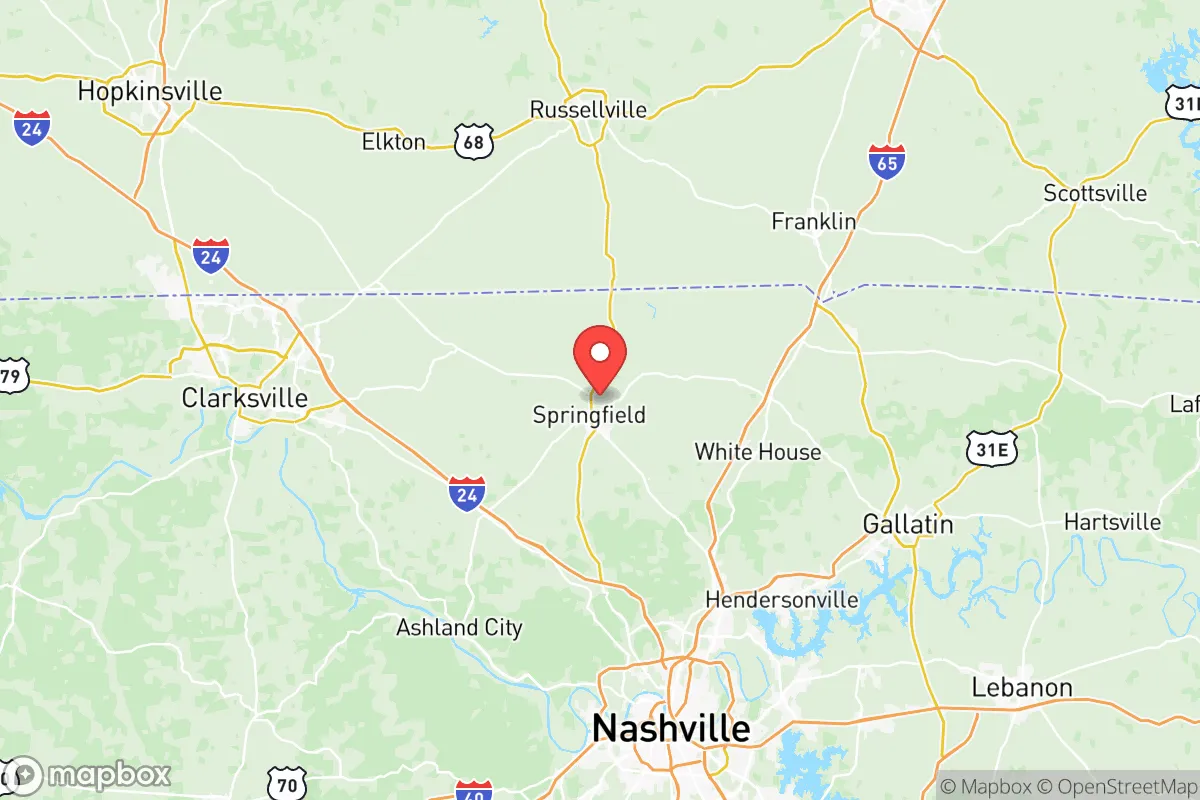
Compared to Tennessee’s statewide R+13 rating, Robertson County’s R+10 means it is a touch more competitive, but not by much—think of it as a slightly lighter shade of red in a deeply red state. The county’s political geography is not uniform: the city of Springfield, the county seat, leans Republican but has a noticeable Democratic minority, with precincts near the downtown area and along Highway 41 often splitting 55-45 in favor of Republicans, while the rural precincts around Adams and Cedar Hill routinely go 75% or more for GOP candidates. The southern edge of the county, particularly around White House and Greenbrier, has seen an influx of younger families and professionals from Nashville, and these areas are where you’ll find the most competitive precincts—some in White House have swung within 5 points in recent local races, making them the closest thing to swing territory in the county. In contrast, the northern and eastern parts, like Cross Plains and Orlinda, are deeply conservative, with voter registration heavily favoring Republicans and turnout often exceeding 80% in presidential years. The state’s R+13 rating is driven by the deep-red rural counties in Middle and East Tennessee, as well as the increasingly Republican suburbs of Chattanooga and Knoxville, but Robertson County’s proximity to Nashville’s blue-leaning Davidson County (D+28) gives it a slightly more moderate flavor than, say, neighboring Sumner County (R+14) or Montgomery County (R+15).
What this means for residents
For conservative residents, Robertson County is a comfortable place to live politically—local offices are almost entirely held by Republicans, and the county commission, school board, and mayor’s office in Springfield all lean right. You’ll find that issues like property taxes, school funding, and growth management are debated within a conservative framework, with a focus on limited government and low taxes. For liberal residents, the reality is more nuanced: while you won’t face overt hostility, you’ll be in a clear minority, and local elections often feel like a foregone conclusion. However, the growing population in White House and Greenbrier has created a small but active Democratic group that organizes around issues like public transit expansion and affordable housing, and they’ve had some success in school board races. The county’s political trajectory suggests it will continue to move rightward as new development attracts more conservative-leaning families from out of state, but the southern corridor may remain a moderating influence if it draws enough Nashville-area professionals who lean center-left on social issues.
Culturally, Robertson County stands out from the rest of Tennessee for its strong agricultural roots—tobacco and cattle farming are still big here—and a slower pace of life that contrasts with the booming suburbs of Williamson or Rutherford counties. Policy-wise, the county has been a leader in opposing state-level gun control measures, with the local sheriff’s office publicly refusing to enforce certain state red-flag laws, and it has also pushed back against Nashville’s transit plans, voting overwhelmingly against a regional transit referendum in 2018. For both conservatives and liberals, the key distinction is that Robertson County feels more like a small-town community than a bedroom suburb, and that identity shapes everything from local zoning debates to how people greet each other at the grocery store. If you’re moving here, expect a place where politics is less about national headlines and more about who’s paving the roads and how fast the new subdivisions are going up—and know that the answer to both questions is usually “conservatively.”

State Political ClimatePolitical Climate in Tennessee
State Political AnalysisPolitical Environment in the State
Tennessee is a solidly Republican state with a Cook PVI of R+13, meaning it votes about 13 points more Republican than the national average in presidential elections. The state has shifted rightward over the past 20 years, driven by rural realignment and the migration of conservative-leaning families from blue states, though the major metros of Nashville and Memphis remain Democratic strongholds. For a relocator, this means you're moving into a state where conservative policy dominates at the state level, but local political realities vary dramatically depending on whether you land in a city, suburb, or small town.
Urban vs. rural divide
The political map of Tennessee is a study in contrasts. Nashville (Davidson County) and Memphis (Shelby County) are the two deep-blue anchors, consistently delivering 60-70% of their votes to Democratic presidential candidates. Nashville's growth as a tech and healthcare hub has only reinforced its liberal lean, while Memphis remains a Democratic stronghold rooted in its majority-Black population and union history. Chattanooga (Hamilton County) and Knoxville (Knox County) are more competitive but lean Republican overall, with Knoxville trending redder as its exurbs expand. The real engine of the state's R+13 rating is the vast rural and small-town expanse: counties like Lincoln, Franklin, and Grundy routinely vote 75-80% Republican. The suburbs around Nashville — Williamson County (Franklin, Brentwood) — are among the wealthiest and most conservative in the nation, though they've shown slight softening in recent cycles as younger professionals move in. The 2020 election saw no major county flips, but the margins in suburban Davidson-adjacent counties like Wilson and Rutherford have tightened slightly as Nashville's growth spills over.
Policy environment
Tennessee's policy posture is unmistakably conservative. The state has no state income tax on wages, relying instead on a high sales tax rate (7% state, plus local add-ons that can push it above 9.5% in some cities). Property taxes are low relative to national averages, especially in rural counties. The regulatory climate is business-friendly, with right-to-work laws and minimal zoning restrictions outside major cities. Education policy has shifted toward school choice: the state expanded its Education Savings Account program in 2023 to cover more counties, and charter schools are common in Memphis and Nashville. Healthcare is a mixed bag — Tennessee did not expand Medicaid under the Affordable Care Act, leaving a coverage gap for low-income adults, but the state has leaned into work requirements for TennCare (Medicaid) enrollees. Election laws have tightened: voter ID requirements are strict, and the state passed a law in 2023 banning private funding of election administration, a response to Zuckerberg-funded grants in 2020. Early voting is available but limited compared to some states.
Recent policy direction
The last five years have seen Tennessee move decisively in a conservative direction across multiple fronts. On gun and self-defense law, the state enacted permitless carry (constitutional carry) in 2021, allowing any law-abiding adult 21 or older to carry a handgun without a permit. On parental and education rights, the 2022 "Don't Say Gay" style law (HB 800) restricts classroom discussion of sexual orientation and gender identity in elementary school, and the 2023 Age-Appropriate Materials Act requires public school libraries to remove "obscene" or "harmful" materials. Medical and bodily autonomy saw a major shift: Tennessee's trigger law banning nearly all abortions took effect in 2022, with no exceptions for rape or incest and narrow exceptions for life-threatening conditions. On property rights, the state has strengthened eminent domain protections and limited local governments' ability to impose rent control. Voting and ballot access has tightened with the aforementioned election law changes, including a ban on drive-through voting and restrictions on absentee ballot drop boxes. On privacy and surveillance, Tennessee passed a consumer data privacy law in 2023 (the Tennessee Information Protection Act), giving residents some control over how businesses use their personal data, though enforcement is lighter than California's. The overall direction is toward maximizing individual liberty in economic and self-defense matters while restricting it on social and medical issues.
Civil unrest & political movements
Tennessee has seen its share of political flashpoints. The 2023 Nashville Covenant School shooting sparked massive protests at the state capitol, with thousands of demonstrators demanding gun control measures — which the Republican supermajority largely ignored, instead passing a bill to protect gun manufacturers from lawsuits. The expulsion and subsequent reappointment of two Democratic state representatives (Justin Jones and Justin Pearson) for protesting on the House floor became a national story. Immigration politics are less heated than in border states, but the 2023 law requiring local law enforcement to cooperate with ICE (HB 1181) passed easily. There is no serious secessionist movement, though "constitutional sheriff" rhetoric appears in some rural counties. Election integrity controversies have been muted compared to states like Georgia or Arizona, but the 2020 audit of Davidson County's election results (which found no significant irregularities) was a political flashpoint. The most visible movement a new resident would notice is the annual "Moral Monday" protests at the capitol, organized by progressive faith groups, and the regular presence of Second Amendment activists at legislative hearings.
Projection
Over the next 5-10 years, Tennessee is likely to remain solidly Republican, but the margins may narrow slightly in suburban areas as in-migration from California, Illinois, and New York brings a mix of conservative and moderate voters. The Nashville metro will continue to grow and diversify, potentially making Davidson County even bluer while pushing Williamson and Rutherford counties slightly toward the center. Rural areas will stay deeply red, and the state's Republican supermajority is unlikely to face a serious challenge at the legislative level. The biggest wild card is whether the influx of new residents — many of whom moved for lower taxes and less regulation — will eventually push for more moderate social policies, particularly on education and healthcare. A new resident moving in now should expect the state's conservative policy direction to continue, with possible incremental shifts on marijuana legalization (medical use has growing bipartisan support) and perhaps a future expansion of Medicaid if federal incentives change. The political culture will remain one where state government acts decisively on social issues while keeping taxes low and regulation light.
For a new resident, the bottom line is straightforward: if you're conservative, you'll find a state government that largely shares your values and acts on them. If you're liberal, you'll find your political voice in Nashville, Memphis, or Chattanooga's urban core, but state-level policy will often feel hostile. The practical takeaway is to choose your location carefully — the difference between living in Franklin versus Nashville is not just a 20-minute drive, but a fundamentally different political environment that shapes your daily experience of schools, taxes, and community norms.
* Values derived from national, state, county, city and local statistics and may differ in a specific area. Last updated: 2026-06-28T02:24:47.000Z
Narrative content on this page is AI-generated and may contain mistakes. Verify any details that matter before acting on them.
ReloMaps may earn a commission from affiliate links at no extra cost to you.

