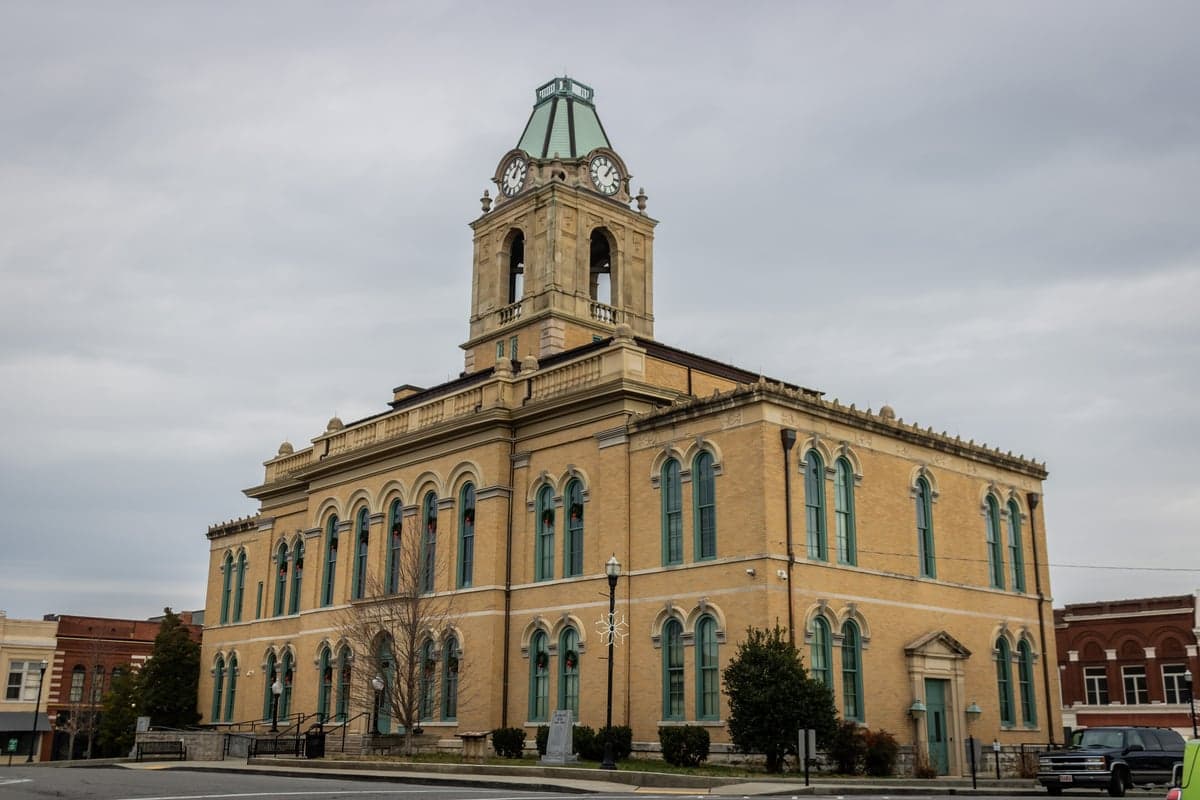
Photo: Wikipedia
Personal Sovereignty in Robertson County
Viable for self-reliance. Generally workable, though some barriers may limit total independence.
What does Personal Sovereignty tell us?
Personal Sovereignty measures your capacity for self-reliance and independence with minimal government friction. Higher scores mean fewer barriers between you and the way you want to live... but it assumes you have the space you need and good neighbors.
What does this tell us?
Personal Sovereignty measures your capacity for self-reliance and independence with minimal government friction. Higher scores mean fewer barriers between you and the way you want to live... but it assumes you have the space you need and good neighbors.
State Policy
Energy independence: Importer (25% of energy produced in-state)
Personal Liberty
Homesteading

Personal Liberty Analysis
Robertson County, Tennessee, offers a notably high degree of personal sovereignty, anchored by Tennessee’s strong state-level protections for gun rights, low tax burden, and limited local government interference in daily life. For individuals and families prioritizing autonomy, the county provides a regulatory environment that is distinctly light-touch compared to neighboring Davidson County (Nashville) or even Williamson County, with local officials in communities like Springfield, White House, and Greenbrier generally deferring to state preemption on firearms and property rights. The overall atmosphere is one of self-reliance, where residents are expected to manage their own affairs with minimal bureaucratic friction, though specific zoning and development rules vary across the county’s incorporated towns and unincorporated areas.
Tax burden and regulatory posture: How light is the local government footprint?
Robertson County’s tax burden is among the most favorable in Middle Tennessee, reinforcing its appeal for those seeking to keep more of their earnings. Tennessee has no state income tax on wages, and the county’s property tax rate is approximately $2.42 per $100 of assessed value (2025-2026), significantly lower than Davidson County’s $3.12 or Williamson County’s $2.75. Sales tax is a combined 9.75% (state 7% plus local 2.75%), which is standard for the region but still below the 10.25% rate in Nashville. Regulatory posture is similarly restrained: the county government does not impose its own business licensing beyond state requirements, and building permits in unincorporated areas are processed with minimal delays—typically under two weeks for standard residential projects. In towns like Cross Plains and Orlinda, zoning is limited to basic land-use categories, with no overlay districts or design review boards, meaning homeowners can erect fences, sheds, or workshops without seeking special approval. The contrast with Nashville’s extensive permitting and inspection regime is stark; Robertson County’s approach is best described as “hands-off unless there’s a clear public safety issue.”
Self-defense and gun law specifics: What the Second Amendment looks like on the ground
Tennessee is a constitutional carry state, and Robertson County fully embraces that framework. As of 2026, any law-abiding adult 21 or older can carry a handgun openly or concealed without a permit, and the county sheriff’s office in Springfield processes enhanced carry permits (for reciprocity with other states) within 30 days. Local gun culture is robust: the Springfield Gun Club and Robertson County Shooting Range are active, and private firearm sales between individuals require no background check or registration. Importantly, Robertson County is a “Second Amendment Sanctuary” jurisdiction—the county commission passed a resolution in 2021 affirming that local resources will not be used to enforce federal firearms restrictions that conflict with Tennessee law. This means no local police or sheriff’s deputies will assist ATF in confiscation efforts, and no local ordinances restrict magazine capacity or firearm types. In White House, which straddles the Robertson-Sumner county line, the city council has similarly declined to enact any local gun restrictions, maintaining the same permissive environment as the unincorporated areas. Stand-your-ground laws apply statewide, with no duty to retreat in any place where the individual is lawfully present.
Self-reliance and homesteading viability: Lot sizes, zoning, and off-grid feasibility
Robertson County is one of the most homestead-friendly areas within commuting distance of Nashville, with large tracts of agricultural land and permissive zoning for self-sufficient living. In unincorporated areas, minimum lot sizes for residential use are typically 1 acre in rural zones, but many parcels in the northern part of the county—near Adams and Cedar Hill—are available in 5- to 20-acre increments, ideal for hobby farms or full homesteads. Zoning allows for livestock (chickens, goats, cattle) on parcels of 2 acres or more, with no limit on the number of animals beyond basic animal cruelty statutes. Off-grid living is legally feasible: Tennessee has no state-level prohibition on rainwater collection, and Robertson County does not require connection to municipal water or sewer in rural areas—wells and septic systems are standard. Solar panels are permitted without special permitting, and composting toilets are allowed as long as they meet state health department standards. The county’s building code is based on the 2018 International Residential Code, but enforcement is limited to structural safety and electrical inspections; there are no aesthetic covenants or energy-efficiency mandates in unincorporated areas. In Springfield and Greenbrier, however, homeowners within city limits must connect to municipal water and sewer, and lot sizes are smaller (typically 0.25–0.5 acres), making full self-sufficiency more challenging. For those seeking maximum autonomy, the unincorporated areas north of Highway 76 offer the best balance of land availability and regulatory freedom.
Personal liberties: Parental rights, medical autonomy, speech, and property
Tennessee’s legal framework strongly supports parental rights and medical autonomy, and Robertson County’s local governance aligns with that posture. Parental rights are codified in state law (Tenn. Code Ann. § 49-6-7001), giving parents explicit authority over their children’s education, healthcare, and religious upbringing. The county’s school board in Springfield has not adopted any curriculum that conflicts with parental opt-out rights, and homeschooling is straightforward: parents file a simple notice of intent with the local school district and maintain a portfolio of work—no standardized testing requirements or home visits. Medical autonomy is similarly protected: Tennessee does not mandate COVID-19 or childhood vaccines for school attendance (only the standard MMR, DTaP, and polio vaccines are required, with broad medical and religious exemptions), and Robertson County has no local health ordinances that override state law. Speech and assembly rights are robust—the county has no noise ordinances that restrict political speech or public gatherings, and the Robertson County Courthouse Square in Springfield is a traditional public forum where protests, rallies, and religious expression occur without permit requirements for groups under 50 people. Property rights are protected by Tennessee’s strong eminent domain laws, which require “public use” (not just public benefit) for takings, and Robertson County has not engaged in any controversial land condemnations in recent memory. The overall legal environment is one where individuals are presumed capable of making their own decisions, with the government stepping in only for clear public safety or health emergencies.
Compared to other areas in Middle Tennessee, Robertson County stands out for its combination of low taxes, permissive gun laws, homestead-friendly zoning, and strong personal liberties—all within a 30- to 45-minute commute to Nashville. While it lacks the urban amenities of Davidson County, it offers a level of personal sovereignty that is increasingly rare in the region, particularly for those who value self-reliance over government services. For families and individuals who prioritize autonomy over convenience, Robertson County—especially the unincorporated areas around Adams, Cedar Hill, and Cross Plains—represents one of the most freedom-oriented options in the state, rivaling rural counties like Dickson or Hickman but with better access to employment and healthcare infrastructure.

* Values derived from national, state, county, city and local statistics and may differ in a specific area. Last updated: 2026-06-28T02:24:47.000Z
Narrative content on this page is AI-generated and may contain mistakes. Verify any details that matter before acting on them.
ReloMaps may earn a commission from affiliate links at no extra cost to you.

