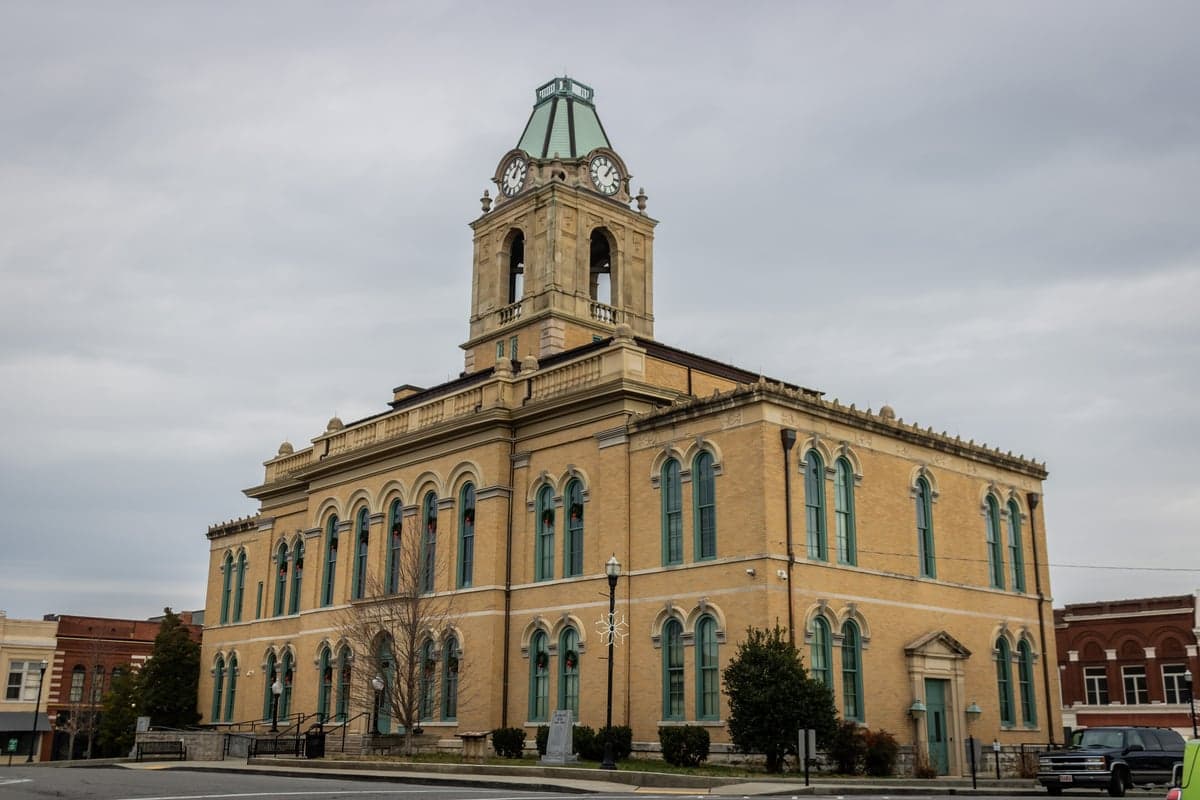
Photo: Wikipedia
Demographics of Robertson County
Affluence Level in Robertson County
A middle-class area roughly in line with national averages across income, home values, education, and employment.
People of Robertson County
Robertson County, Tennessee is a predominantly white, family-oriented community of 74,291 residents where a strong rural and small-town identity persists alongside steady suburban growth. The population is 79.3% white, 9.6% Hispanic, 7.0% Black, and 0.6% East/Southeast Asian, with a foreign-born share of just 3.6%—well below the national average. The county’s character is shaped by its agricultural roots, its position on the northern edge of the Nashville metropolitan area, and a population that is less college-educated (21.1%) than the state average, reflecting a workforce concentrated in manufacturing, logistics, and trades. Residents tend to value self-reliance, community ties, and a slower pace of life, while the growing Hispanic population is gradually adding new cultural and economic dimensions to the county’s historically Anglo-American fabric.
Settlement & growth (pre-1960)
Before European settlement, the area that is now Robertson County was part of the hunting grounds of the Cherokee and Chickasaw nations, who used the region’s forests and rivers for seasonal hunting but maintained no permanent villages. The first permanent white settlers arrived in the late 1770s and early 1780s, primarily Scots-Irish and English pioneers pushing south and west from Virginia and North Carolina through the Cumberland Gap. These early families were drawn by land grants offered to veterans of the American Revolution and by the promise of fertile soil in the Cumberland River basin. The county was formally established in 1796, the same year Tennessee became a state, and its earliest settlements—Springfield, the county seat, and Adams—were founded by these frontier farmers who cleared land for tobacco, corn, and livestock.
Through the 19th century, Robertson County’s population grew slowly but steadily, almost entirely from natural increase and continued migration from the Upper South. The county was a center of tobacco cultivation, and the labor system relied heavily on enslaved Black people; by 1860, roughly 30% of the county’s population was enslaved. After the Civil War and Emancipation, many freedmen remained in the area as sharecroppers and tenant farmers, forming small rural communities such as Orlinda and Cedar Hill, where their descendants still live today. The late 19th and early 20th centuries saw no major new immigrant waves—Robertson County was too rural and agricultural to attract the Southern and Eastern Europeans who settled in Northern industrial cities. Instead, the population remained overwhelmingly native-born white and Black, with a social structure rooted in farming, small-town commerce, and Protestant church life.
The post-World War II period brought the first significant changes. The expansion of the Tennessee highway system and the growth of Nashville’s manufacturing economy began pulling Robertson County into the Nashville orbit. Springfield saw modest industrial development in the 1950s and 1960s, with factories producing textiles, auto parts, and food products drawing some workers from surrounding rural areas. However, the county’s population growth remained slow compared to booming suburban counties south of Nashville; Robertson County was still considered a distant, rural outpost rather than a commuter suburb. The 1960 census recorded just over 27,000 residents, a figure that had barely doubled since 1850.
Modern era (post-1965)
The 1965 Hart-Cellar Act had little immediate effect on Robertson County, as the county’s economy and social networks did not attract the post-1965 immigrant waves that transformed urban and coastal America. The foreign-born population remains low at 3.6% today, and the county’s racial and ethnic composition has shifted primarily through domestic migration rather than international immigration. The most significant demographic change since the 1990s has been the growth of the Hispanic population, which now stands at 9.6%. This growth is driven by Mexican and Central American immigrants and their U.S.-born children, who have moved into the county for work in construction, landscaping, poultry processing, and agriculture. The Hispanic community is most concentrated in and around Springfield and Greenbrier, where a small but growing network of Spanish-language churches, tiendas, and service providers has emerged.
The Black population, at 7.0%, has remained relatively stable as a share of the county total, though many younger Black residents have left for Nashville or other urban centers. The historic Black communities in Orlinda and Cedar Hill have aged and shrunk, while a small number of Black families have moved into newer subdivisions in Springfield and White House. The East/Southeast Asian population (0.6%) and Indian-subcontinent population (0.1%) are tiny, consisting mostly of professionals employed in Nashville’s healthcare and tech sectors who have chosen Robertson County for its lower housing costs and larger lots.
The most transformative domestic trend since 2000 has been suburban spillover from Nashville. White House, straddling the Robertson-Sumner county line, has become a fast-growing bedroom community for Nashville commuters, attracting young families and middle-class professionals seeking affordable homes and good schools. Greenbrier and Springfield have also seen new subdivisions, strip malls, and industrial parks, as the Nashville metropolitan area’s growth pushes north along Interstate 65. This influx has brought a more diverse mix of residents—including some from other states and a small number of Asian and Indian professionals—but the county remains overwhelmingly white and native-born compared to Davidson County or Williamson County.
The future
Robertson County’s population is projected to continue growing, driven by Nashville’s northward expansion and the completion of highway improvements that shorten commute times. The county will likely become more diverse, but slowly and primarily through Hispanic population growth and a gradual increase in Asian and Indian residents attracted by employment in the broader Nashville region. The white share of the population will decline gradually as the Hispanic share rises, but Robertson County is unlikely to become a majority-minority county within the next 20 years. New residential development will concentrate in White House, Greenbrier, and the southern edge of Springfield, while the northern and eastern parts of the county—including Adams and Cedar Hill—will remain more rural and less diverse.
The county’s cultural identity is evolving from a purely rural, Anglo-American farming community into a more suburban, mixed-economy county with a growing Hispanic presence. This transition is not without tension, but it is proceeding more gradually than in faster-growing suburban counties. For a family or individual moving in now, Robertson County offers a relatively affordable, safe, and community-oriented environment where the population is still predominantly white and native-born, but where the Hispanic community is becoming an increasingly visible part of everyday life in the towns and schools.
Robertson County is becoming a slower-changing, more family-oriented northern extension of the Nashville metro area—a place where suburban growth is real but not overwhelming, and where the population is diversifying at a pace that allows long-time residents and newcomers to adjust gradually. For those seeking a conservative, community-focused lifestyle with access to urban employment, the county offers a stable middle ground between rural isolation and suburban sprawl.

* Values derived from national, state, county, city and local statistics and may differ in a specific area. Last updated: 2026-06-28T02:24:47.000Z
Narrative content on this page is AI-generated and may contain mistakes. Verify any details that matter before acting on them.
ReloMaps may earn a commission from affiliate links at no extra cost to you.

