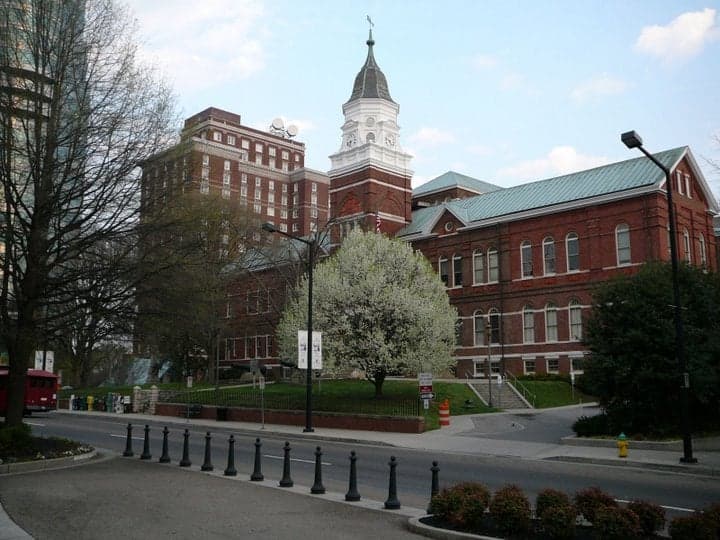
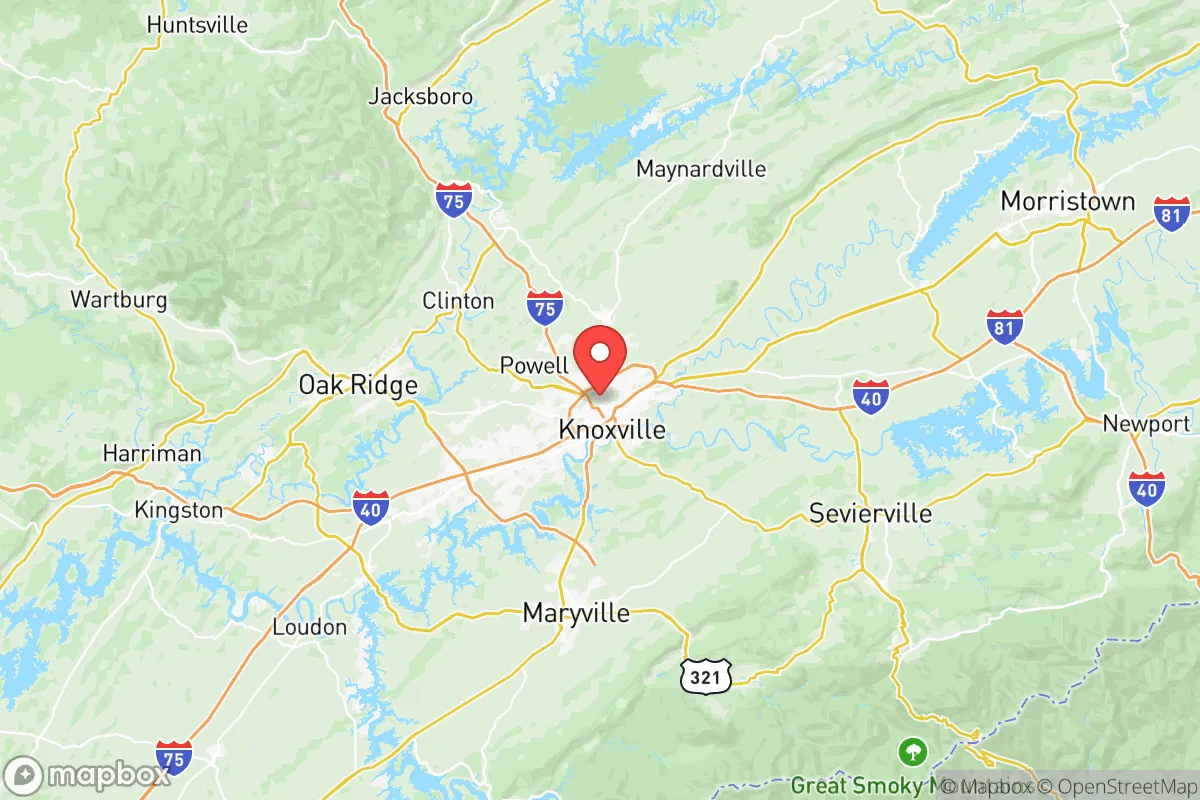
Photo: Wikipedia
Political ClimatePolitical Climate in Knox County
Showing district-level results — no local-only data available.
Local Political AnalysisPolitical Analysis of Knox County
Knox County, Tennessee, is a solidly conservative area with a Cook Partisan Voting Index (PVI) of R+17, making it four points more Republican than the state overall (R+13). That said, this isn’t a monolithic red block. The county’s political heart beats differently depending on where you stand—literally. The city of Knoxville itself, especially downtown and around the University of Tennessee campus, has been trending bluer in recent cycles, while the suburban and exurban towns like Farragut, Hardin Valley, and Powell remain deep red. If you want to find the swing precincts—and there aren’t many—look to the western edge of the county near Karns or the areas around Cedar Bluff, where independent and moderate voters can tilt a close race.
How it compares
Compared to Tennessee as a whole, Knox County is noticeably more Republican than the state average, but the gap isn’t as wide as it may seem. The state’s R+13 PVI gets driven up by the deep-red rural counties in Middle and West Tennessee, like Williamson (R+30) or Lincoln (R+40). In Knox County, the GOP dominance is strong but tempered by the urban core. For example, in the 2022 gubernatorial race, Bill Lee carried Knox County with about 62% of the vote, while he won statewide with 65%. Conversely, in the 2020 presidential election, Donald Trump won Knox County with roughly 58%—a full 2 points below his statewide margin. That urban-rural split matters: Knoxville’s 2nd and 4th City Council districts have consistently elected Democrats, and the county-wide school board races often see competitive contests in the city precincts. In contrast, towns like Farragut and Powell routinely deliver 70%+ GOP margins, pulling the county to the right.
What this means for residents
The practical reality for residents is a predictable political environment that still allows for local nuance. For conservatives, Knox County is comfortable: most local offices are held by Republicans, and policies on taxes, development, and education tend to lean toward limited government and traditional values. Property tax rates remain relatively low for a growing metro area, and the county commission regularly prioritizes business-friendly zoning. For liberals, life here is more about finding your pocket of community. Downtown Knoxville and areas like the Fourth and Gill neighborhood host active Democratic clubs, progressive churches, and a reliable voting bloc that can swing citywide races. The county school board sees genuine debate over curriculum and funding, though conservative majorities hold sway. State-level politics—like Tennessee’s strict abortion ban and permitless carry law—do shape daily life, but locally, residents on both sides tend to focus on practical issues like road improvements, growth management, and school capacity.
Culturally, Knox County stands apart from the rest of Tennessee in a few key ways. The presence of the University of Tennessee brings a steady flow of younger, more liberal-leaning residents, and the ongoing revitalization of downtown Knoxville has created a visible arts and food scene that feels distinct from the state’s more rural character. In contrast, Williamson County is more about affluent suburban conservatism, while East Tennessee’s coal country (e.g., Campbell County) feels more isolated. A policy distinction: Knox County has a locally controlled health department that sets its own rules—something that became a flashpoint during the pandemic—while many rural counties defer more to state authority. Looking forward, if Knoxville’s growth continues attracting remote workers and tech talent, the urban precincts could shift further left, potentially making county-wide races more competitive by the 2030s. For now, though, it’s an area where the old guard and the new wave are still figuring out how to coexist, with the GOP firmly in the driver’s seat.

State Political ClimatePolitical Climate in Tennessee
State Political AnalysisPolitical Environment in the State
Tennessee is a solidly red state with a Cook PVI of R+13, meaning it typically votes about 13 points more Republican than the national average in federal elections. This has been a long-term trajectory: the state last voted for a Democratic presidential candidate in 1996 (Bill Clinton, a Southerner), and over the past three cycles, Republican margins have only widened, from about 15 points in 2016 to over 30 points in 2020 and a comfortable 14-point win in 2024. The dominant coalition is a mix of culturally conservative rural whites, evangelicals concentrated in the Nashville Basin and East Tennessee, and a growing number of suburban conservatives, especially in the fast-growing counties ringing Nashville and Memphis. The Democratic base remains strong in the state's two major urban cores—Memphis and Nashville—as well as a few smaller college towns like Knoxville and Chattanooga, but it is outnumbered statewide.
Urban vs. rural divide
The political map of Tennessee is a textbook study in urban-rural polarization. Memphis (Shelby County) and Nashville (Davidson County) are the state's Democratic anchors, with Shelby consistently delivering 60-65% of its vote to Democratic candidates and Davidson slightly lower but still solidly blue. However, both are losing statewide influence to the sprawling red suburbs around them. Williamson County, directly south of Nashville, is one of the wealthiest and fastest-growing counties in the nation and votes roughly 60% Republican, while Rutherford County (Murfreesboro) is even redder. Meanwhile, the major metro of Knoxville (Knox County) tilts Republican overall (around 55-60%), and the suburbs of Chattanooga (Hamilton County) are competitive but lean Republican. The deep-red rural counties—like Lincoln, Bedford, and Giles in Middle Tennessee, and the northeastern mountain counties like Johnson and Carter—routinely deliver 75-80% Republican margins. If you move to a suburb like Franklin (Williamson County) you'll see Trump signs and a bustling GOP donor network; move to Murfreesboro (Rutherford) and you'll find a mix of college students and young families, with a conservative tilt that is solidifying as the city expands. Outside the I-65 corridor, smaller towns like Cookeville and Crossville feel overwhelmingly red, with local politics dominated by GOP primaries.
Policy environment
Tennessee's policy environment reflects its strong Republican majorities in both chambers of the state legislature (a supermajority in each) and a GOP governor (Bill Lee, first elected 2018, re-elected in 2022). The state has no personal income tax (only a limited tax on interest and dividends, which is being phased out), making it attractive for high-earning relocators. The sales tax is among the nation's highest, at 7% state rate plus local add-ons (often 9.5% in cities), but the lack of income tax is a central draw. On education, the state has enacted a broad school voucher program (the Education Freedom Act of 2025), allowing state funds to follow students to private schools, including religious ones. Public school funding is a perennial issue, with rural districts especially feeling the pinch. On healthcare, Tennessee did not expand Medicaid under the Affordable Care Act, and the state maintains some of the strictest abortion laws in the country, banning the procedure at conception with few exceptions (after the 2022 Dobbs decision and a trigger law took effect). Election laws have been tightened: a strict voter ID requirement is in place, and the state recently eliminated a convenience option for absentee voting that some counties had used. The regulatory environment is broadly business-friendly, with no state-level means-testing for professional licensure, though local zoning in growing suburbs like Hendersonville can still be contentious.
Recent policy direction
Over the last two legislative sessions, Tennessee has moved decisively to the right across multiple fronts. On gun and self-defense law, the state enacted permitless carry in 2021, allowing any adult (18+) who can legally possess a firearm to carry it openly or concealed without a permit. On parental and education rights, the "Don't Say Gay" style bill (SB 793, 2023) restricts classroom instruction on sexual orientation and gender identity through 8th grade, and a 2022 law allows parents to review school curriculum and challenge materials they find "age-inappropriate." On speech, the state passed a law in 2022 requiring social media companies to disclose content moderation policies, and there has been significant legal debate over the state's attempt to enforce a ban on "divisive concepts" in public universities (partially blocked by courts as of 2025). On privacy and surveillance, Tennessee has no broad data privacy law, but the 2023 Tennessee Information Protection Act requires companies to disclose the sale of personal data to consumers. On medical and bodily autonomy, the state has passed near-total abortion bans, and a 2024 law prohibits gender-affirming care for minors (banned puberty blockers, hormones, and surgery). On property rights, the state has limited local rent control and restricts local governments from regulating short-term rentals like Airbnb in many cases. On taxation, the Hall tax on investment income was fully repealed in 2021, and the state continues to resist any income tax on wages. On voting/ballot access, in 2023 the legislature passed a law banning the use of "slate mailers" (incentivized absentee ballot request programs) and shortening the window for absentee ballot return. These laws collectively point toward a state with low personal taxes, permissive gun laws, conservative social policy, and a legislature that is actively preempting local progressive ordinances. A new resident in Brentwood or Green Hills (Nashville's wealthy enclaves) would mostly encounter these policies through absent income tax and conservative social norms; in Memphis or Nashville proper, the state preemption on local policy (e.g., no local minimum wage hikes, no rent control) is a source of friction.
Civil unrest & political movements
Tennessee has not seen the large-scale civil unrest of some contiguous states, but it has its share of organized political movements. In 2020, Nashville saw several days of protests following the killing of George Floyd, primarily downtown and at the Tennessee State Capitol, with some property damage and arrests. The state responded with a 2021 law that enhanced penalties for blocking traffic during protests and created a new crime of "aggravated rioting." On the right, gun rights activists have been visible at the Capitol, especially after the 2023 Covenant School shooting in Nashville, when thousands of pro-gun advocates rallied to oppose any new firearms restrictions. Immigration politics are less salient here than in Texas or Arizona, though the legislature passed a 2024 law requiring local law enforcement to cooperate with federal immigration authorities (a "sanctuary city" ban, targeting Nashville and Memphis, both of which have "Welcoming City" policies). Local sheriffs in urban counties have largely complied. Secession or nullification rhetoric is fringe; the Tennessee legislature in 2021 passed a resolution opposing federal gun control, but it was symbolic. Election integrity controversies have been minimal compared to large swing states; the state's K-12 schools teach civics with a focus on the U.S. Constitution, and there is a small but vocal movement for "school choice" and "parental rights" that has shaped legislation. A new resident in Clarksville (home to Fort Campbell) would notice strong military-civilian support and a pro-veteran political culture, while in Chattanooga the left-leaning activist scene around UTC and the alternative arts district is small but vocal.
Projection
Over the next 5-10 years, Tennessee's political trajectory looks to remain solidly red, but with urban and suburban nuances. The state's population is growing by about 1% annually, driven by domestic migration from blue states (California, Illinois, New York) into the Nashville, Knoxville, and Chattanooga metros. These newcomers tend to be more moderate than native Tennesseans, but many are moving precisely for low taxes and limited regulation, so they often align with the Republican coalition on economic issues. However, in fast-growing suburbs like Spring Hill (Maury/Williamson county line) and Nolensville (Williamson County), the influx of culturally moderate professionals could gradually shift local GOP primaries toward less overtly socially conservative candidates. The Democratic base is likely to remain concentrated in Memphis and Nashville, with Nashville's growth (it is one of the fastest-growing big cities in the South) potentially adding a few more down-ballot Democratic seats in the state house over time, but not enough to overcome the supermajority. The most significant near-term flashpoint will be education: the voucher program expansion may trigger a backlash among rural Republicans who prize their public schools, potentially leading to some primary challenges. Expect continued preemption battles between Nashville/Memphis and the state over local control of policing budgets, minimum wage, and zoning. For a relocator, the takeaway is that Tennessee will remain a low-tax, limited-government, culturally conservative state for the foreseeable future, with its major cities offering pockets of liberal life for those who want it, but with no serious threat to GOP dominance statewide.
For a new resident, the bottom line is straightforward: Tennessee delivers what its political reputation promises. You'll pay no state income tax, enjoy broad gun rights, and live under a government that is consistently pushing a conservative social and economic agenda. If you're a conservative, you'll feel the state is aligned with your values, especially in suburbs like Franklin or Murfreesboro. If you're a liberal, you'll find safe havens in Nashville and Memphis, but you'll face a state government that sometimes overrides local policies you might support. Either way, the state's political stability—with a clear majority and slow demographic change—means few surprises. Just know that the culture wars over education and LGBTQ+ rights are active here, and local school boards and county commissions are where most of the real action happens. Move in ready for a state that has picked its path and is sticking with it.
* Values derived from national, state, county, city and local statistics and may differ in a specific area. Last updated: 2026-06-29T22:44:32.000Z
Narrative content on this page is AI-generated and may contain mistakes. Verify any details that matter before acting on them.
ReloMaps may earn a commission from affiliate links at no extra cost to you.

