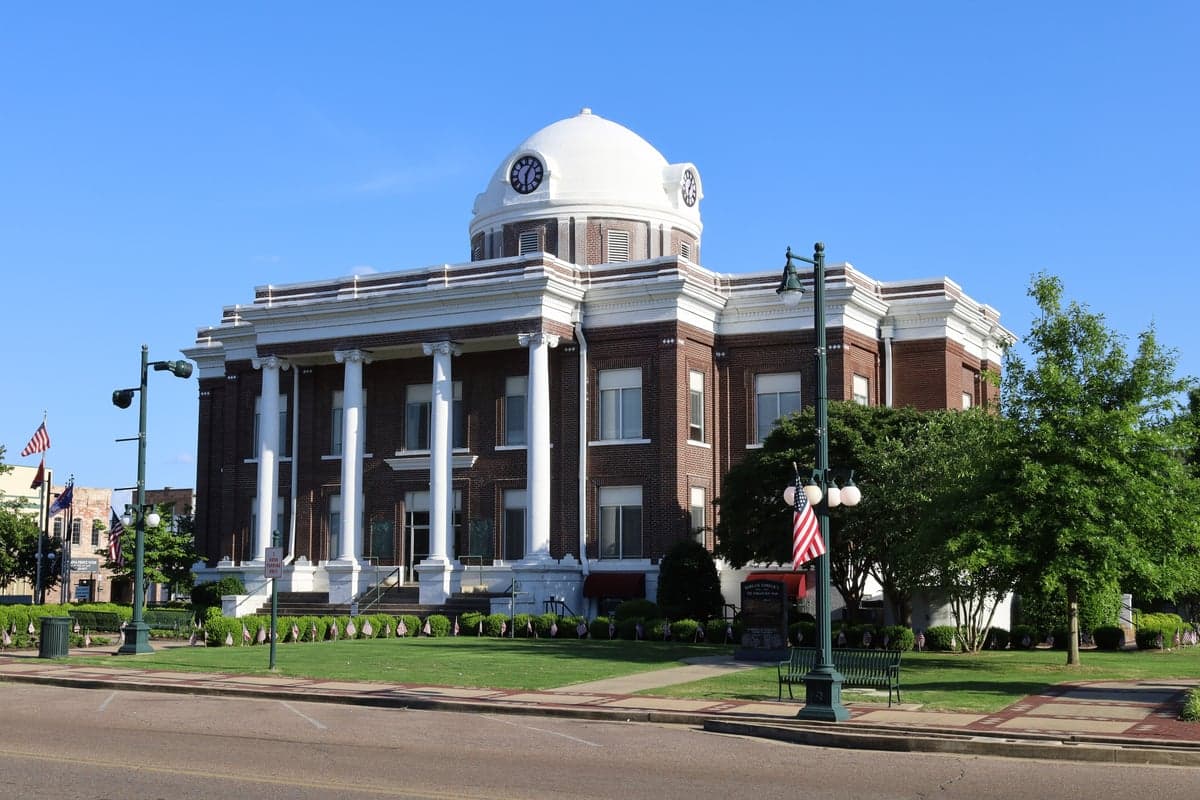
Photo: Wikipedia
Political ClimatePolitical Climate in Dyer County
Showing district-level results — no local-only data available.
Local Political AnalysisPolitical Analysis of Dyer County
Dyer County, Tennessee, is a reliably Republican stronghold with a Cook PVI of R+21, making it significantly more conservative than the state of Tennessee as a whole, which sits at R+13. This isn't a recent shift; the county has voted for the GOP presidential candidate by wide margins for decades, and the trend has only solidified since 2016. The real story isn't whether Dyer County is red—it's how deep that red runs and where the few pockets of blue can be found.
How it compares
The eight-point gap between Dyer County's R+21 and Tennessee's R+13 is substantial. To put it in perspective, while Tennessee is already a solidly red state, Dyer County votes about as conservatively as the most Republican counties in neighboring Mississippi or Alabama. This means local elections are often decided in the Republican primary, not the general election. The county's rural and agricultural character, combined with a strong manufacturing base in the county seat of Dyersburg, reinforces a culture of self-reliance and traditional values. However, there is nuance. Dyersburg itself, as the population center, is the only place where you'll find any meaningful Democratic vote—typically around 30-35% in presidential races, concentrated in the older, more diverse neighborhoods near downtown and around the Dyersburg State Community College area. In contrast, the smaller towns like Newbern, Tiptonville, and Trimble are even more conservative, often pushing the countywide margin past 70% for the GOP. The swing precincts, if you can call them that, are the suburbanizing fringes of Dyersburg, where new subdivisions are drawing in families from more moderate areas of West Tennessee, but even those precincts lean heavily Republican.
What this means for residents
For conservative residents, Dyer County offers a political environment where their views are the clear majority. Local government, from the county commission to the school board, is dominated by Republicans who prioritize low taxes, limited regulation, and a traditional social agenda. You'll find strong support for the Second Amendment and a general skepticism of federal overreach. For liberal residents, the reality is more challenging. While they are not actively suppressed, they are a distinct minority. Political discussions in casual settings—at a coffee shop on Lake Road in Dyersburg or at a high school football game—tend to assume a conservative consensus. Progressive candidates rarely run for local office, and when they do, they face an uphill battle for funding and visibility. The practical effect is that liberal residents often focus their political energy on state or national issues, or they find community in non-political civic groups. The county's trajectory suggests this dynamic will persist; in-migration is mostly from other conservative areas, and the region's economic reliance on agriculture and industry reinforces the status quo.
Culturally, Dyer County's politics are woven into everyday life. The county's strong religious presence, particularly in the many Baptist and Methodist churches, directly influences policy debates, especially around school curriculum and public events. There is a palpable pride in the area's "small-town" identity, which translates into a preference for local control over state mandates. One notable distinction from the broader state is the county's deep connection to the Mississippi River economy—farming, barge traffic, and related industries—which makes issues like water rights and federal infrastructure funding more salient here than in, say, the Nashville suburbs. For anyone moving to Dyer County, the political climate is less about partisan battles and more about a shared, if conservative, sense of community. It's a place where your vote is unlikely to change the outcome, but your willingness to help a neighbor during a flood or a harvest will define your place in the town.

State Political ClimatePolitical Climate in Tennessee
State Political AnalysisPolitical Environment in the State
Tennessee is a solidly Republican state with a Cook PVI of R+13, meaning it votes about 13 points more Republican than the national average in presidential elections. The state has shifted rightward over the past 20 years, driven by a combination of rural realignment, suburban growth in conservative-leaning exurbs, and a steady influx of migrants from bluer states. While Democrats once held competitive statewide races as recently as the 2000s, the GOP now controls every statewide office, both chambers of the legislature, and both U.S. Senate seats, with no serious Democratic statewide challenge on the horizon.
Urban vs. rural divide
The political map breaks down along classic lines: the state’s four major metros — Nashville (Davidson County), Memphis (Shelby County), Knoxville (Knox County), and Chattanooga (Hamilton County) — are the Democratic strongholds, but only Nashville and Memphis are reliably blue. Davidson County voted for Joe Biden by 35 points in 2020, while Shelby County went for Biden by 32 points. Knox County and Hamilton County, by contrast, are light red: Knox County voted for Donald Trump by 20 points, and Hamilton County by 12 points. The real GOP firepower comes from the sprawling exurbs and rural areas. Williamson County, south of Nashville, is one of the wealthiest and fastest-growing counties in the country and voted for Trump by 22 points. Rutherford County (Murfreesboro) and Wilson County (Lebanon) are also deep red, each giving Trump margins of 30+ points. The rural counties of Middle and West Tennessee — like Hardeman, McNairy, and Wayne — routinely vote 70-80% Republican. East Tennessee, anchored by Knoxville, is the most consistently conservative region in the state, with counties like Sevier, Blount, and Washington delivering 75%+ GOP margins. The only notable Democratic holdout outside the major cities is Shelby County, which includes Memphis and its inner suburbs, but even there, the surrounding suburban and rural areas are heavily Republican.
Policy environment
Tennessee’s policy environment is defined by low taxes, limited regulation, and a strong conservative social agenda. The state has no personal income tax — only a 6.5% flat corporate income tax and a 7% sales tax on most goods (with food taxed at 4%). Property taxes are among the lowest in the nation, with an effective rate around 0.71% of home value. The regulatory posture is business-friendly: Tennessee is a right-to-work state, has no state-level minimum wage above the federal $7.25, and offers generous economic development incentives. Education policy is dominated by school choice: the state has a robust charter school law, a voucher program for students in low-performing districts (the Education Savings Account program, expanded in 2023), and a growing number of public charter schools, especially in Memphis and Nashville. Healthcare is a mixed bag: Tennessee did not expand Medicaid under the Affordable Care Act, leaving roughly 300,000 residents in the coverage gap, but the state has a relatively competitive private insurance market. Election laws are moderately restrictive: voters must show a photo ID, absentee voting requires an excuse, and early voting is available for two weeks. The state has no automatic voter registration and purges inactive voters regularly. Gun laws are among the most permissive in the country: permitless carry for adults 21 and older was enacted in 2021, and the state has no red-flag law, no waiting period, and no universal background check requirement for private sales.
Recent policy direction
The last five years have seen a sharp conservative shift across multiple fronts. On guns, the 2021 permitless carry law (SB 765) eliminated the requirement for a handgun permit, though a permit is still available for reciprocity with other states. In 2023, the legislature passed a law allowing teachers to carry firearms on school grounds with school district approval. On education, the 2023 “Parental Bill of Rights” (SB 1456) requires schools to notify parents of any changes to a student’s health or well-being, including mental health services, and prohibits instruction on sexual orientation or gender identity in grades K-3. The state also banned transgender athletes from participating in girls’ sports (2021) and restricted gender-affirming care for minors (2023). On speech and privacy, Tennessee passed a law in 2023 requiring age verification for adult websites and another law restricting drag performances in public spaces (later blocked by a federal judge). On property rights, the state has strong eminent domain protections and no statewide rent control. On taxes, the legislature has cut the corporate income tax rate from 6.5% to 6.5% (no change) but has reduced the sales tax on food from 4% to 4% (no change) — the real tax relief has come from property tax freezes for seniors and a gradual phase-out of the state’s inheritance tax (already eliminated). On voting, the state passed a law in 2021 requiring absentee ballot applications to include a driver’s license number or the last four digits of a Social Security number, and it banned the use of private funding for election administration (the “Zuckerbucks” ban). The overall direction is toward more individual liberty on guns and property, more parental control in education, and more restrictions on transgender rights and public expression.
Civil unrest & political movements
Tennessee has seen its share of political flashpoints. In 2023, the expulsion of two Democratic state representatives — Justin Jones and Justin Pearson — from the House for leading a gun control protest on the floor after the Covenant School shooting in Nashville sparked national attention and large protests at the state capitol. Both were quickly reappointed by their local county commissions. The state has a small but active anti-abortion movement that celebrated the 2022 trigger law banning abortion at conception, with no exceptions for rape or incest. On the left, groups like the Tennessee Immigrant and Refugee Rights Coalition (TIRRC) organize around immigrant rights, though the state has no sanctuary cities and local law enforcement cooperates with federal immigration authorities. On the right, the Tennessee Firearms Association and the Tennessee Eagle Forum are influential. Election integrity controversies have been minimal compared to other states, though the 2020 election saw some local Republican activists question the results in Shelby County. There is no serious secession or nullification movement, though some rural counties have passed symbolic “Second Amendment sanctuary” resolutions. The most visible flashpoint for a new resident would likely be the ongoing debate over gun laws, especially in Nashville and Memphis, where city leaders have pushed for local gun control measures that are preempted by state law.
Projection
Over the next 5-10 years, Tennessee is likely to remain solidly Republican, but the margins may narrow slightly as Nashville and its inner suburbs continue to grow and diversify. The state’s population is projected to increase by about 10% by 2030, with most growth in the Nashville and Knoxville metros. In-migration from blue states like California, Illinois, and New York tends to be moderately conservative or libertarian-leaning, not hard-left, so the overall partisan balance may shift only a point or two. The legislature will likely continue to push conservative social policies, especially on education and transgender rights, but may face more federal court challenges. The biggest wild card is the state’s growing urban population: if Nashville and Memphis continue to attract young, diverse, and college-educated residents, they could become more politically influential, but they are unlikely to flip the state legislature or statewide offices. A new resident moving in now should expect a state that is deeply conservative in its rural and exurban areas, moderately conservative in its suburbs, and increasingly liberal in its urban cores — with the state government firmly in GOP hands for the foreseeable future.
For a new resident, the bottom line is straightforward: if you lean conservative, you’ll find a state that aligns with your values on taxes, guns, education, and social issues. If you lean liberal, you’ll find vibrant urban communities in Nashville, Memphis, and parts of Knoxville and Chattanooga, but you’ll face a state government that is actively hostile to many of your policy preferences. Either way, the cost of living is low, the economy is strong, and the political climate is stable — just don’t expect the state to change direction anytime soon.
* Values derived from national, state, county, city and local statistics and may differ in a specific area. Last updated: 2026-06-27T07:34:05.000Z
Narrative content on this page is AI-generated and may contain mistakes. Verify any details that matter before acting on them.
ReloMaps may earn a commission from affiliate links at no extra cost to you.

