Photo: Wikipedia
Demographics of Dyer County
Affluence Level in Dyer County
A below-average socioeconomic profile. Incomes, home values, and educational attainment trail the U.S., with higher poverty and unemployment.
People of Dyer County
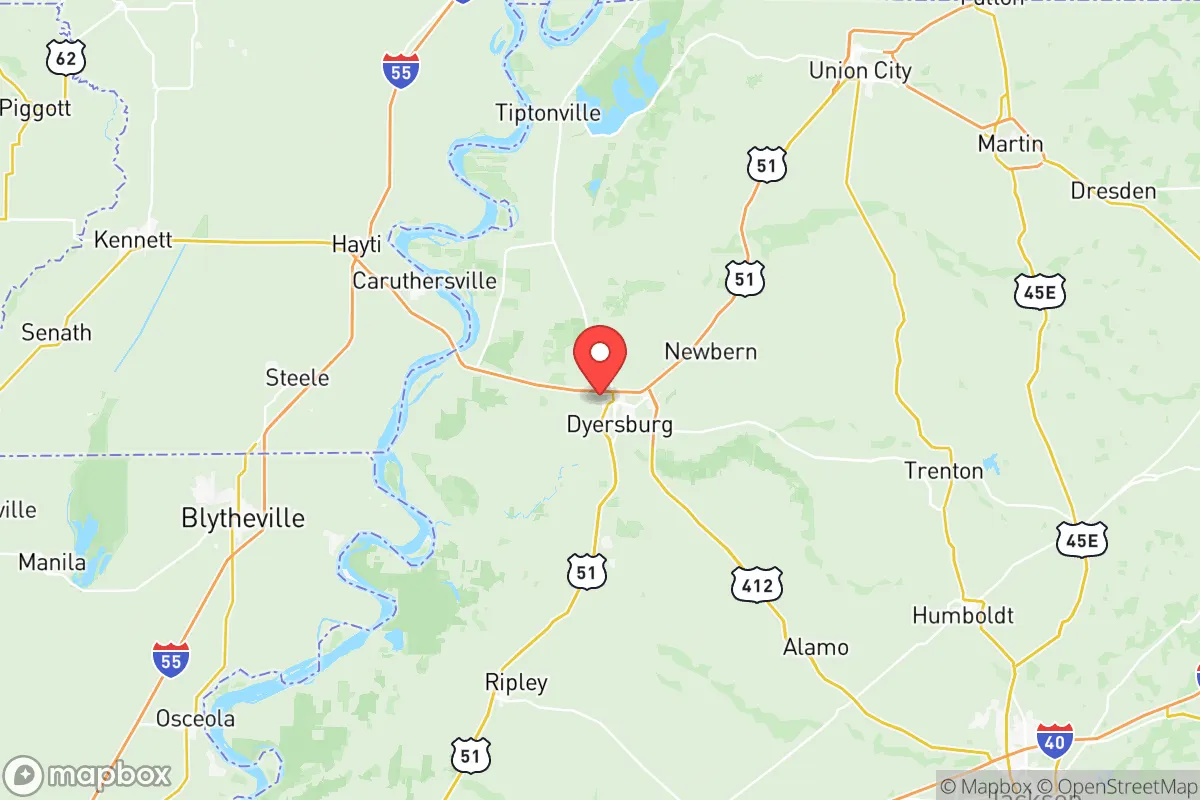
Today, Dyer County, Tennessee, is home to 36,681 residents, a predominantly rural and small-town population concentrated in the county seat of Dyersburg and the smaller communities of Newbern, Trimble, and Lenox. The county’s character is shaped by its deep Southern roots, with a population that is 77.4% White, 14.9% Black, and 3.8% Hispanic, and a notably low foreign-born share of just 1.0%. Distinctive markers include a strong agricultural heritage—cotton and soybean farming remain economic pillars—and a cultural identity tied to the Mississippi River Delta region, with a slower pace of life and a high proportion of native-born residents.
Settlement & growth (pre-1960)
Before European settlement, the area that is now Dyer County was part of the hunting grounds of the Chickasaw Nation, who controlled much of West Tennessee. The Chickasaw were forcibly removed through a series of treaties in the early 19th century, most notably the 1818 Jackson Purchase, which opened the region to American settlers. Spanish and French explorers had passed through the area along the Mississippi River, but no permanent European colonies were established here.
The first major wave of American settlers arrived in the 1820s and 1830s, primarily Scots-Irish and English farmers moving west from the Piedmont and Appalachian regions of Virginia, North Carolina, and Kentucky. They were drawn by the promise of fertile, flat land ideal for cotton cultivation. Dyer County was formally established in 1823, and the town of Dyersburg was laid out in 1825 as the county seat. These early settlers established a plantation-based economy reliant on enslaved African American labor. By 1860, enslaved people made up roughly one-third of the county’s population, a legacy that continues to shape the Black community’s presence in Dyersburg and the surrounding rural areas today.
After the Civil War and Reconstruction, the county’s Black population remained concentrated in Dyersburg and in agricultural hamlets like Lenox and Bogota, where sharecropping and tenant farming replaced the plantation system. The late 19th and early 20th centuries saw a modest influx of German and Irish immigrants, who worked as laborers on the railroads and in the timber industry, but these groups never formed large ethnic enclaves. The county’s population grew steadily through the early 1900s, peaking at around 37,000 in 1940, as cotton remained king and the Mississippi River provided a transportation artery for goods.
World War II and the post-war era brought mechanization to agriculture, reducing the need for farm labor and triggering a slow out-migration of both Black and White residents to industrial cities in the North and Midwest. The construction of Interstate 155 in the 1960s improved access to Dyersburg, but the county did not experience the rapid suburbanization seen in other parts of Tennessee. By 1960, the population had slipped to about 33,000, and the county’s demographic profile remained overwhelmingly White and native-born, with a significant but declining Black minority.
Modern era (post-1965)
The 1965 Hart-Cellar Act had minimal direct impact on Dyer County. The foreign-born population today stands at just 1.0%, far below the national average, and the county has not seen the large-scale immigration from Latin America, Asia, or the Indian subcontinent that has reshaped many other parts of the United States. The Hispanic population, at 3.8%, is the largest immigrant-origin group, and its growth has been gradual rather than explosive. Most Hispanic residents are concentrated in Dyersburg, where they work in agriculture, food processing, and construction. There is no distinct ethnic enclave, but a small but visible Hispanic community has formed around the city’s Catholic church and local service industries.
Domestic migration has been the more significant driver of demographic change since 1965. The county has attracted a modest number of retirees and working-age families from the Rust Belt—particularly Illinois, Indiana, and Ohio—drawn by lower housing costs, a lower cost of living, and a slower pace of life. These newcomers are overwhelmingly White and tend to settle in Dyersburg or in newer subdivisions on the outskirts of Newbern. The Black population, which was 18.5% in 2000, has declined slightly to 14.9% as younger Black residents have moved to larger cities like Memphis and Nashville for better job opportunities. The Asian population (East and Southeast Asian) is negligible at 0.4%, and the Indian-subcontinent population is effectively zero.
Suburbanization has been limited. Dyersburg remains the commercial and social hub, with smaller towns like Trimble (population ~600) and Lenox (unincorporated) retaining their rural character. The county has not experienced the sprawling exurban development seen in counties closer to Memphis or Nashville. The college-educated share of the population is 21.6%, below the national average, reflecting the county’s reliance on manufacturing, agriculture, and service-sector jobs rather than knowledge-economy employment.
The future
Dyer County’s population is projected to remain relatively stable, with modest growth driven by domestic in-migration from higher-cost regions. The county is becoming slightly more diverse, but slowly. The Hispanic share is expected to continue its gradual increase, potentially reaching 5-6% by 2035, as families settle in Dyersburg and find work in agriculture and light manufacturing. The Black population share is likely to hold steady or decline slightly, as out-migration to urban centers continues. The White population will remain the overwhelming majority, though its share may edge down as the Hispanic cohort grows.
New communities are not forming distinct ethnic enclaves; instead, Hispanic residents are dispersing across Dyersburg and, to a lesser extent, Newbern. The county’s cultural identity—rooted in Southern Baptist traditions, hunting and fishing, and a strong sense of local community—is likely to persist, though it may become slightly more varied as Hispanic cultural elements (food, music, religious practices) become more visible. The biggest demographic wildcard is whether the county can attract more college-educated workers and families. Without a major employer or a shift toward remote-work-friendly infrastructure, the population will likely remain older, less educated, and more homogeneous than the national average.
For someone moving in now, Dyer County offers a stable, affordable, and culturally traditional environment. It is not a place of rapid change or high diversity, but it is a place where community ties remain strong, and where the pace of life is dictated by the seasons and the land rather than by the rhythms of a booming metropolis.

* Values derived from national, state, county, city and local statistics and may differ in a specific area. Last updated: 2026-06-27T07:34:05.000Z
Narrative content on this page is AI-generated and may contain mistakes. Verify any details that matter before acting on them.
ReloMaps may earn a commission from affiliate links at no extra cost to you.

