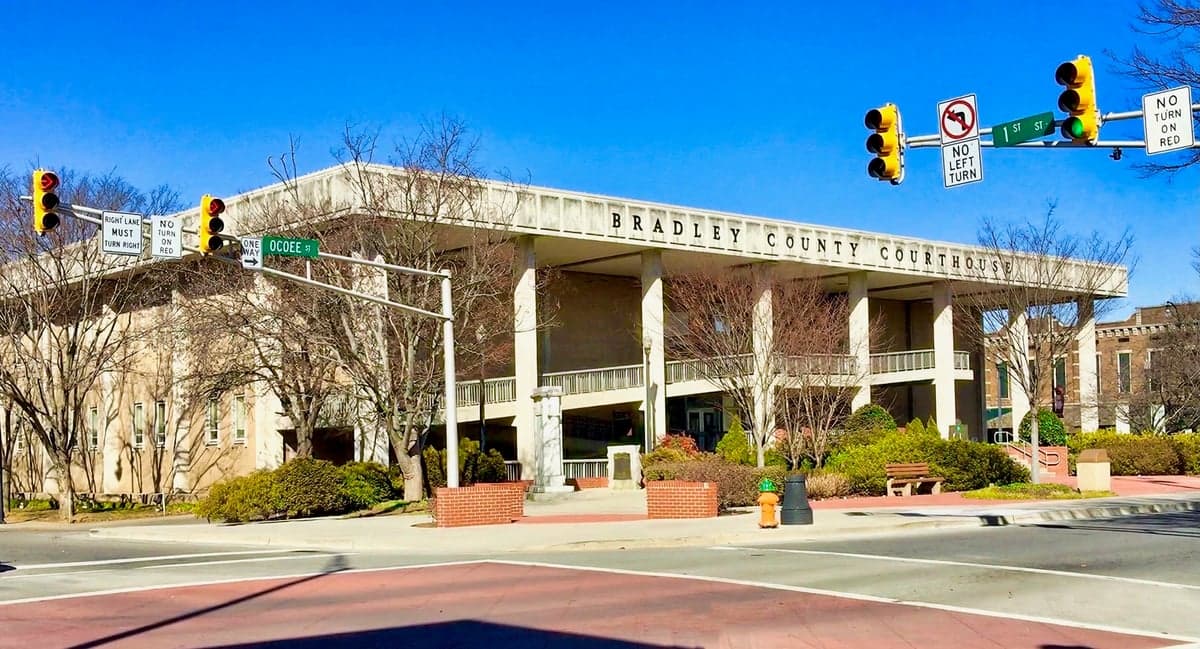
Photo: Wikipedia
Political ClimatePolitical Climate in Bradley County
Showing district-level results — no local-only data available.
Local Political AnalysisPolitical Analysis of Bradley County
Bradley County, Tennessee, is a reliably conservative area that has only grown more Republican over the past decade, anchored by the city of Cleveland and its surrounding rural communities. The county’s Cook Partisan Voting Index (PVI) of R+18 puts it five points to the right of Tennessee’s statewide PVI of R+13, and that gap has widened in recent cycles—Donald Trump carried the county by 38 points in 2020, up from 36 points in 2016. The shift is most visible in the fast-growing suburban fringe around Cleveland, where new subdivisions are drawing families from bluer states who tend to align with the local GOP majority, rather than bringing liberal leanings with them.
How it compares
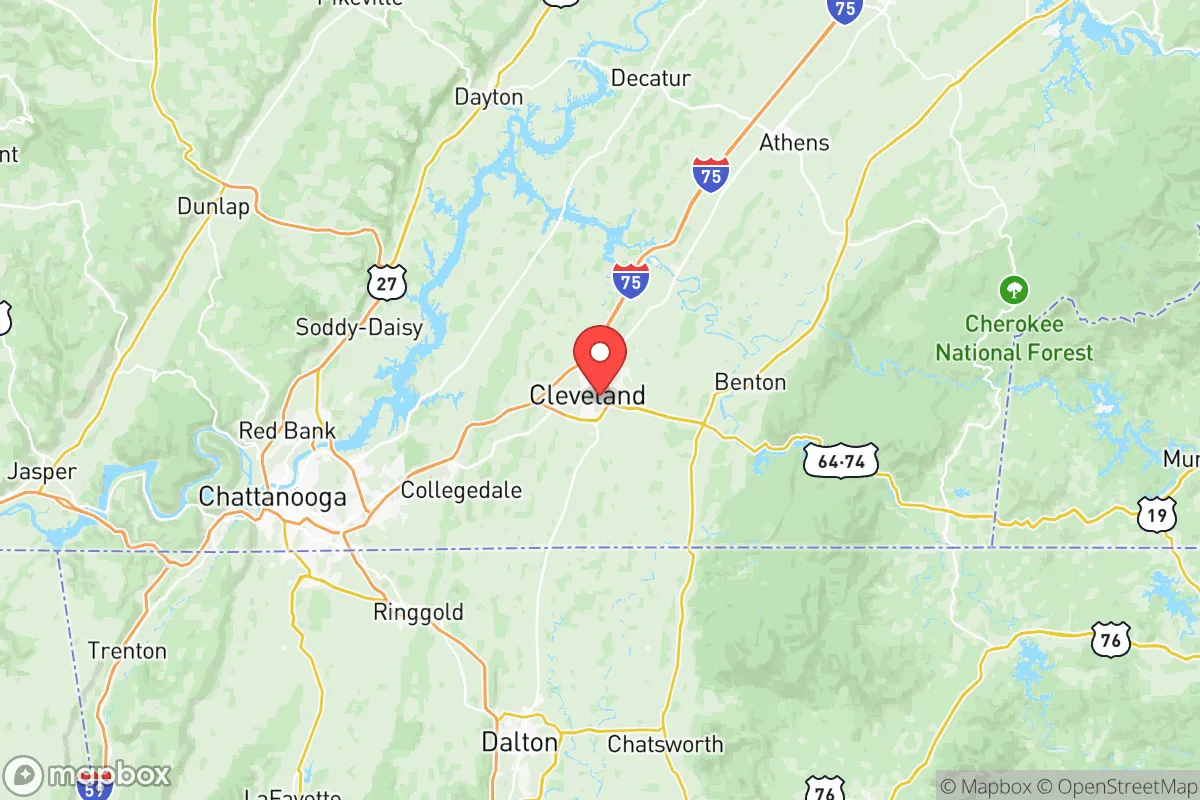
Bradley County’s R+18 rating makes it significantly more conservative than Tennessee as a whole, and it stands out even within the conservative southeastern corner of the state. For context, neighboring Hamilton County (Chattanooga) sits at R+14, while McMinn County to the north is R+22—so Bradley falls in the middle of the regional pack. The real variation is inside the county itself. Cleveland’s urban core, particularly around Lee University and the downtown historic district, has a handful of precincts that vote closer to 50-50 or even lean slightly Democratic in local races, driven by younger voters and university faculty. Meanwhile, the towns of Charleston, Benton Station, and the rural areas east of the Ocoee River are deep red, often delivering 70-80% Republican margins. The swing precincts are in the newer subdivisions along the APD-40 corridor west of Cleveland, where transplants from other states are settling—these areas still vote Republican, but by narrower margins than the rest of the county, and they’re the ones to watch if the political balance ever shifts.
What this means for residents
For conservative residents, Bradley County offers a political environment where their values are the default—local school board meetings, county commission decisions, and law enforcement priorities all reflect a conservative majority. Republican candidates rarely face serious primary challenges, and general elections are effectively decided in the spring. For liberal or moderate residents, the reality is more nuanced: you won’t find many openly progressive elected officials, but you also won’t face the kind of social pressure you might in a smaller, more insular rural county. Cleveland’s growing diversity—driven by Lee University’s international student body and a rising Hispanic population in the manufacturing workforce—has created pockets where different viewpoints are tolerated, even if they’re not politically dominant. The practical effect is that most residents, regardless of party, focus on local issues like school funding, road improvements, and industrial recruitment rather than national culture wars.
The cultural and policy distinctions in Bradley County are subtle but real. The county has a notably strong tradition of civic volunteerism and church-based community support that transcends politics—food banks, youth sports leagues, and disaster relief efforts are organized through congregations and nonprofits rather than government programs. On policy, the county commission has consistently opposed Medicaid expansion and voted to keep the property tax rate among the lowest in the region, even as Cleveland’s population has grown by 12% since 2020. Looking ahead, the political trajectory seems locked in for the near term: the county will remain R+18 or redder, with the only real question being whether the suburban swing precincts eventually moderate the margins or continue to align with the rural majority.

State Political ClimatePolitical Climate in Tennessee
State Political AnalysisPolitical Environment in the State
Tennessee is a solidly Republican state with a Cook PVI of R+13, meaning it votes about 13 points more Republican than the national average in presidential elections. The state has shifted sharply rightward over the past 20 years, driven by the realignment of rural and exurban voters, the collapse of Democratic strength in the western and central regions, and the cultural conservatism of the fast-growing Nashville and Knoxville suburbs. While Democrats still hold a few urban strongholds and have made gains in some college towns, the overall trajectory has been a steady march toward deep-red status since the early 2000s.
Urban vs. rural divide
The political map of Tennessee is a study in contrasts. The three major metro areas — Nashville, Memphis, and Knoxville — each have distinct political characters. Nashville (Davidson County) is the most reliably Democratic major city in the state, consistently voting 60-65% for Democratic presidential candidates, though its suburbs like Franklin and Brentwood in Williamson County are among the most Republican-leaning affluent suburbs in the country. Memphis (Shelby County) is a Democratic stronghold driven by a large African American population, but the surrounding West Tennessee counties are deeply red. Knoxville (Knox County) has trended rightward over the past decade, with the city itself becoming more competitive for Democrats while the surrounding rural counties remain overwhelmingly Republican. The rural areas — from the Mississippi Delta counties in the west to the Appalachian counties in the east — vote Republican by margins of 70-80% or more. The only notable exceptions are a handful of historically Democratic rural counties in the Upper Cumberland region that have flipped red in the last two cycles. Chattanooga (Hamilton County) has become a political battleground, with the city trending blue while the county as a whole remains Republican-leaning.
Policy environment
Tennessee's policy environment is defined by low taxes, limited government, and cultural conservatism. The state has no personal income tax on wages, relying instead on a 7% sales tax (the highest in the nation) and a 6.5% corporate income tax. Property taxes are relatively low, with a statewide average effective rate of about 0.67%. The regulatory posture is business-friendly, with a right-to-work law and no state-level minimum wage above the federal $7.25. Education policy has been a flashpoint: the state has a robust school voucher program (the Education Savings Account pilot, expanded in 2023) and has banned critical race theory and divisive concepts in public schools. Healthcare policy is marked by the state's refusal to expand Medicaid under the Affordable Care Act, leaving roughly 300,000 Tennesseans in the coverage gap. Election laws have tightened: the state requires photo ID to vote, has restricted early voting hours, and in 2023 passed a law making it a felony for election officials to send unsolicited absentee ballot applications. Gun laws are among the most permissive in the country, with permitless carry for adults 21 and older (effective 2021) and no red flag law.
Recent policy direction
The last five years have seen Tennessee accelerate its conservative policy agenda. In 2021, the legislature passed a permitless carry law, allowing any law-abiding adult 21 or older to carry a handgun without a permit. In 2023, the state enacted a near-total abortion ban with no exceptions for rape or incest, only for medical emergencies. On education, the state passed a Parents' Bill of Rights in 2022, requiring schools to notify parents of any medical or mental health services offered to students and banning instruction on sexual orientation and gender identity in elementary grades. On speech and privacy, Tennessee has banned TikTok on state-owned devices and passed a law requiring age verification for adult websites. Property rights have been strengthened with a 2023 law limiting the ability of local governments to regulate short-term rentals. On voting, the state has moved to restrict ballot drop boxes and limit third-party ballot collection. The overall direction is toward expanding gun rights, restricting abortion access, increasing parental control over education, and limiting local government autonomy on issues like housing and environmental regulation.
Civil unrest & political movements
Tennessee has seen its share of political activism, though large-scale civil unrest has been relatively rare compared to states like Oregon or Minnesota. The most visible flashpoint in recent years was the 2023 Nashville Covenant School shooting, which sparked a wave of student-led protests at the state capitol demanding gun control measures. The protests led to the expulsion of two Democratic state representatives (Justin Jones and Justin Pearson) for violating House rules during a protest on the floor, a move that drew national attention and resulted in their swift reinstatement by local county commissions. The episode highlighted the deep divide between the Republican supermajority in the legislature and the more liberal city of Nashville. Immigration politics have been relatively quiet, though the state has passed laws requiring local law enforcement to cooperate with federal immigration authorities and banning sanctuary city policies. There has been no serious secession or nullification movement, though some rural counties have passed symbolic resolutions asserting local control over federal land management. Election integrity has been a recurring theme, with the legislature creating a special election integrity unit in 2022 and passing laws to purge voter rolls more aggressively. A new resident would notice the presence of both pro-life and pro-choice activists at the capitol, as well as occasional protests from teachers' unions and gun rights groups.
Projection
Over the next 5-10 years, Tennessee is likely to remain solidly Republican, but the nature of that conservatism may shift. The state is experiencing rapid in-migration, particularly to the Nashville and Knoxville metro areas, with many newcomers coming from blue states like California, New York, and Illinois. These new residents tend to be more moderate on cultural issues but still fiscally conservative, which could push the state's politics toward a more suburban, Chamber of Commerce-style Republicanism. The rural-urban divide will likely deepen, with Nashville and Memphis becoming more Democratic while the suburbs and exurbs remain Republican. The state's growing Hispanic population, concentrated in Nashville and Memphis, could begin to shift the political calculus in a decade or two, but for now, it remains a small share of the electorate. The biggest wild card is the state's abortion ban, which could become a political liability if it drives away moderate voters or if medical complications from the ban generate negative headlines. Expect continued fights over school vouchers, Medicaid expansion, and local control, with the Republican supermajority likely to maintain its grip but face increasing internal tension between rural populists and suburban moderates.
For a new resident, the bottom line is straightforward: Tennessee is a deeply conservative state where Republican policies dominate at every level of government. If you're a conservative, you'll find a welcoming environment with low taxes, permissive gun laws, and a government that shares your values. If you're a liberal, you'll find a state where your vote in statewide elections won't matter much, but where you can still find like-minded communities in Nashville, Memphis, and parts of Knoxville and Chattanooga. The practical takeaway is that Tennessee offers a stable, predictable political environment for those who align with its conservative direction, but it's not a place where political change is likely to come from the ballot box anytime soon.
* Values derived from national, state, county, city and local statistics and may differ in a specific area. Last updated: 2026-07-12T03:48:59.000Z
Narrative content on this page is AI-generated and may contain mistakes. Verify any details that matter before acting on them.
ReloMaps may earn a commission from affiliate links at no extra cost to you.

