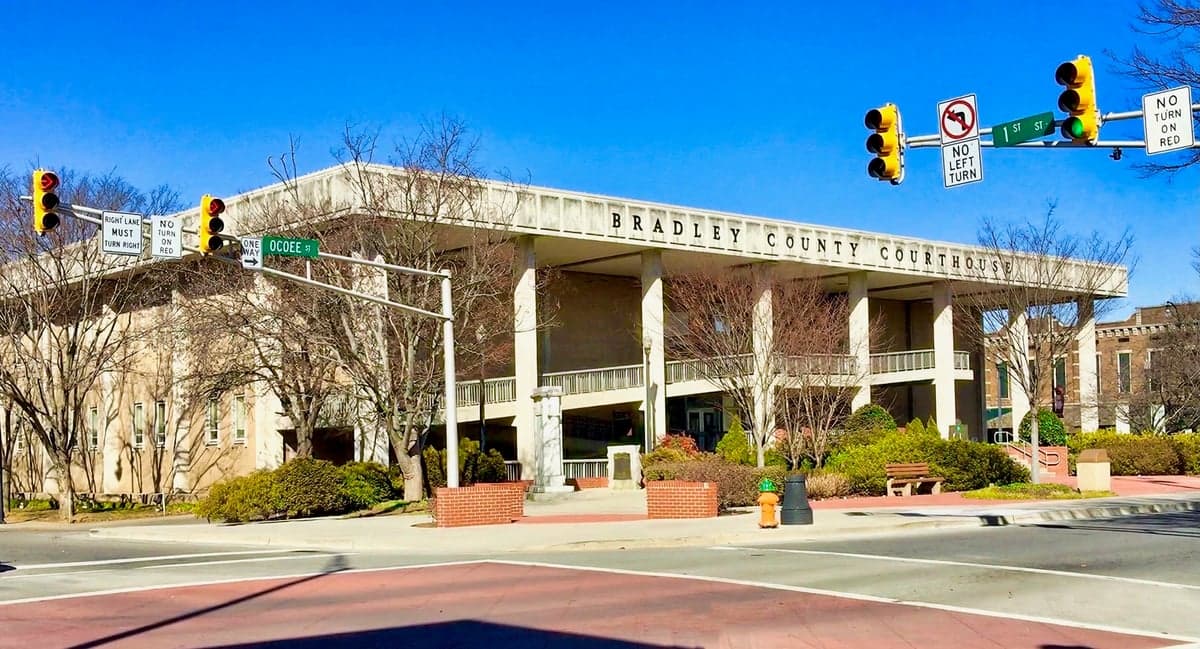
Photo: Wikipedia
Demographics of Bradley County
Affluence Level in Bradley County
A middle-class area roughly in line with national averages across income, home values, education, and employment.
People of Bradley County
Bradley County, Tennessee, is home to roughly 109,743 residents, a population that remains predominantly white (82.4%) with a growing Hispanic community (8.0%) and smaller Black (4.6%) and Asian (0.5%) populations. The county’s character is rooted in its Appalachian and Southern heritage, shaped by decades of manufacturing and a steady influx of domestic migrants from other parts of Tennessee and the Rust Belt. With a foreign-born share of just 3.1% and a college attainment rate of 24.6%, Bradley County is less diverse and less educated than the national average, but its population is slowly shifting as new industries and housing developments draw a wider range of residents.
Settlement & growth (pre-1960)
Before European settlement, the area now known as Bradley County was part of the traditional homeland of the Cherokee Nation, who lived in scattered villages along the Hiwassee River and its tributaries. The Cherokee were forcibly removed via the Trail of Tears in the late 1830s, opening the land to white settlers from Virginia, North Carolina, and South Carolina. These early pioneers were predominantly Scots-Irish and English, drawn by the promise of fertile bottomland and the opportunity to establish small farms. The county was formally created in 1836, and the town of Cleveland was laid out as the county seat, quickly becoming the commercial and political hub.
Throughout the 19th century, the population grew steadily as subsistence farmers and their families cleared land and built communities. The arrival of the railroad in the 1850s transformed the local economy, connecting Cleveland and smaller settlements like Charleston and Calhoun to regional markets. After the Civil War, the county saw a modest influx of freed African Americans, who established rural communities and worked as sharecroppers or laborers. By 1900, the population had reached roughly 16,000, still overwhelmingly white and native-born.
The early 20th century brought industrialization, with textile mills and furniture factories opening in Cleveland and the surrounding area. This drew a new wave of domestic migrants from the rural South, including white families from the mountains of East Tennessee and North Carolina. The post-World War II era saw further growth as the federal government invested in infrastructure, including the construction of the Ocoee River dams and the expansion of U.S. Highway 11. By 1960, the county’s population had climbed to around 38,000, with Cleveland serving as the dominant urban center and smaller communities like East Cleveland and Wildwood Lake emerging as residential suburbs.
Modern era (post-1965)
The 1965 Hart-Cellar Act had a limited direct impact on Bradley County, as the region did not attract large numbers of post-1965 immigrants. Instead, the county’s demographic changes since the 1970s have been driven primarily by domestic migration. The decline of manufacturing in the Rust Belt prompted a steady stream of families from Ohio, Michigan, and Indiana to relocate to the Sun Belt, drawn by lower costs of living and a growing job market. Many of these new residents settled in Cleveland and its expanding suburbs, including South Cleveland and North Cleveland, where new housing developments and retail centers were built to accommodate them.
The Hispanic population began to grow noticeably in the 1990s and 2000s, driven by employment opportunities in manufacturing, construction, and agriculture. Today, the 8.0% Hispanic share is the county’s largest minority group, with many families concentrated in Cleveland and the unincorporated area of Hopewell. The Black population, at 4.6%, remains relatively small and is largely centered in Cleveland, with historic roots in neighborhoods like Blue Springs. East and Southeast Asian communities, at 0.5%, are a tiny but visible presence, with a handful of families working in professional fields and running small businesses in Cleveland. The Indian subcontinent population, at 0.6%, is similarly small, with most individuals employed in healthcare or engineering at local hospitals and manufacturing firms.
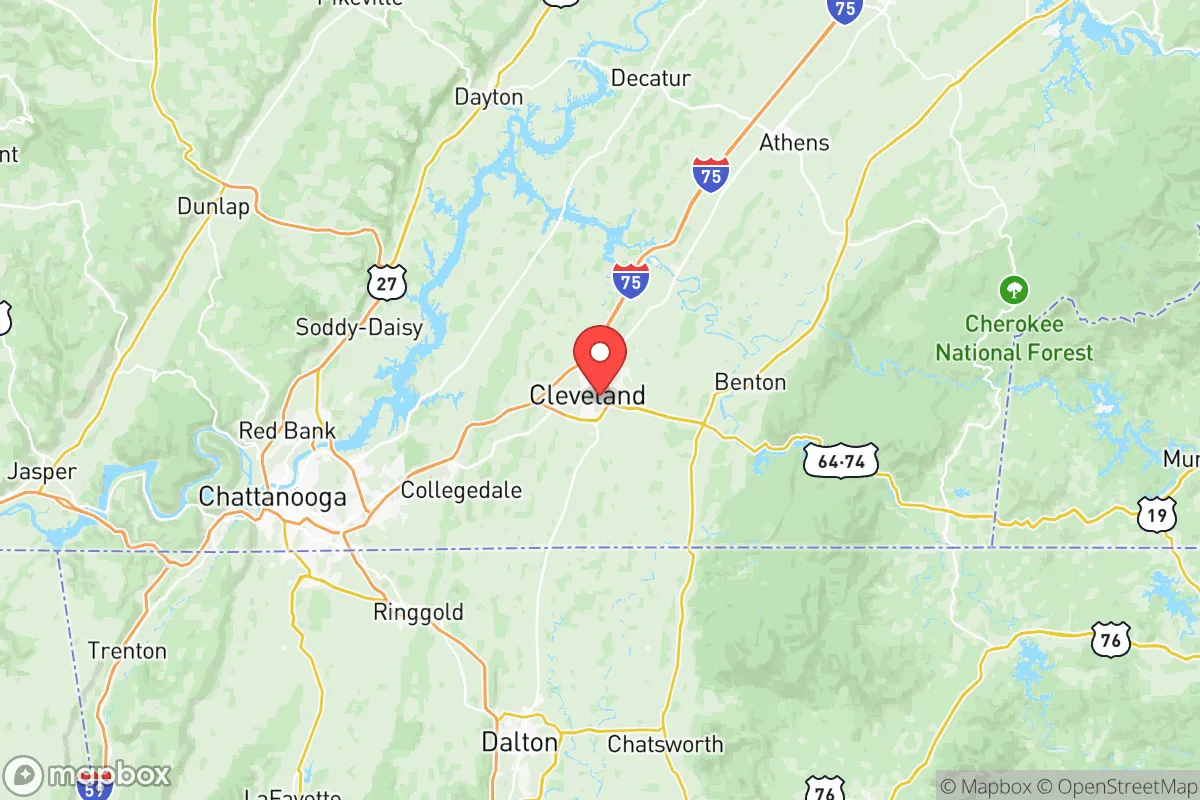
Suburbanization has reshaped the county’s geography over the past 50 years. While Cleveland remains the economic and cultural anchor, bedroom communities like Benton Station and Waterville have grown as residents seek larger lots and quieter surroundings. The county’s overall density remains low, but the population has become more dispersed, with new subdivisions and strip malls spreading along major corridors like Interstate 75 and U.S. Highway 64.
The future
Bradley County is projected to continue growing at a moderate pace, driven by domestic migration from higher-cost states and the expansion of local industries like automotive parts manufacturing and logistics. The Hispanic share is likely to increase gradually, as younger families and workers are drawn to the area’s relatively affordable housing and steady job market. The white share, while still dominant, will slowly decline as the county becomes more diverse, though the pace of change will remain slower than in many other parts of Tennessee and the South.
New communities are expected to concentrate along the I-75 corridor, particularly around Cleveland and the southern edge of the county near the Georgia line. The Indian and East/Southeast Asian populations will likely remain small, with growth tied to specific professional sectors rather than broad immigration waves. The county’s cultural identity, rooted in conservative values and a strong sense of local tradition, is likely to persist, even as new residents bring different backgrounds and perspectives. For someone moving in now, Bradley County offers a stable, family-oriented environment with a slowly diversifying population and a growing economy, but little of the rapid demographic change seen in larger metropolitan areas.
Bradley County is becoming a slightly more diverse, steadily growing community where domestic migration outweighs international immigration. For a family or individual seeking a low-cost, conservative-leaning area with a strong manufacturing base and access to outdoor recreation, it remains a solid choice, but those looking for a highly multicultural or cosmopolitan environment will find the county’s demographic profile relatively homogeneous and slow to change.

* Values derived from national, state, county, city and local statistics and may differ in a specific area. Last updated: 2026-07-12T03:48:59.000Z
Narrative content on this page is AI-generated and may contain mistakes. Verify any details that matter before acting on them.
ReloMaps may earn a commission from affiliate links at no extra cost to you.

