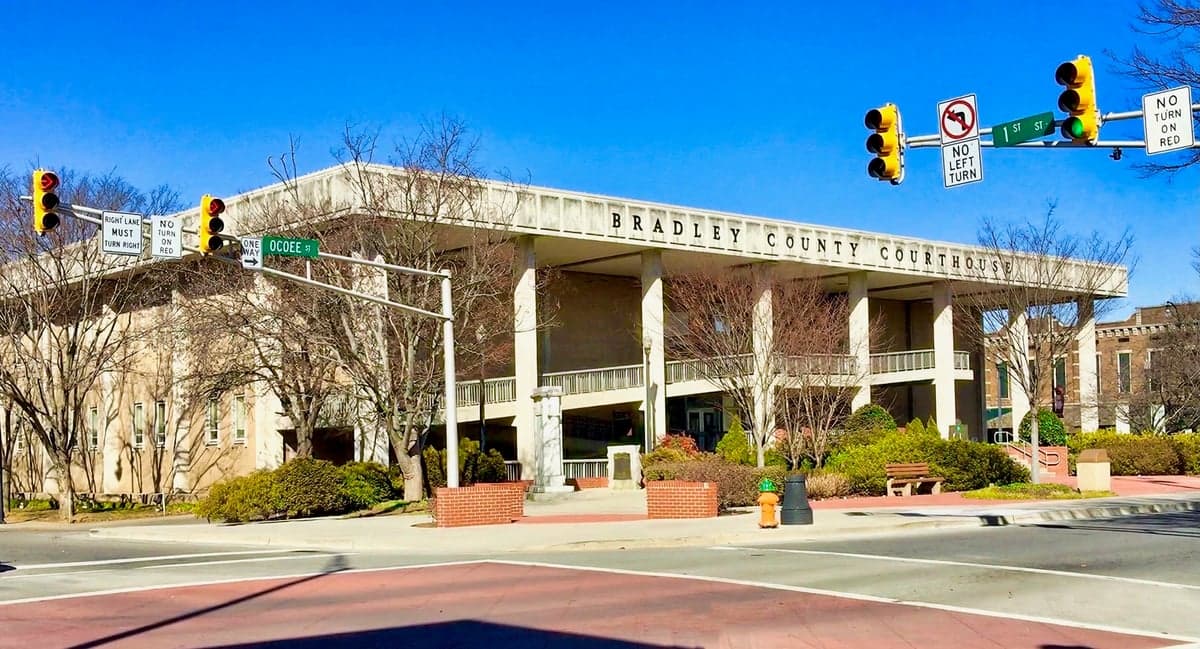
Photo: Wikipedia
Personal Sovereignty in Bradley County
Viable for self-reliance. Generally workable, though some barriers may limit total independence.
What does Personal Sovereignty tell us?
Personal Sovereignty measures your capacity for self-reliance and independence with minimal government friction. Higher scores mean fewer barriers between you and the way you want to live... but it assumes you have the space you need and good neighbors.
What does this tell us?
Personal Sovereignty measures your capacity for self-reliance and independence with minimal government friction. Higher scores mean fewer barriers between you and the way you want to live... but it assumes you have the space you need and good neighbors.
State Policy
Energy independence: Importer (25% of energy produced in-state)
Personal Liberty
Homesteading

Personal Liberty Analysis
Bradley County, Tennessee, anchored by the city of Cleveland, offers a notably high degree of personal sovereignty, rooted in Tennessee’s strong tradition of limited government and individual liberty. The county’s regulatory environment is light-touch compared to many urban and suburban areas in the Southeast, with local officials generally deferring to state preemption on firearms, property rights, and land use. For single individuals and families who prioritize autonomy—whether in self-defense, financial independence, or lifestyle choices—Bradley County provides a legal and cultural framework that supports self-reliance without the friction found in more heavily governed jurisdictions.
Tax burden and regulatory posture: how Tennessee’s policies shape daily life
Tennessee’s absence of a state income tax on wages is the cornerstone of its pro-sovereignty posture, and Bradley County residents benefit directly. The state relies on a sales tax (7% state rate, plus a local option that brings Bradley County’s combined rate to 9.75%) and property taxes, which are moderate. The county’s effective property tax rate is roughly $2.30 per $100 of assessed value, translating to about $1,150 annually on a $250,000 home—well below national averages. This low fixed-cost structure means residents retain more of their earnings for personal priorities, whether savings, investments, or homestead improvements. Regulatory posture is similarly restrained: Bradley County has no county-wide zoning in unincorporated areas, meaning property owners in places like Charleston or Hopewell can build, fence, or operate small-scale enterprises without seeking multiple permits. The city of Cleveland does enforce zoning within its limits, but the county’s rural and suburban tracts remain largely free of land-use bureaucracy, a significant advantage for those seeking to minimize government interaction in daily life.
Self-defense and gun law specifics: what the Second Amendment looks like on the ground
Tennessee is a constitutional carry state, and Bradley County reflects that ethos fully. As of 2026, any law-abiding adult 21 or older can carry a handgun openly or concealed without a permit, and no state-level registration or waiting period applies. The county’s sheriff’s office, led by Steve Lawson, is known for a pro-Second Amendment stance and issues enhanced carry permits for reciprocity with other states, but the permit is optional. Local gun culture is robust: Cleveland hosts multiple gun shops and indoor ranges, and the nearby Ocoee River area has a strong hunting tradition. Stand-your-ground laws apply statewide, with no duty to retreat in any place where a person is lawfully present. For families, this means self-defense training and firearm ownership are normalized, not stigmatized. The only notable restriction is the state’s prohibition on carrying in certain posted locations (schools, government buildings), but enforcement is generally non-confrontational. Compared to neighboring Georgia or North Carolina, Tennessee’s gun laws are among the most permissive in the region, and Bradley County’s rural character reinforces that freedom.
Self-reliance and homesteading viability: lot sizes, zoning, and off-grid feasibility
Bradley County’s unincorporated areas are a strong match for homesteading and off-grid living. Minimum lot sizes in the county’s rural zones are typically 1 to 5 acres, depending on the specific area and proximity to water sources, but there is no county-wide minimum in unzoned tracts. In McDonald and Wildwood Lake, properties of 2 to 10 acres are common, with many already featuring gardens, chicken coops, or small livestock. Off-grid feasibility is high: Tennessee has no state law prohibiting rainwater collection, and solar panel installation is unrestricted in unincorporated areas. The Tennessee Valley Authority (TVA) provides grid electricity, but residents can disconnect without penalty, provided they meet basic septic and well regulations. The county health department requires permits for new wells and septic systems (typically $300–$500), but these are straightforward to obtain. Zoning in Cleveland proper restricts livestock and large gardens, but the city limits are small relative to the county’s total land area. For families seeking a self-sufficient lifestyle, the area around Benton Springs and East Cleveland offers affordable land—often under $10,000 per acre—with minimal regulatory overhead. The county’s building codes apply only to new construction, not to existing structures or renovations, further reducing bureaucratic friction for those improving a property.
Personal liberties: parental rights, medical autonomy, speech, and property
Tennessee has enacted several laws that strengthen personal liberties in Bradley County. Parental rights are explicitly protected under state law, with a 2023 statute affirming that parents have the fundamental right to direct their children’s education, healthcare, and religious upbringing. This means families in Cleveland and surrounding areas can homeschool without state interference (only a simple notice of intent is required), and school boards in Bradley County have been conservative in implementing curriculum changes. Medical autonomy is similarly broad: Tennessee does not mandate COVID-19 or childhood vaccination for school attendance, and there is no state-level vaccine passport system. The state’s 2022 law prohibiting discrimination based on vaccination status in public accommodations further protects individual choice. Free speech is robust, with no local ordinances restricting political signage or public assembly beyond standard time-place-manner rules. Property rights are reinforced by Tennessee’s strong eminent domain protections, which require just compensation and a public purpose for any taking. In Bradley County, the absence of county-wide zoning means property owners can use their land for a wide range of activities—from small-scale manufacturing to private shooting ranges—without needing variances or special permits. The only notable limitation is the county’s noise ordinance, which is enforced only after 10 p.m. in residential areas, a minor constraint for most.
Overall, Bradley County ranks among the more sovereignty-friendly areas in the Southeast, particularly for those who value low taxes, permissive gun laws, and the ability to live off-grid or homestead with minimal government involvement. While the city of Cleveland imposes some zoning and business licensing, the county’s unincorporated tracts—especially around Charleston, McDonald, and Wildwood Lake—offer a level of personal freedom that rivals rural counties in Texas or Idaho. For a family or individual seeking a balance of economic opportunity and individual autonomy, Bradley County provides a legal and cultural environment where self-reliance is not just tolerated but expected.

* Values derived from national, state, county, city and local statistics and may differ in a specific area. Last updated: 2026-07-12T03:48:59.000Z
Narrative content on this page is AI-generated and may contain mistakes. Verify any details that matter before acting on them.
ReloMaps may earn a commission from affiliate links at no extra cost to you.

