
Photo: Wikipedia
Political ClimatePolitical Climate in Springboro, OH
District shown is the primary district for this city’s centroid. Cities may span multiple districts.
Local Political AnalysisPolitical Analysis of Springboro, OH
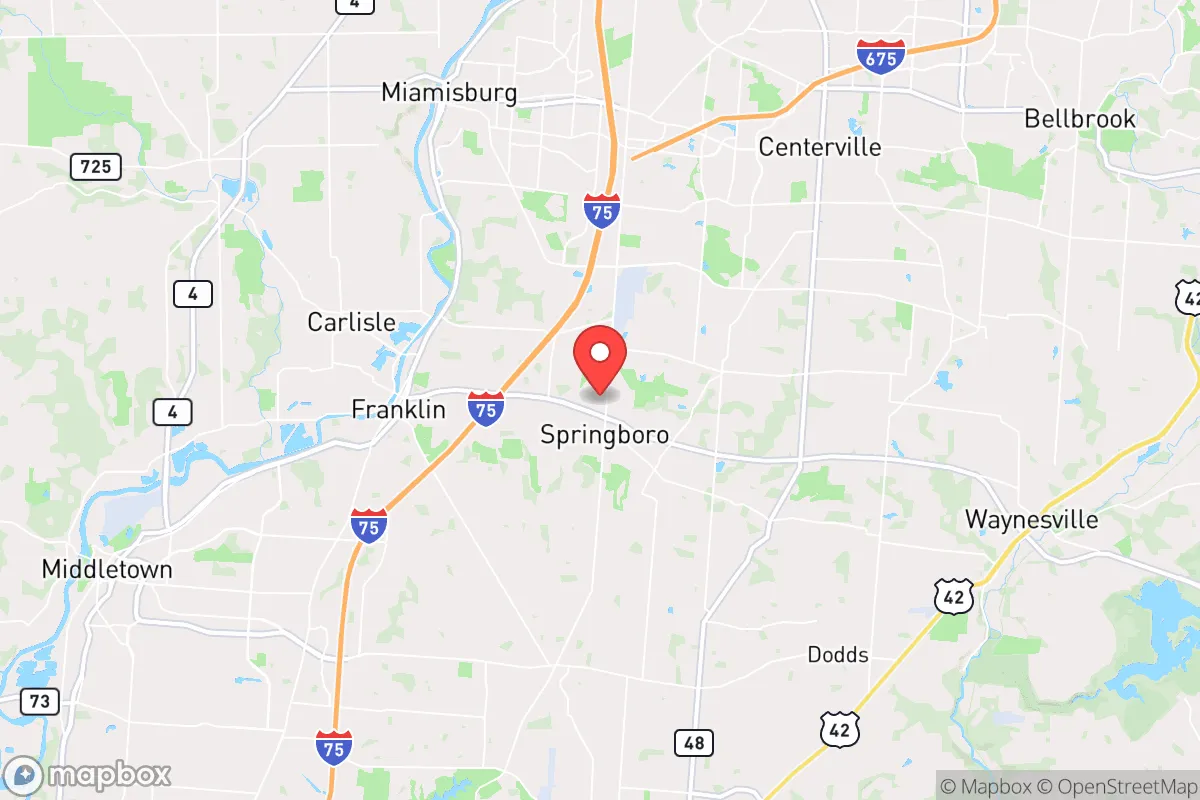
Springboro is one of those places where the political ground has shifted under your feet without you really noticing until you look at a map. The city itself sits in Warren County, which is deep red territory, but the Cook PVI for the Springboro area is D+3, which tells you the town has been trending bluer for a while now. That’s a big deal because just a few miles north in Dayton, you’re in a solidly Democratic stronghold, while heading south toward Lebanon or Mason, you’re back in deep red country. The trajectory here is toward a more balanced, purple-ish middle ground, driven largely by new families moving in from the Cincinnati suburbs and a growing professional class that doesn’t fit neatly into either party’s mold.
How it compares
The contrast between Springboro and the rest of Ohio is stark. The state as a whole has a Cook PVI of R+5, meaning it leans Republican by a comfortable margin in statewide races. But Springboro’s D+3 rating puts it on the other side of the partisan divide, making it a relative outlier in southwestern Ohio. If you drive 15 minutes east to Waynesville, you’ll find a more traditional conservative small-town vibe, while 20 minutes west in Miamisburg you get a mix of working-class and suburban voters that lean more Republican than Springboro does. The real comparison, though, is with the broader Dayton metro area: Springboro is the most politically moderate-to-liberal suburb in a region that otherwise votes red by about 10 points in presidential elections. That’s not an accident—it’s a reflection of the city’s demographics, which skew younger, more educated, and more affluent than the surrounding county.
What this means for residents
For conservative residents, Springboro isn’t hostile territory, but it’s no longer the reliably red stronghold it was 20 years ago. You’ll still see plenty of Trump signs in yards during election season, and the local school board and city council races tend to be competitive but not lopsided. The practical effect is that conservative voices are heard, but they have to engage in real debate rather than just assuming they’ll win. For liberal residents, the D+3 lean means you’re not isolated—there are enough like-minded neighbors to form a genuine community, and local Democratic clubs are active and growing. But you’re still in a county that votes Republican by wide margins, so statewide and national elections can feel like a losing battle. The upside is that local politics are genuinely contested, which forces both sides to moderate and compromise more than they might in a deep-red or deep-blue bubble.
Culturally, Springboro’s political middle ground shows up in practical ways. The city has a strong public school system that enjoys broad community support, and there’s little appetite for the kind of culture-war fights that dominate school boards in more polarized suburbs. The local government tends to focus on development and infrastructure rather than social issues, which keeps the temperature lower than in nearby towns like Lebanon or Franklin. Looking ahead, the trajectory seems to be toward a continued slow shift leftward, driven by the same demographic trends that are reshaping suburbs across the Midwest. But don’t expect a sudden flip—Springboro’s political identity is likely to remain a pragmatic, slightly-left-of-center purple for the foreseeable future, which is probably the best outcome for anyone who values actual governance over partisan posturing.

State Political ClimatePolitical Climate in Ohio
State Political AnalysisPolitical Environment in the State
Ohio has shifted from a classic presidential bellwether to a solidly Republican state, carrying a Cook PVI of R+5 after voting for Donald Trump by 8 points in both 2016 and 2020 and by 11 points in 2024. The state’s political center of gravity has moved rightward over the past two decades, driven by the collapse of union-era Democratic strength in the industrial Mahoning Valley and the growing dominance of exurban and rural conservatives in the western and southern counties. Yet the state remains deeply divided: the three C’s — Columbus, Cleveland, and Cincinnati — still anchor a Democratic coalition that can win statewide in low-turnout judicial and local races, but the GOP now controls every statewide office, both chambers of the legislature, and the state supreme court.
Urban vs. rural divide
The political map of Ohio is a textbook study in the urban-rural split. Cuyahoga County (Cleveland) and Franklin County (Columbus) together cast about 30% of the state’s vote and deliver margins of 60-70% for Democrats, while Hamilton County (Cincinnati) has become a competitive swing county after trending left in the Trump era. The rural and exurban counties that ring these metros — Delaware, Licking, Warren, and Butler — are now deep red, with Republican margins often exceeding 30 points. The most dramatic shift has been in the Mahoning Valley: Mahoning and Trumbull counties, which went for Obama by 20+ points in 2012, flipped to Trump by 4-5 points in 2024, mirroring the broader realignment of white working-class voters. Meanwhile, Appalachian counties like Scioto and Lawrence have become reliably Republican, while the northwest corner (Toledo’s Lucas County) remains a Democratic holdout, though shrinking. The result is a state where the partisan lean of your specific town matters enormously — a relocator moving to Dublin (suburban Columbus) will find a purple-to-blue environment, while a move to Mason (north of Cincinnati) lands you in a solidly red exurb.
Policy environment
Ohio’s policy environment reflects its Republican trifecta, but with notable moderation on fiscal matters. The state has a flat income tax rate of 3.5% (down from a top rate of nearly 5% in 2020), with a phase-out to 2.75% by 2026, and no tax on Social Security benefits. Sales tax is 5.75% at the state level, with local add-ons pushing it to 7-8% in most cities. Property taxes are relatively high, averaging about 1.5% of home value, and have become a flashpoint as home values surged post-2020. On education, Ohio funds a voucher program (EdChoice) that has expanded significantly — over 100,000 students now use public funds for private or religious schools — and the state has a “school report card” system that grades districts A-F. Healthcare policy is mixed: the state expanded Medicaid under the Affordable Care Act in 2014, and roughly 3 million Ohioans are on the program, but the legislature has passed laws restricting abortion (a six-week ban, currently blocked by court order) and requiring parental consent for minors’ abortions. Election laws have tightened: voter ID is now required (with a limited list of acceptable IDs), drop boxes are restricted to one per county, and early voting hours have been standardized. Gun laws are permissive: Ohio is a “constitutional carry” state (permitless carry for adults 21+ since 2022), with no waiting periods, no universal background checks, and “stand your ground” self-defense laws.
Recent policy direction
The last five years have seen a clear rightward shift on social and cultural issues, while economic policy has remained broadly pro-business. In 2023, the legislature passed House Bill 68, which would ban gender-affirming care for minors and restrict transgender athletes in school sports — Governor DeWine vetoed it, but the legislature overrode him, making Ohio one of the most restrictive states on transgender rights. On education, the state enacted a “Parents’ Bill of Rights” (HB 8) in 2023, requiring schools to notify parents of any changes to a student’s health or well-being and restricting instruction on sexual orientation in early grades. On gun rights, the 2022 permitless carry law was paired with a “stand your ground” statute that removed the duty to retreat in public spaces. On property rights, Ohio has a strong “right to farm” law that limits nuisance lawsuits against agricultural operations, and the state has preempted local governments from banning natural gas hookups in new construction. On voting, the 2023 omnibus election law (HB 458) shortened the absentee ballot application window, required ID for all in-person voting, and banned private funding of election administration. On the economic liberty side, Ohio has become a “right-to-work” state in practice if not in law — while the 2011 law was repealed by referendum in 2011, the legislature has steadily weakened public-sector unions through other means. The state also legalized recreational marijuana via ballot initiative in 2023, though the legislature has since moved to increase taxes and restrict home cultivation.
Civil unrest & political movements
Ohio has been a battleground for national political movements, with visible flashpoints in both urban and rural areas. The 2020 George Floyd protests in Columbus and Cincinnati saw significant property damage and National Guard deployment, and the state’s response — including the use of tear gas and curfews — remains a point of contention. On the right, the “Ohio Freedom Alliance” and local “Moms for Liberty” chapters have been active in school board races, particularly in suburban counties like Delaware and Warren. Immigration politics have flared in smaller cities: Springfield became a national flashpoint in 2024 after a surge of Haitian migrants strained local services, leading to a city council resolution declaring a “humanitarian crisis” and drawing visits from national conservative figures. There is no sanctuary city policy in Ohio — in fact, the state passed a law in 2024 requiring local law enforcement to cooperate with federal immigration authorities. Election integrity controversies have been muted compared to some states, though the 2020 and 2024 results in Mahoning County were subject to local activist scrutiny. The “Ohio Constitution Party” and other minor parties have a presence but little electoral impact. Overall, political activism is visible but not disruptive in daily life — most Ohioans encounter it through yard signs, local news, and occasional protests at the statehouse.
Projection
Over the next 5-10 years, Ohio is likely to become more Republican at the state level, but with a growing internal tension between the party’s populist and establishment wings. Demographic trends favor the GOP: the state’s population is aging (median age 40), and the Democratic-leaning urban cores are growing slowly or shrinking, while the red exurbs are booming. In-migration from other states is modest but tilts conservative — people moving from California and Illinois tend to settle in the Cincinnati and Columbus suburbs. The wild card is the state’s growing Hispanic population, concentrated in the northwest (Toledo) and southwest (Dayton area), which could shift the calculus if turnout patterns change. On policy, expect continued movement on school choice (possibly universal vouchers), further income tax cuts, and more restrictive abortion laws if the courts allow. The marijuana legalization vote suggests a libertarian streak that may moderate some social policy, but the legislature’s pushback also shows the limits. A relocator moving in now should expect that in a decade, Ohio will be a reliably red state in presidential elections, with a legislature that continues to push conservative cultural policies, but with enough local variation — especially in the suburbs of the three C’s — to find a community that matches their political comfort zone.
For a new resident, the bottom line is that Ohio offers a broadly conservative policy environment with low taxes, permissive gun laws, and strong parental rights in education, but with significant local variation. If you’re moving to Dublin or Upper Arlington, you’ll find a purple-to-blue community with high property taxes and progressive neighbors; if you’re heading to Mason or West Chester, you’ll land in a red exurb with lower taxes and a more traditional culture. The state’s political trajectory is clear — rightward — but the pace is gradual enough that you can find your niche without feeling like you’re in a political monoculture. Just be aware that the state’s laws on abortion, transgender rights, and voting are among the most restrictive in the Midwest, and that local politics in the cities will feel very different from the statehouse in Columbus.
* Values derived from national, state, county, city and local statistics and may differ in a specific area. Last updated: 2026-09-18T05:28:41.000Z
Narrative content on this page is AI-generated and may contain mistakes. Verify any details that matter before acting on them.
ReloMaps may earn a commission from affiliate links at no extra cost to you.

