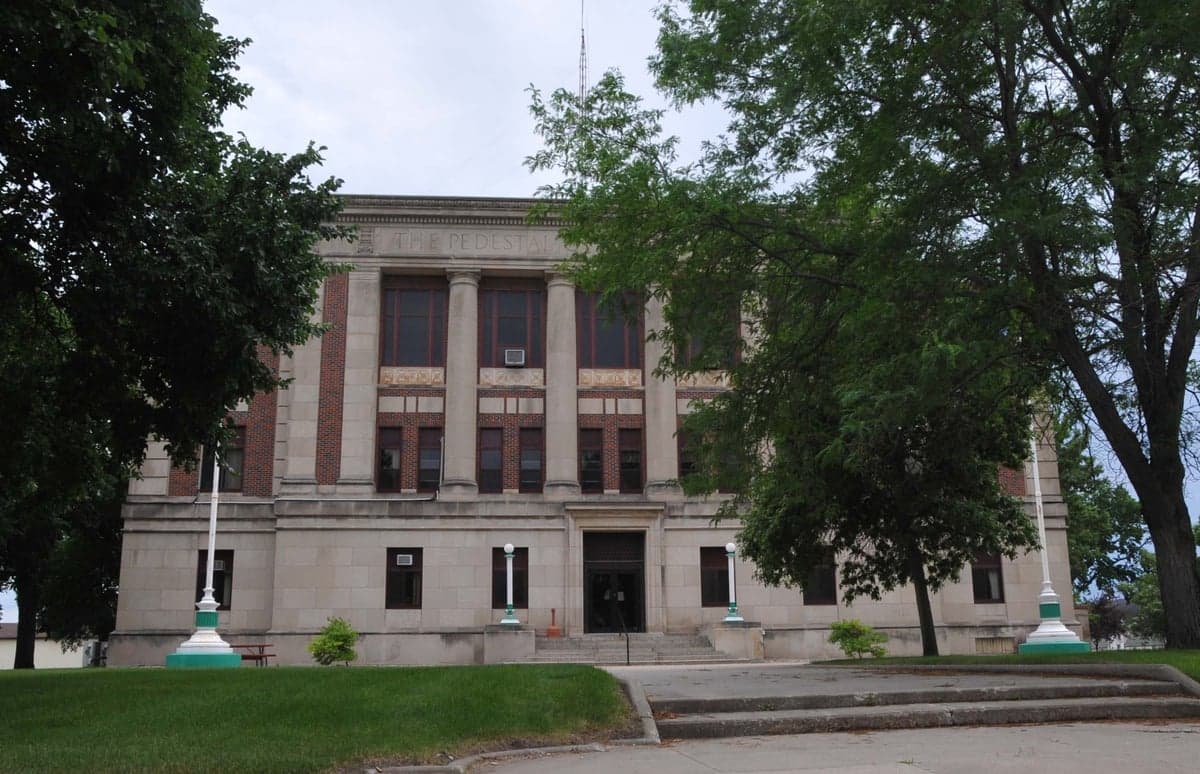
Photo: Wikipedia
Political ClimatePolitical Climate in Spink County
Showing state-level results — no local-only data available.
Local Political AnalysisPolitical Analysis of Spink County
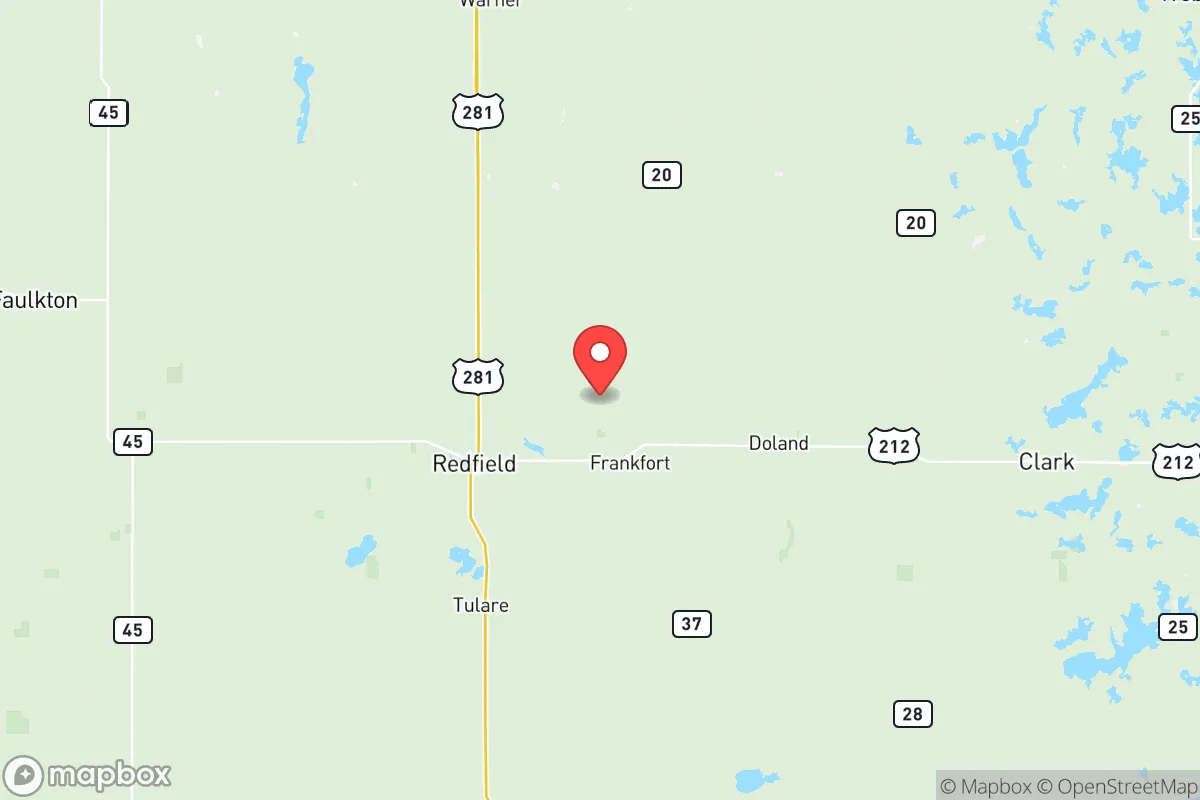
Spink County, South Dakota, is a reliably Republican stronghold with a Cook Partisan Voting Index (PVI) of R+15, meaning it votes about 15 points more Republican than the national average. This isn't a recent shift; the county has been consistently red for decades, though the margin has tightened slightly in presidential races since 2016 as rural Democratic holdouts have faded. The county seat, Redfield, tends to be the most politically moderate area, while smaller towns like Frankfort and Doland lean heavily Republican. The only precinct that occasionally flirts with competitive margins is around the Redfield area, where a mix of state employees and healthcare workers at the Redfield Community Memorial Hospital can produce a slightly more balanced vote.
How it compares
Compared to South Dakota as a whole, Spink County is notably more conservative. While the state has a strong Republican lean overall—with no statewide Democrat winning since 1978—Spink County's R+15 PVI places it to the right of the state's average, which is estimated to be around R+12 to R+14. This means that in a typical election, a Republican candidate in Spink County will outperform their statewide margin by a few points. For example, in the 2024 presidential race, Donald Trump carried Spink County with roughly 72% of the vote, compared to about 63% statewide. The county's agricultural base, with major employers like the Redfield Energy ethanol plant and numerous family farms, reinforces a conservative economic and social outlook. There is no significant urban or college-town counterweight like you'd find in Minnehaha County (Sioux Falls) or Brookings County, which pull the state's overall numbers slightly leftward.
What this means for residents
For conservative residents, Spink County offers a deeply supportive political environment where local offices—from county commission to school board—are almost universally held by Republicans. Policy debates tend to focus on agricultural issues, property taxes, and local infrastructure rather than national culture-war topics. For liberal residents, the reality is that they are a clear minority, but not an invisible one. The Redfield area provides a small but active Democratic presence, often centered around the local teachers' union and a handful of retired state workers. Political conversations here are generally civil and neighborly, though national politics can create friction. The practical effect of the county's lean is that state and federal representatives are almost always Republican, meaning conservative residents feel well-represented, while liberal residents often find their views sidelined in local governance.
Culturally, Spink County's politics are intertwined with its rural identity. There is a strong emphasis on self-reliance, limited government, and Second Amendment rights, which is reflected in local ordinances and the general attitude toward regulation. One notable policy distinction is the county's approach to land use and zoning—it is minimal, with most decisions left to individual landowners, a stance that aligns with the area's libertarian-leaning conservatism. The county also tends to support state-level initiatives that limit property tax increases and expand school choice, though the local public schools in Redfield and Doland remain well-funded and central to community life. For newcomers, the political climate is welcoming if you share the dominant values, but can feel isolating if you don't. The trajectory is stable: Spink County will remain a Republican stronghold for the foreseeable future, with no demographic or economic shifts on the horizon that would alter its political character.

State Political ClimatePolitical Climate in South Dakota
State Political AnalysisPolitical Environment in the State
South Dakota is a deeply Republican state, with a partisan lean of roughly +30 points in federal elections, making it one of the most reliably red states in the country. The dominant coalition is a mix of rural agricultural interests, small-government conservatives, and a growing libertarian-leaning population drawn by low taxes and minimal regulation. Over the past two decades, the state has shifted further right, driven by out-migration from more moderate rural areas and in-migration of conservatives to places like Rapid City and the Sioux Falls metro, while the Democratic presence has shrunk to a few isolated pockets.
Urban vs. rural divide
The political map breaks down predictably: the Sioux Falls metro (Minnehaha and Lincoln counties) is the state's economic engine and votes Republican, but with a slightly more moderate, business-friendly flavor than the rest of the state. Lincoln County, a fast-growing suburban area south of Sioux Falls, is one of the most Republican counties in the nation, routinely voting +40 to +50 points red. Rapid City and Pennington County lean Republican but have a noticeable libertarian streak, with a strong Second Amendment and anti-tax sentiment that sometimes puts them at odds with the more socially conservative rural areas. The Democratic base is largely confined to Minnehaha County (Sioux Falls proper), Brookings (home to South Dakota State University), and Vermillion (University of South Dakota), plus a handful of Native American reservations like Pine Ridge and Rosebud, which vote overwhelmingly Democratic but have low turnout. The rural expanse — places like Huron, Mitchell, and Watertown — is deeply conservative, with a focus on agriculture, gun rights, and opposition to federal overreach.
Policy environment
South Dakota's policy environment is defined by its no income tax structure, low property taxes, and a regulatory posture that favors business and individual autonomy. The state has no corporate income tax, no personal income tax, and no inheritance tax, making it a magnet for retirees and remote workers. Education policy is locally controlled, with school choice limited but growing; the state has a small but active charter school sector and a robust homeschooling community. Healthcare policy is conservative: the state did not expand Medicaid until 2023, after a voter-approved ballot measure forced the issue, and abortion is heavily restricted following the 2025 trigger law that bans the procedure with narrow exceptions. Election laws are among the most accessible in the country — same-day voter registration, no-excuse absentee voting, and a mail-in ballot option — but the state also has voter ID requirements. The legislature has consistently resisted federal mandates on environmental regulation, gun control, and public health, passing laws to preempt local ordinances on firearms and to limit emergency powers.
Recent policy direction
Over the past five years, South Dakota has moved aggressively to expand individual liberties across several fronts. In 2023, the legislature passed HB 1080, a permitless carry law allowing any adult who can legally possess a firearm to carry it concealed without a permit. The same year, SB 53 banned gender-affirming care for minors, making South Dakota one of the first states to do so. On education, HB 1017 (2022) created a "Parents' Bill of Rights," requiring schools to notify parents of curriculum changes and allowing them to opt their children out of certain materials. Property rights were strengthened by SB 180 (2023), which limits the use of eminent domain for carbon pipeline projects — a direct response to the controversial Summit Carbon Solutions pipeline. On taxation, the state has continued to cut property taxes and sales taxes on groceries, with a 2024 law reducing the state sales tax from 4.5% to 4.2%. Voting access remains broad, but the state has tightened ballot initiative rules, requiring a higher signature threshold for constitutional amendments after the Medicaid expansion and marijuana legalization votes. Medical and bodily autonomy is sharply limited: abortion is banned at conception, and the state has no protections for medical marijuana patients beyond a limited CBD law.
Civil unrest & political movements
South Dakota has seen relatively little civil unrest compared to other states, but there have been notable flashpoints. The Standing Rock protests (2016-2017) against the Dakota Access Pipeline drew national attention and involved clashes between protesters and law enforcement, with the state government firmly supporting the pipeline. More recently, the Summit Carbon Solutions pipeline has sparked organized opposition from landowners and county commissions, particularly in Brown County and Spink County, where residents have passed resolutions against eminent domain for private gain. On the left, activist groups like South Dakota Voices for Peace and ACLU of South Dakota have mobilized around immigrant rights and voting access, though the state has no sanctuary policies and has passed laws requiring local law enforcement to cooperate with federal immigration authorities. Election integrity controversies have been minimal, though the 2020 and 2022 cycles saw some Republican activists push for audits, which the secretary of state resisted. The state's Native American population, concentrated on reservations like Pine Ridge and Rosebud, has been a persistent source of political tension, with disputes over jurisdiction, law enforcement funding, and voting access on reservations.
Projection
Over the next 5-10 years, South Dakota's political trajectory is likely to remain deeply conservative, but with a growing libertarian and populist strain. In-migration from blue states — particularly to the Black Hills region and the Sioux Falls metro — is bringing new residents who are often more culturally conservative but also more skeptical of government power, including the state government. This could create friction between the old-guard establishment Republicans and a newer, more confrontational wing that opposes corporate subsidies and eminent domain for pipelines. The Democratic Party is unlikely to recover outside of a few college towns and reservation communities, meaning the real political battles will be within the Republican primary. Expect continued pressure to cut taxes further, expand school choice, and resist federal mandates on environmental and health policy. The biggest wild card is the state's aging population and the need to attract younger workers, which could moderate some social policies over time, but for the foreseeable future, South Dakota will remain a place where individual liberty — particularly on guns, taxes, and property rights — is the dominant political value.
For a new resident, the bottom line is straightforward: if you value low taxes, minimal government interference in your daily life, and a culture that prizes self-reliance, South Dakota will feel like a natural fit. If you lean left on social issues or want robust public services, you'll find yourself in a distinct minority, especially outside of Sioux Falls or Brookings. The state's political climate is stable, predictable, and unlikely to shift dramatically, but the growing tension between traditional conservatism and a more libertarian, anti-establishment strain means the details of policy — especially around property rights and corporate influence — are worth watching closely.
* Values derived from national, state, county, city and local statistics and may differ in a specific area. Last updated: 2026-07-10T20:25:21.000Z
Narrative content on this page is AI-generated and may contain mistakes. Verify any details that matter before acting on them.
ReloMaps may earn a commission from affiliate links at no extra cost to you.

