
Photo: Wikipedia
Demographics of Roberts County
Affluence Level in Roberts County
A middle-class area roughly in line with national averages across income, home values, education, and employment.
People of Roberts County
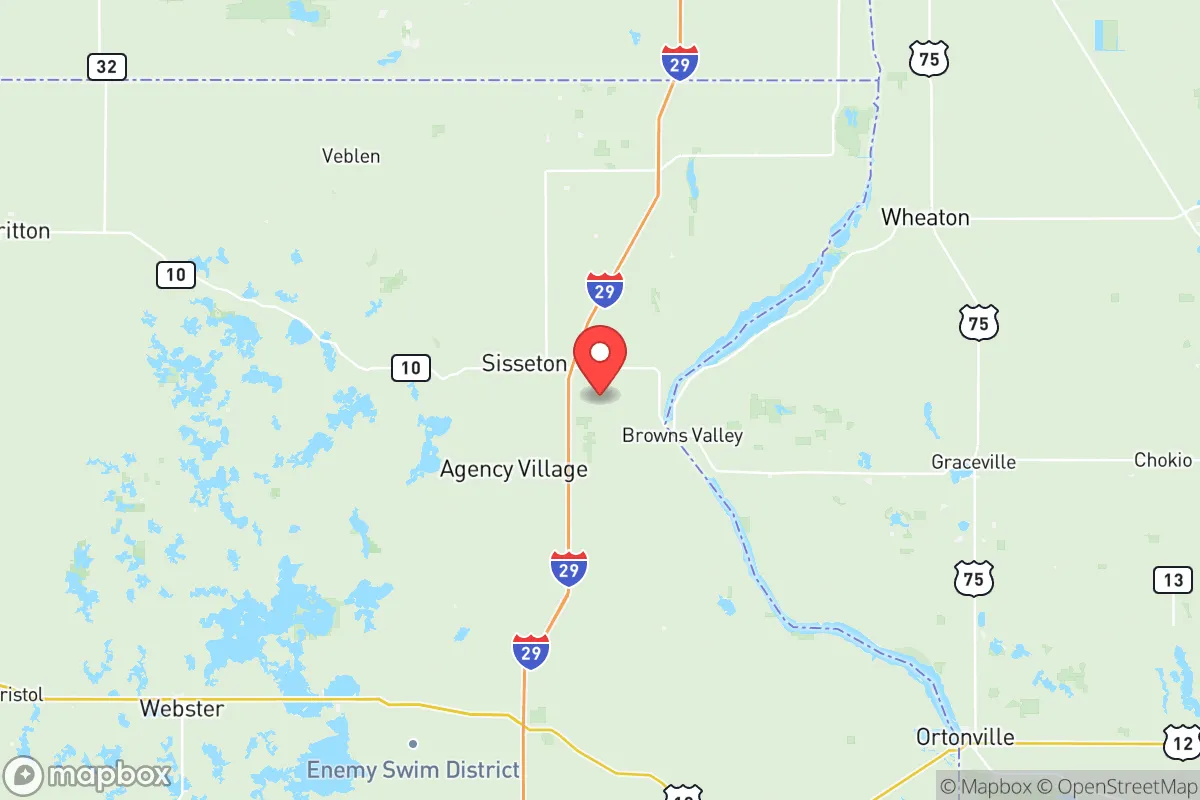
Roberts County, South Dakota, is home to roughly 10,200 residents, making it one of the least densely populated counties in a sparsely populated state. Its defining demographic characteristic is a near-even split between white and Native American populations, with a tiny foreign-born share (0.6%) and minimal racial diversity beyond these two groups. The county's identity is shaped by its position on the Lake Traverse Indian Reservation, where the Sisseton Wahpeton Oyate have deep roots, and by a historic Scandinavian and German farming settlement pattern that has left a legacy of small, agrarian towns like Sisseton, Rosholt, and New Effington. With low educational attainment (18.3% college educated) and a population that has been slowly declining, Roberts County is a place where the future hinges on whether economic opportunity can be created to retain young families from both communities.
Settlement & growth (pre-1960)
The human history of Roberts County begins with the Dakota people, specifically the Sisseton and Wahpeton bands of the Eastern Dakota, who inhabited the region around the Coteau des Prairies and the Lake Traverse area for centuries before European contact. Their seasonal camps followed bison and wild rice harvests, and the lakes and prairie potholes provided a reliable food source. French fur traders and missionaries passed through in the 1700s, but no permanent European settlement occurred during the French or Spanish periods. The area was part of the vast Louisiana Purchase territory before being formally organized as part of Minnesota Territory and later Dakota Territory.
The first major population shift came with the 1867 Treaty of Traverse des Sioux, which created the Lake Traverse Reservation for the Sisseton and Wahpeton people. The reservation originally covered a large area, but subsequent land allotments under the Dawes Act of 1887 broke up communal holdings and opened much of the land to non-Native settlers. The county itself was created in 1883 by the Dakota Territorial Legislature and named for Solomon Roberts, a prominent fur trader and early settler. The railroad arrived in the 1880s, bringing waves of Scandinavian immigrants—Norwegians, Swedes, and Danes—along with German and Irish settlers, who established farms on the former reservation lands. The town of Sisseton, the county seat, was platted in 1887 and became the commercial and administrative hub, with grain elevators, banks, and churches reflecting the Lutheran and Catholic traditions of the new arrivals. Other towns sprang up along the rail lines: Rosholt (founded 1906) attracted Danish farmers; New Effington (1905) became a service center for Norwegian homesteaders; Claire City and Ortley grew as small market towns; and Peur Creek and Victor served as rural post office hamlets.
By 1900, the county's population had surged past 12,000 as homesteaders broke sod and planted wheat, oats, and flax. The Dakota population was largely confined to the reservation portion of the county, and the two communities—Native and European—lived parallel, largely separate lives. Land allotment resulted in many Native families losing their holdings to tax forfeiture or fraudulent sales, accelerating population displacement and poverty. The Dust Bowl and Great Depression hit the county hard in the 1930s, causing many farm families to leave. By 1940, the population had fallen to about 14,000, and the mechanization of agriculture after World War II reduced the need for farm labor further. The county's population peaked around 15,000 in the 1930s and then began a long decline as young people left for cities and better opportunities. Summit, a town founded by Finnish immigrants in the 1880s, saw its population dwindle, and many of the smallest hamlets were entirely abandoned by 1960.
Modern era (post-1965)
Post-1965, Roberts County did not experience the immigration-driven demographic change seen in many parts of the United States. The 1965 Hart-Cellar Act drastically changed U.S. immigration policy, opening the door to large-scale Asian, Latin American, and African migration to cities and coastal states. However, Roberts County attracted almost none of these new arrivals. Its foreign-born population stands at just 0.6%, one of the lowest figures in the nation. The tiny Hispanic population (2.4%) and minuscule East/Southeast Asian population (0.2%) are largely composed of second- or third-generation individuals who moved from other parts of the U.S. for work or family, not recent international immigrants. There is no visible Indian-subcontinent community (0.0%).
The defining demographic event of the modern era has been a slow, steady reassertion of Native American identity and governance. The tribal government of the Sisseton Wahpeton Oyate, based in Agency Village southwest of Sisseton, has gained increasing influence over the county's affairs, including managing health services, education, and economic development through tribal enterprises. The reservation's land base has been partially restored through federal trust acquisitions, and the tribal population has grown faster than the white population due to higher birth rates and some return migration of Native families from urban areas. Today, Native Americans make up roughly 41% of Roberts County residents, a share that has steadily risen since the 1970s. Towns like Agency Village, Veblen, and the area around Lake Traverse have become centers of tribal life, with new housing developments, a casino (Dakota Connection), and tribal schools.
Meanwhile, the white, largely Scandinavian and German farm population has continued to age and shrink. The county's overall population has declined from 11,197 in 1990 to 10,219 today, and the median age has risen above 43. Young white adults tend to leave for college or jobs in larger cities like Watertown, Brookings, or the Twin Cities and often do not return. The number of farm operations has fallen sharply, and the remaining ones have grown larger, requiring fewer workers. The result is a county where the two main population groups are moving in opposite demographic directions: the Native cohort is younger and growing slowly, while the white cohort is older and shrinking. This has created a degree of cultural and political tension, but also a growing need for cooperation on shared challenges like healthcare, education, and infrastructure, which benefit both communities.
The future
Roberts County is likely to become more Native American and less white over the next 10–20 years, while remaining overwhelmingly non-Hispanic and non-immigrant. Projections suggest the white population will continue to decline through outmigration and low birth rates, while the Native population will hold steady or grow slightly due to higher fertility. The county is not expected to attract Hispanic or Asian immigrants in significant numbers; it lacks the job base (no major factories, no warehouse distribution, no high-tech sector) that draws newcomers. The economy is anchored by the tribal casino and related tourism, agriculture (soybeans, corn, wheat), and government services (education, healthcare, tribal administration).
New residential concentration is likely around Sisseton and Agency Village, where tribal housing projects and healthcare facilities are expanding, and around Lake Traverse for recreational property. Some white retirees who grew up in the county may return, but this will be a small trickle. The county's cultural identity is evolving from a predominantly white, Scandinavian farming community into a more explicitly binational community where both Dakota and European heritage are recognized. The Sisseton Wahpeton College, based in Agency Village, is playing a growing role in education and cultural preservation, and tribal language programs are promoting Dakota language use among younger generations.
The biggest risk to the county's future is population decline overall, which threatens school funding, healthcare access, and economic vitality. If current trends hold, the total population could drop below 9,000 by 2040. However, if the tribal economy can attract a few hundred new families—whether through expanded casino operations, renewable energy projects on reservation lands, or telework-friendly housing development—the curve could flatten or reverse modestly.
For someone moving in now, Roberts County offers a quiet, tight-knit, affordable rural life with strong community institutions but limited job diversity and very little ethnic or cultural variety. The two dominant communities are distinct and historically separate, though daily life—schools, sports, local government—forces cooperation. It is a place where history and geography have created a demographic map unlike anywhere else in South Dakota, and where the future will be written by the ability of the Sisseton Wahpeton Oyate and their white neighbors to build a shared economy together.

* Values derived from national, state, county, city and local statistics and may differ in a specific area. Last updated: 2026-06-27T05:06:41.000Z
Narrative content on this page is AI-generated and may contain mistakes. Verify any details that matter before acting on them.
ReloMaps may earn a commission from affiliate links at no extra cost to you.

