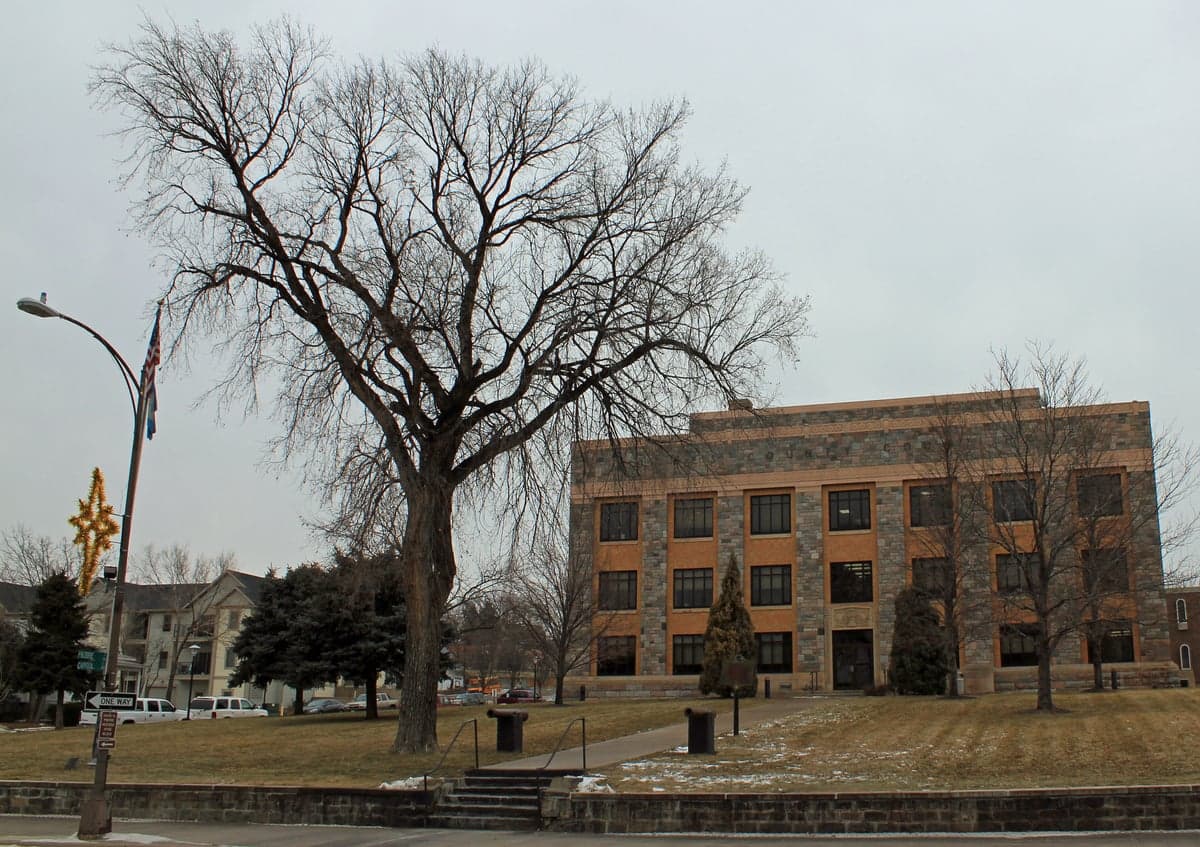
Photo: Wikipedia
Political ClimatePolitical Climate in Hughes County
Showing state-level results — no local-only data available.
Local Political AnalysisPolitical Analysis of Hughes County
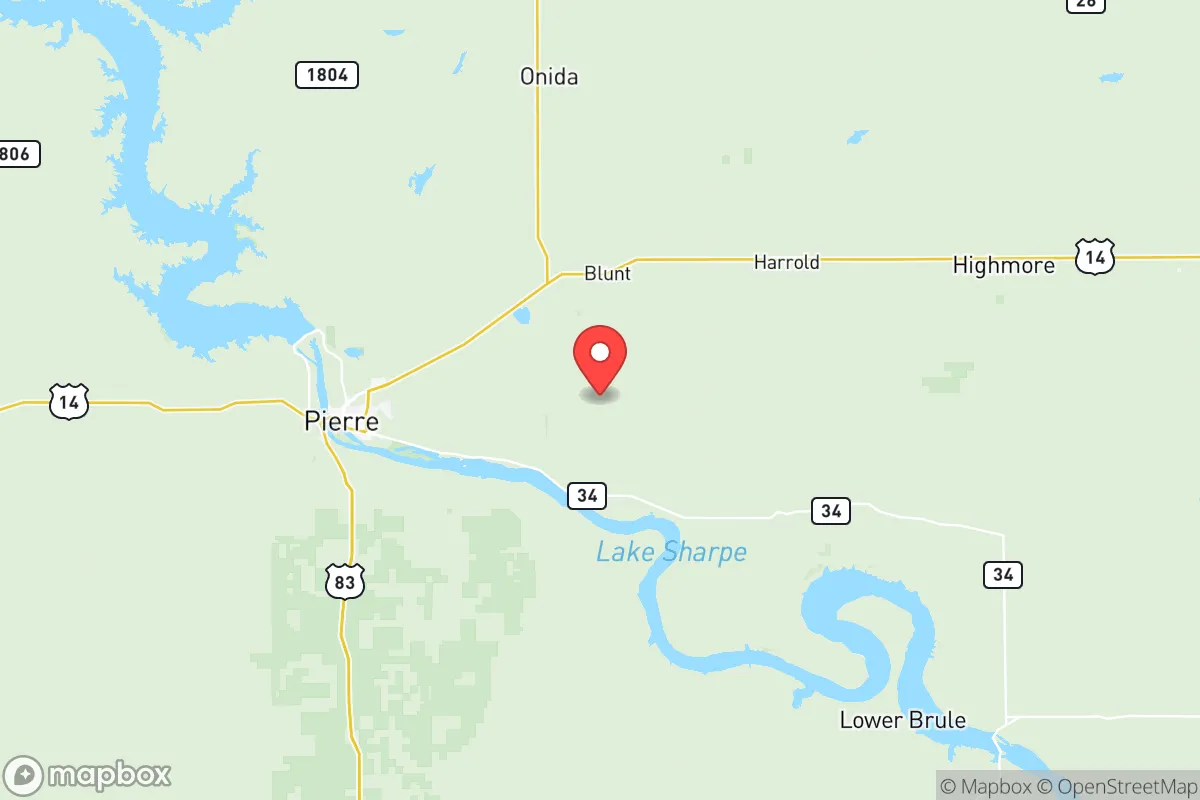
Hughes County, anchored by the state capital Pierre, is a solid Republican stronghold with a Cook Partisan Voting Index (PVI) of R+15, making it significantly more conservative than the national average. In practice, this means Republicans routinely win county-level races by double-digit margins, though the presence of state government employees and a small but vocal Democratic base in Pierre itself creates subtle political variation. The county has held steady in its Republican lean over the past decade, with no major shift toward the center or further right, unlike some rural counties that have swung harder red since 2020.
How it compares
Compared to South Dakota as a whole, Hughes County is slightly more Republican than the state average. While the state's overall PVI is not officially calculated, South Dakota consistently votes Republican by margins around R+15 to R+20 in presidential elections, meaning Hughes County sits near the middle of the pack for the state. The key difference is internal: Pierre, the county seat and largest city, tends to be more moderate than the surrounding rural areas. In Pierre, precincts near the state capitol complex and the downtown core occasionally produce closer races, with Democratic candidates pulling 35-40% of the vote in local legislative contests. In contrast, the unincorporated areas and smaller towns like Blunt and Harrold vote Republican by margins exceeding 70%. The swing precincts are in Pierre's newer subdivisions on the city's east side, where a mix of state employees and private-sector workers create a more competitive environment than the deeply red farm country to the north and west.
What this means for residents
For conservative residents, Hughes County offers a political environment where their views are the clear majority. Local government, school board, and county commission races are typically decided in Republican primaries, and policy leans toward limited regulation, low taxes, and support for agriculture and energy development. For liberal residents, the reality is more nuanced: while they are a distinct minority, the presence of state government jobs and a small but active Democratic Party organization in Pierre means they are not entirely isolated. There is a functioning local Democratic club, and progressive candidates can occasionally win city council seats in Pierre's more moderate wards. However, statewide and countywide offices remain out of reach, and liberal residents often find their political influence limited to local issues like city budgeting or school curriculum debates.
Culturally, Hughes County reflects the broader South Dakota ethos of self-reliance and community involvement, but with a notable government-town twist. The capitol's presence means a higher concentration of college-educated professionals and a more diverse economy than the rest of central South Dakota. This creates a subtle cultural divide: Pierre residents are more likely to discuss state policy and national politics over coffee, while rural residents focus on crop prices and county road maintenance. The county's politics are pragmatic rather than ideological—most elected officials, regardless of party, emphasize constituent services and local infrastructure over national culture war issues. For anyone moving here, the political climate is stable and predictable, with the understanding that conservative values dominate but a respectful, if small, liberal minority is part of the community fabric.

State Political ClimatePolitical Climate in South Dakota
State Political AnalysisPolitical Environment in the State
South Dakota has been a reliably Republican state for decades, but the nature of that conservatism has shifted notably over the past 10-20 years. The state’s overall partisan lean is deep red — Donald Trump won it by over 26 points in 2024, and no Democrat has carried the state since Lyndon Johnson in 1964. However, the dominant coalition has moved from a more pragmatic, farm-and-ranch conservatism toward a culturally assertive, small-government populism. The trajectory has been a steady rightward drift, accelerated by in-migration from blue states and a growing libertarian streak, particularly in the Black Hills region.
Urban vs. rural divide
The political map breaks down along a clear urban-rural axis, but with some nuance. Sioux Falls, the state’s largest city and economic engine, is the most competitive area — Minnehaha County voted for Trump by about 12 points in 2024, down from 18 in 2020, as younger professionals and out-of-state transplants have made it slightly more purple. Rapid City and Pennington County are reliably red but with a libertarian edge; the Black Hills region has a strong independent streak, with many residents who dislike federal land management and favor gun rights above all else. Brookings, home to South Dakota State University, is the most liberal pocket in the state — Brookings County has voted for Democratic presidential candidates in recent cycles, driven by faculty and students. The rural counties — Harding, Perkins, and Ziebach in the west, and Turner, Hutchinson, and Bon Homme in the east — are deeply Republican, often voting 80-90% for GOP candidates. The Native American reservations, including Pine Ridge and Rosebud, are overwhelmingly Democratic but have low turnout due to voter ID laws and geographic isolation, limiting their electoral impact.
Policy environment
South Dakota’s policy environment is defined by low taxes, minimal regulation, and a hands-off approach to social issues. There is no state income tax, and the state sales tax is 4.5% (local options can push it to 6.5%). Property taxes are moderate, with a median effective rate around 1.1%. The regulatory posture is business-friendly — no state-level minimum wage above the federal $7.25, no right-to-work law (though it’s effectively a right-to-work state due to low union density), and no state-level environmental regulations beyond federal mandates. Education policy is decentralized; school choice is limited to charter schools in Sioux Falls and Rapid City, but homeschooling is lightly regulated. Healthcare is a mixed bag: the state did not expand Medicaid until 2023, after a voter-approved ballot measure in 2022, and abortion is banned at all stages of pregnancy with narrow exceptions for life of the mother, rape, and incest. Election laws are restrictive by national standards: voter ID is required, same-day registration is not allowed, and absentee voting requires an excuse. The state has no automatic voter registration and no early voting period beyond absentee-by-mail.
Recent policy direction
The last five years have seen a flurry of legislation that points toward a more assertive, culturally conservative direction. In 2023, the legislature passed HB 1080, banning gender-affirming care for minors, and SB 46, which restricts classroom discussion of gender identity and sexual orientation in K-12 schools. Gun laws have been loosened further: permitless carry was enacted in 2019, and in 2024 the state passed a law prohibiting local governments from enforcing federal gun regulations (a “Second Amendment Sanctuary” measure). On education, the state created a school voucher-like program in 2023, allowing families to use state funds for private school tuition. Property rights were strengthened with the passage of SB 201 in 2022, which limits eminent domain for carbon pipelines — a direct response to the Summit Carbon Solutions pipeline controversy. On voting, the legislature tightened ballot access in 2024 by requiring a photo ID for absentee ballots and shortening the petition window for ballot initiatives. Medical marijuana was legalized by voter initiative in 2020, but the legislature has since restricted dispensary locations and product types. The overall direction is toward fewer state services, more local control, and a cultural posture that prioritizes parental rights and gun ownership over other liberties.
Civil unrest & political movements
South Dakota has seen relatively little civil unrest compared to larger states, but there have been notable flashpoints. The Noem administration’s response to COVID-19 — no mask mandates, no business closures, and a “let the people decide” approach — was broadly popular but drew criticism from public health officials and some tribal leaders. The Keystone XL pipeline protests in 2020-2021 saw clashes between activists and law enforcement, particularly in the western part of the state. The Summit Carbon Solutions pipeline has become a major political flashpoint since 2022, with landowners and environmental groups fighting the project through county ordinances and lawsuits; several counties have passed resolutions opposing eminent domain for the pipeline. Immigration politics are muted — the state has a very small foreign-born population (about 4%), but there have been local controversies over refugee resettlement in Sioux Falls, with some residents opposing it and others welcoming it for economic reasons. There is no sanctuary city policy anywhere in the state. Election integrity controversies have been minimal, though the 2020 election saw a brief push by some GOP activists for a forensic audit, which was rejected by the secretary of state. The Wounded Knee occupation legacy still resonates on the Pine Ridge Reservation, but it’s more a historical memory than an active movement. Overall, the political climate is stable, with most activism coming from property rights groups, gun rights advocates, and anti-abortion organizations.
Projection
Over the next 5-10 years, South Dakota is likely to become more, not less, conservative, but with a growing libertarian faction that could create internal GOP tensions. In-migration from California, Colorado, and Minnesota is accelerating — the state grew by about 9% between 2010 and 2020, and that pace is increasing. These newcomers tend to be conservative-leaning but less culturally traditional; they care more about low taxes and gun rights than about social issues like abortion or LGBTQ+ rights. This could lead to a split between the “business conservative” wing (centered in Sioux Falls) and the “cultural conservative” wing (stronger in rural areas and the Black Hills). The Native American population is growing but remains politically marginalized due to low turnout and gerrymandering; there are ongoing lawsuits over redistricting that could shift legislative seats. The state’s fiscal position is strong — a budget surplus and low debt — but the aging population (median age 37) and out-migration of young adults could strain rural services. A new resident moving in now should expect a state that remains deeply Republican, with low taxes, minimal regulation, and a cultural environment that is welcoming to traditional families but increasingly skeptical of government overreach in any form.
For a new resident, the bottom line is this: South Dakota offers a political environment that is predictably conservative — low taxes, strong gun rights, limited government services, and a cultural posture that prizes individual liberty over collective action. If you’re a conservative, you’ll find a state that aligns with your values on most issues, with the caveat that the libertarian wing is growing and may push for even less government involvement in personal choices. If you’re a liberal, you’ll find a state where your vote has limited impact at the state level, but where local politics in Sioux Falls or Brookings can offer some representation. The practical takeaway: expect a hands-off government that won’t interfere much in your life, but also won’t provide many services or protections beyond the basics. It’s a trade-off that works well for self-reliant individuals and families, but less so for those who rely on public programs or value a strong social safety net.
* Values derived from national, state, county, city and local statistics and may differ in a specific area. Last updated: 2026-07-02T10:33:10.000Z
Narrative content on this page is AI-generated and may contain mistakes. Verify any details that matter before acting on them.
ReloMaps may earn a commission from affiliate links at no extra cost to you.

