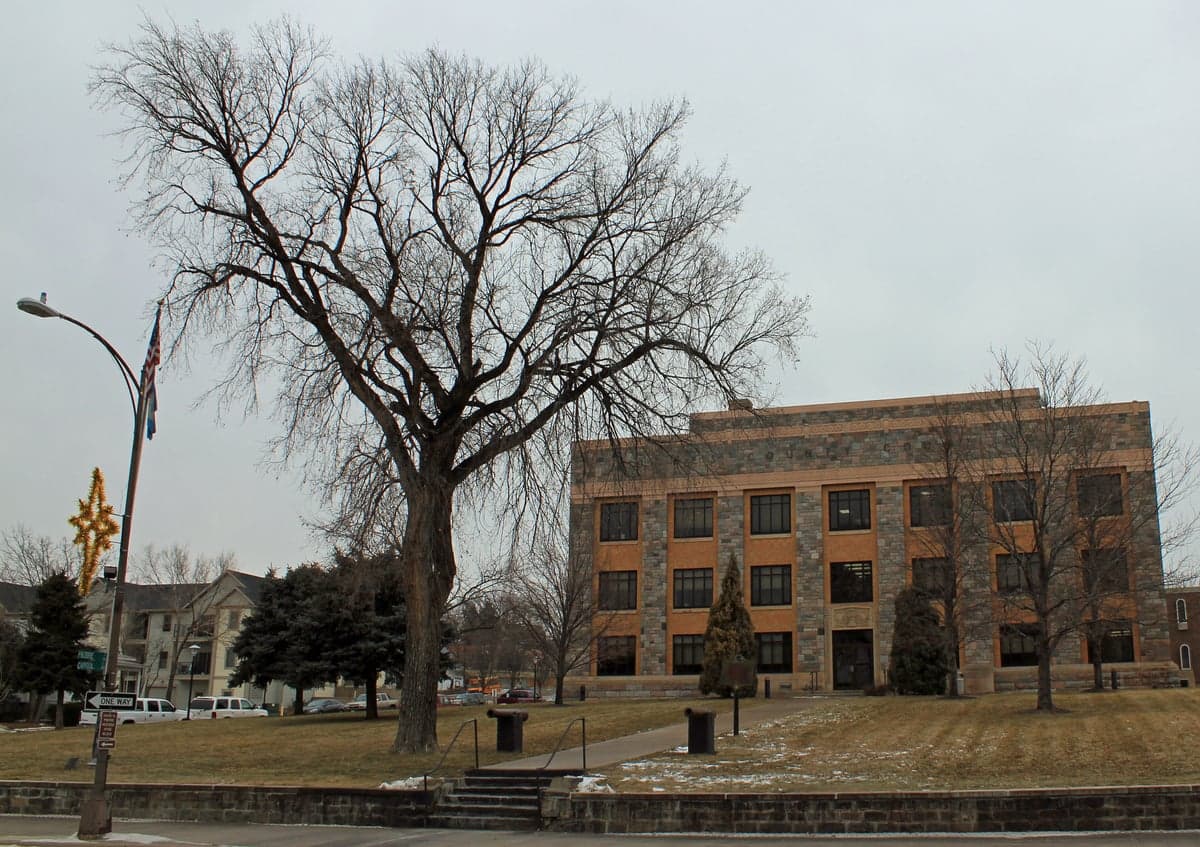
Photo: Wikipedia
Demographics of Hughes County
Affluence Level in Hughes County
A middle-class area roughly in line with national averages across income, home values, education, and employment.
People of Hughes County
Today, Hughes County, South Dakota, is defined by its concentrated population center of Pierre (the state capital) and a strong, predominantly white, family-oriented character. With 17,732 residents, the county is notably homogeneous — 80.7% white, 0.2% foreign-born, and with no Black population — creating a distinct community identity rooted in state government, agriculture, and outdoor recreation along the Missouri River. The population is well-educated relative to rural peers (35.9% college educated) and leans conservative, reflecting a region where civic life revolves around capital politics, the Fort Pierre Chouteau historical legacy, and a stable, slow-growth demographic pattern.
Settlement & growth (pre-1960)
Before Euro-American settlement, the area now known as Hughes County was central to the Oceti Sakowin (Sioux) — specifically the Lakota and Dakota nations — who used the Missouri River valley as a seasonal hunting and trading corridor. The Lewis and Clark Expedition passed through in 1804 and 1806, noting the strategic bluffs and river crossings. The first permanent non-Native presence was the fur trade: the French established the Fort Pierre Chouteau trading post (now Fort Pierre) in 1832 on the west bank of the Missouri, making it one of the oldest continuous settlements in the Dakotas. The U.S. Army’s Fort Sully (established 1863 near present-day Pierre) solidified military control after the Dakota War of 1862, paving the way for homesteaders.
The defining settlement wave arrived with the Dakota Land Boom of the 1880s, when the Chicago and North Western Railway extended lines into central Dakota territory. Homesteaders—overwhelmingly of Northern European stock—claimed 160-acre parcels under the Homestead Act of 1862. The county was formally organized in 1880, and Pierre was platted in 1880 on the east bank of the Missouri, named after fur trader Pierre Chouteau Jr. A crucible moment came in 1889: when South Dakota was admitted to the Union, Pierre won a fierce, bribery-tinged competition against Huron, Mitchell, and Chamberlain to become the permanent state capital, a decision that cemented the county’s economic and political future. German, Norwegian, Swedish, and Czech immigrants dominated this wave, settling not only Pierre but also the small agricultural hamlets of Blunt (founded 1881 as a railroad town), Harrold (1883), and Canning (a rural settlement along the railroad). These communities relied on dryland wheat farming and cattle ranching, with the Missouri River providing a natural boundary and transportation route.
The 1930s Dust Bowl hit Hughes County hard, as it did much of the Great Plains, causing a population decline from a 1930 peak of nearly 9,000 to roughly 8,000 by 1940. Many farm families left for California or cities, but those who stayed adapted by shifting to cattle ranching and irrigated farming with the development of the Oahe Dam and Reservoir in the 1940s and 1950s. The dam, authorized in 1944 and completed in 1962, brought a major construction workforce to the area, including temporary labor camps near Fort Pierre, and flooded the original townsite of Forest City (a historic Missouri River steamboat landing) and several Lakota villages. This infrastructure project depopulated the river bottomlands but concentrated county population in Pierre and Fort Pierre, which remain the only incorporated towns. By 1960, Hughes County’s population had stabilized at roughly 8,100, overwhelmingly white and Native-born, with a small Lakota presence on nearby Indian reservations (though not within Hughes County’s boundaries; the Crow Creek Reservation lies just south, in Buffalo County).
Modern era (post-1965)
The 1965 Hart-Cellar Act had virtually no demographic effect on Hughes County. With a foreign-born share of just 0.2% in 2024 — essentially zero — the county remains one of the least immigrant-impacted areas in the United States. No significant post-1965 immigrant enclave formed in Pierre, Fort Pierre, Blunt, or Harrold. Instead, demographic change since the 1960s has been driven by domestic migration patterns and natural population dynamics. The completion of the Oahe Dam and the establishment of state government as the dominant employer (the State Capitol, State Penitentiary, and associated offices) attracted a steady inward flow of white-collar families from other parts of South Dakota and the Midwest, particularly during the 1970s and 1980s as state government expanded.
Population growth has been modest but consistent: from 8,100 in 1960 to 10,700 in 1970, 12,400 in 1980, and 15,400 in 2000, reaching 17,732 in the 2020 census. This growth came almost entirely from natural increase (births minus deaths) and domestic migration of native-born whites, with a small but visible East/Southeast Asian presence (0.8% in 2024). This tiny Asian population — likely professionals such as doctors at the Avera St. Mary’s Hospital or state government IT specialists — is widely dispersed, with no identifiable ethnic enclave. The Hispanic share of 3.1% is the county’s only notable non-white demographic shift, concentrated in Pierre’s service and construction sectors, but still below the South Dakota state average of 4.5%. The Black share of 0.0% reflects the near-total absence of the Great Migration’s later dispersals into the rural Plains.
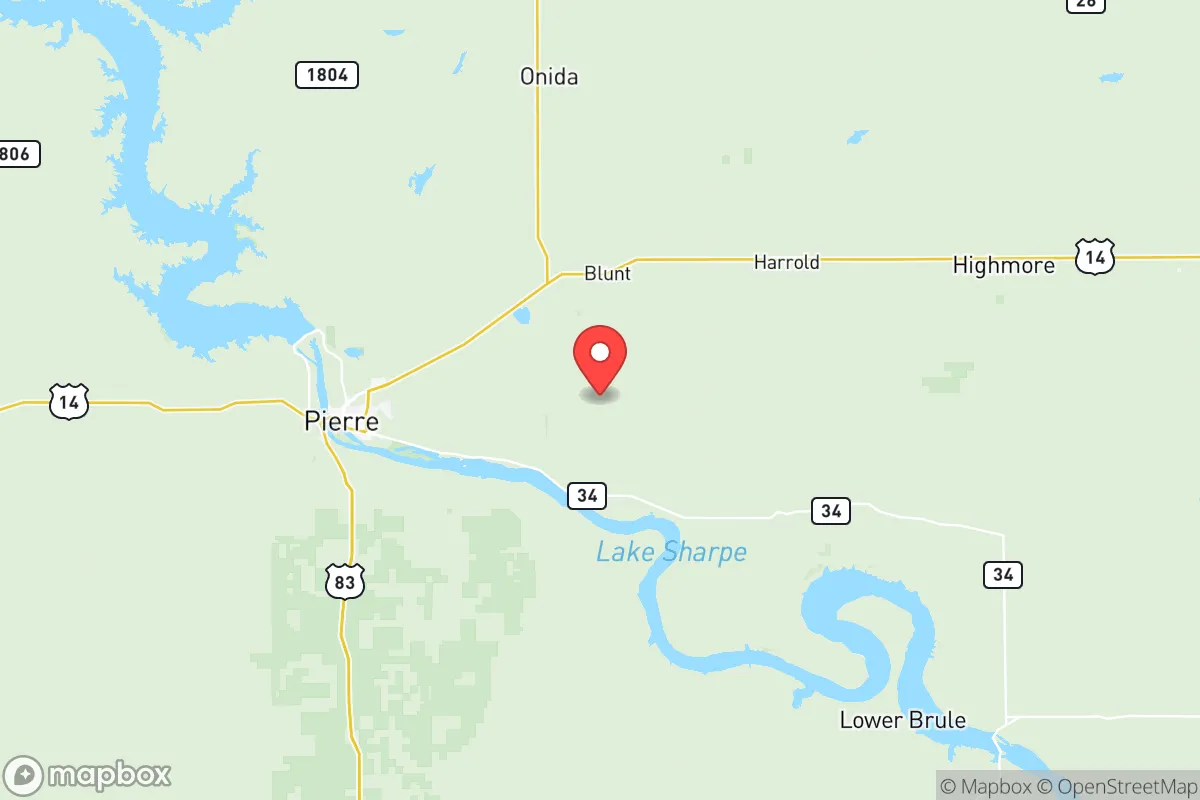
Suburbanization played out within a very small frame. The unincorporated area around Pierre, especially west toward the Missouri River near Cedar Island and south along Highway 34, saw low-density home construction during the 1990s and 2000s as families sought larger lots and river access. But the county has no true suburbs — Pierre (population ~14,000) and Fort Pierre (population ~2,300) remain small, walkable communities where the majority of residents live inside city limits. The agricultural hamlets of Blunt (population ~350) and Harrold (population ~120) have aged in place, losing younger residents to Pierre or out-of-state metro areas.
The future
Hughes County is projected to continue its slow, stable growth — the state demographer’s office forecasts a population of roughly 18,500 by 2040. The county is not becoming more diverse. With a 0.2% foreign-born share and 0.0% Black population, future diversity gains, if any, will likely be marginal increases in the Hispanic and East/Southeast Asian shares, as these groups gradually follow economic opportunities in Pierre’s health care and manufacturing sectors (the county’s largest private employers include Avera St. Mary’s Hospital, the state government, and concrete/aggregate operations). No new immigrant communities are forming; any growth will be from the children of existing minority residents or from inter-county migration of Hispanic workers from meatpacking hubs farther east (e.g., Huron, Sioux Falls).
The cultural identity of Hughes County is likely to remain rooted in its role as the state capital — politically conservative, civic-minded, and family-focused — with a strong attachment to outdoor recreation along Lake Oahe (walleye fishing, boating, hunting). The population is aging slightly (median age 40, compared to 37 nationally), which may moderate growth rates over the next decade as natural increase slows. New residential development is expected to continue the existing pattern: infill in Pierre and Fort Pierre, with scattered country lots on the periphery. The rural hamlets of Blunt and Harrold will continue to shrink, serving as bedroom communities for a handful of commuters and retirees. There is no sign of the urbanization or diversification trends reshaping larger Plains cities like Sioux Falls or Rapid City reaching Hughes County at scale.
For someone moving to Hughes County today, the bottom line is clear: this is a stable, culturally conservative, low-diversity community built around state government and the Missouri River landscape. The population is not undergoing dramatic change; the immigration and urbanization reshaping much of the American West are absent here. A new resident will find a small-town, largely white, politically engaged environment where knowing your neighbor and participating in local affairs are expected norms. If demographic dynamism or ethnic diversity is a priority, Hughes County is the wrong choice — but for those seeking a predictable, safe, and civic-minded Plains community, it remains a strong option.

* Values derived from national, state, county, city and local statistics and may differ in a specific area. Last updated: 2026-07-02T10:33:10.000Z
Narrative content on this page is AI-generated and may contain mistakes. Verify any details that matter before acting on them.
ReloMaps may earn a commission from affiliate links at no extra cost to you.

