Photo: Wikipedia
Political ClimatePolitical Climate in Richland County
Showing district-level results — no local-only data available.
Local Political AnalysisPolitical Analysis of Richland County
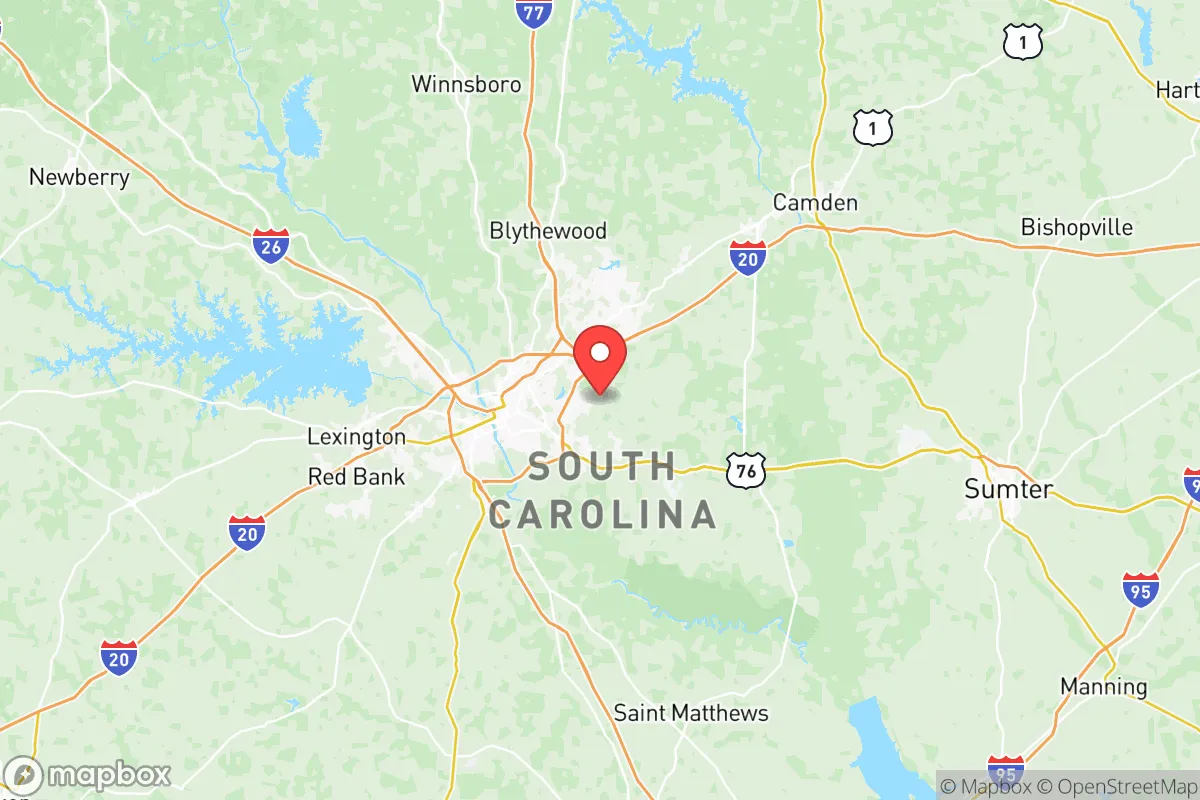
Richland County is a Democratic stronghold in a Republican-leaning state, with a Cook PVI of R+7 that actually masks a deep urban-rural split. The county itself votes reliably blue in presidential elections—Hillary Clinton won it by 17 points in 2016, Joe Biden by 19 in 2020—but that's almost entirely driven by the city of Columbia and its inner suburbs. The rest of the county, particularly the northern and eastern rural areas, votes as red as the rest of South Carolina. The county's overall PVI is R+7 because the state as a whole is R+8, meaning Richland is only slightly less Republican than the state average, but that's a statistical illusion: the county's Democratic vote is concentrated in a dense urban core, while the Republican vote is spread across a much larger land area.
How it compares
Compared to South Carolina as a whole, Richland County is a blue island in a red sea. The state's R+8 PVI reflects a solidly Republican electorate outside of a few urban counties—Charleston, Richland, and parts of Greenville. Within Richland, the contrast is stark. Columbia's downtown precincts, like those around the University of South Carolina and Five Points, routinely vote 70-80% Democratic. In contrast, the town of Blythewood in northern Richland County leans Republican, often voting 55-60% for GOP candidates. The suburban areas around Irmo and Lake Murray are more competitive—these are the swing precincts where local races are decided. In the 2022 governor's race, for example, Irmo precincts split almost evenly between Henry McMaster and Joe Cunningham, while Blythewood went about 55% for McMaster. The county's Democratic lean is real, but it's not monolithic: the further you get from Columbia's urban core, the more the county looks like the rest of South Carolina.
What this means for residents
For conservative residents, living in Richland County means being in the political minority at the county level but still well-represented at the state level. The county council and school board are reliably Democratic, which can frustrate conservatives on issues like zoning, taxes, and education policy. But state legislative districts are drawn to give rural and suburban areas strong Republican voices—your state senator from Blythewood or northern Richland is likely a Republican who can influence state-level decisions on roads, schools, and business regulations. For liberal residents, the county government is generally aligned with their values on social issues and urban development, but state preemption laws limit what the county can do on things like minimum wage, gun control, and environmental regulations. Richland County's Democratic majority means local policies tend to be more progressive than the state's, but the state legislature often overrides them. This creates a constant tension: Columbia can pass a local anti-discrimination ordinance, but the state can block it. It's a political reality that both sides have learned to navigate.
Culturally, Richland County's political divide shows up in everyday life. Columbia's urban core is home to a vibrant arts scene, a large university population, and a growing tech sector—all of which lean left. The rural parts of the county are more traditional, with a strong military presence from Fort Jackson, a deep hunting and fishing culture, and a slower pace of life. One notable policy distinction: Richland County has a higher property tax rate than surrounding Lexington County, which is more Republican and has lower taxes. This is a frequent point of contention in local elections. The county also has a more robust public transit system (the COMET bus network) and more investment in affordable housing programs than its neighbors. For newcomers, the key takeaway is that Richland County offers a genuine choice: you can live in a blue urban environment or a red rural one, all within the same county lines. The political climate is not a monolith—it's a reflection of the county's diversity, for better or worse.

State Political ClimatePolitical Climate in South Carolina
State Political AnalysisPolitical Environment in the State
South Carolina has been a reliably Republican state for a generation, with a Cook Partisan Voting Index of R+8, meaning it votes about eight points more Republican than the nation as a whole. That lean is driven by a coalition of white evangelical voters, rural conservatives, and a growing number of transplants from other red states, but it’s not a monolith — the state has a significant Democratic base anchored by the African American community, which makes up about 27% of the population, and by the rapidly growing Charleston and Columbia metro areas. Over the last 10-20 years, the state has shifted rightward on cultural and economic issues, even as its suburbs have become more competitive, creating a political landscape that feels both deeply entrenched and quietly in flux.
Urban vs. rural divide
The political map of South Carolina is a textbook study in the urban-rural split. The state’s two largest metros — Charleston and Columbia — are the only real Democratic strongholds, and even they are not uniformly blue. Charleston County has trended Democratic for a decade, driven by the city’s tourism economy, its growing tech and port sectors, and an influx of out-of-state professionals; it voted for Biden by about 15 points in 2020. But just outside the city limits, places like Mount Pleasant and Summerville are more purple, with many precincts splitting tickets. Columbia, home to the state university and a large state government workforce, is similarly Democratic in the city core, but Lexington County to its west — suburbs like Lexington and Irmo — is among the most reliably Republican areas in the state. The real engine of the state’s red lean is the rural and small-town corridor from the Pee Dee region through the Midlands and into the Upstate. Counties like Oconee, Pickens, and Anderson in the Upstate routinely vote 70-75% Republican, while the Lowcountry’s Beaufort and Hilton Head areas are more moderate but still lean right, thanks to a large retiree population from the Midwest and Northeast. The Greenville-Spartanburg metro is the state’s fastest-growing area and a bellwether: Greenville County itself is still Republican, but the city of Greenville has become noticeably more liberal, with younger professionals and a growing arts scene pushing it toward the center-left.
Policy environment
South Carolina’s policy environment is broadly conservative, with a few notable exceptions that reflect its particular history. The state has no personal income tax on Social Security benefits and a flat income tax rate that is being phased down to 6.2% by 2026, with a goal of reaching 5% in the coming years. Sales tax is 6% at the state level, but local options can push it to 9% in some counties. Property taxes are among the lowest in the country, especially for owner-occupied homes, thanks to a 4% assessment cap that was locked in by a 2006 constitutional amendment. The regulatory posture is business-friendly: South Carolina is a right-to-work state, and its tort reform laws have made it a popular destination for manufacturers — BMW, Boeing, and Volvo all have major plants here. On education, the state has expanded school choice significantly, with the 2023 Education Scholarship Trust Fund program providing up to $6,000 per year for private school tuition, and a 2024 law that allows charter schools to operate without local district approval. Healthcare policy is more mixed: the state did not expand Medicaid under the Affordable Care Act, leaving about 200,000 low-income adults in the coverage gap, but it has a robust network of federally qualified health centers. Election laws have tightened in recent years: voter ID is required, early voting was expanded to two weeks in 2022, but absentee voting by mail requires an excuse, and the state has purged inactive voters from rolls regularly.
Recent policy direction
The last five years have seen South Carolina move decisively to the right on a broad set of issues that relocators care about. On gun rights, the state enacted permitless carry in 2024, allowing any law-abiding adult to carry a concealed firearm without a permit; it also has a “stand your ground” law and preempts local gun ordinances. Parental rights in education were strengthened by the 2023 “Parents’ Bill of Rights,” which requires schools to notify parents of any changes to a student’s health or well-being and prohibits instruction on sexual orientation or gender identity in K-5 classrooms. The state also passed a near-total abortion ban in 2023, with exceptions only for rape, incest, and the life of the mother, and a six-week ban that was in effect before that. On property rights, South Carolina is a “Dillon’s Rule” state, meaning local governments have only the powers explicitly granted by the state, which has limited local rent control and zoning restrictions. Privacy and surveillance are less protected: the state has no comprehensive data privacy law, and law enforcement can access cell phone location data without a warrant in some circumstances. Voting access has been a flashpoint: the 2021 “Election Integrity Act” shortened the window for absentee ballot returns and banned ballot drop boxes, though it also added two weeks of early voting. On speech, the state has no hate crime law, which is a notable gap, but it also has no law restricting speech on college campuses beyond federal requirements.
Civil unrest & political movements
South Carolina’s political activism is visible but not as volatile as in some other states. The most significant flashpoint in recent memory was the 2015 Charleston church shooting, which led to the removal of the Confederate flag from the Statehouse grounds — a moment that was both a reckoning and a rallying point for activists on both sides. Since then, the state has seen periodic protests over Confederate monuments, particularly in Charleston and Columbia, but they have been largely peaceful. The “Moms for Liberty” movement has been active in school board races, especially in Lexington and Greenville counties, pushing for book bans and curriculum transparency. On the left, the “SC for Abortion Rights” coalition has organized rallies at the Statehouse, and the NAACP remains a powerful force in the state’s African American communities. Immigration politics are less heated than in border states: South Carolina has no sanctuary cities, and a 2011 law (SB 20) requires law enforcement to check immigration status of anyone arrested, but enforcement has been uneven. There is a small but vocal secessionist movement — the “League of the South” has a presence in the Upstate — but it has no real political influence. Election integrity controversies flared after 2020, with some Republican county officials questioning results, but the state’s GOP leadership, including Governor Henry McMaster, has largely moved on. A new resident would notice that political signs and bumper stickers are common, but actual conflict is rare — most people keep their politics to themselves in daily life.
Projection
Over the next 5-10 years, South Carolina is likely to remain solidly Republican, but the margins will probably narrow in the suburbs. The state is growing fast — it added about 200,000 new residents between 2020 and 2024 — and many of those newcomers are coming from blue states like New York, New Jersey, and California. While some of these transplants are conservative, many are moderates or liberals who will push Charleston, Greenville, and Columbia further left. The rural areas will stay deeply red, but they are losing population, so their electoral weight is shrinking. The big question is whether the state’s Republican Party will continue to move right on cultural issues or moderate to hold the suburbs. The 2024 legislative session saw some internal GOP fights over school vouchers and tax cuts, suggesting a pragmatic wing is still alive. For a new resident, the practical takeaway is that the state’s politics will feel conservative in the countryside and in state government, but increasingly diverse and contested in the cities — and that the gap between those two worlds is likely to widen, not narrow.
For someone moving to South Carolina, the bottom line is that you’ll find a state that is broadly conservative in its laws and culture, but with real variation depending on where you land. If you’re conservative, you’ll feel at home in most places, especially in the Upstate or the suburbs around Columbia. If you’re liberal, you’ll find your people in Charleston, Columbia, or the more progressive pockets of Greenville, but you’ll need to accept that state-level policy will often be at odds with your views. The state’s low taxes, business-friendly climate, and strong gun rights are stable features, while its abortion laws and education policies are likely to remain contested. The best advice: visit the specific city or town you’re considering, talk to locals, and understand that the political climate in Greenville is not the same as in Beaufort or Florence — and that’s the real story of South Carolina politics.
* Values derived from national, state, county, city and local statistics and may differ in a specific area. Last updated: 2026-06-15T12:11:45.000Z
Narrative content on this page is AI-generated and may contain mistakes. Verify any details that matter before acting on them.
ReloMaps may earn a commission from affiliate links at no extra cost to you.

