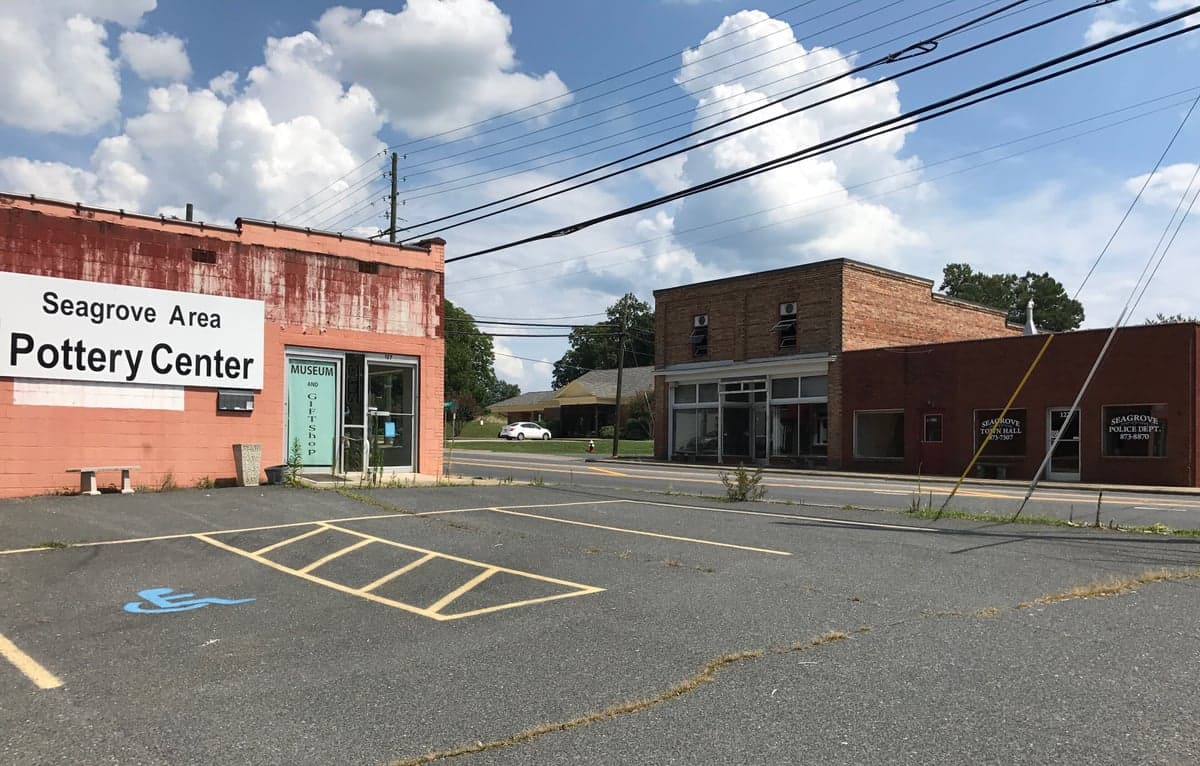
Photo: Wikipedia
Personal Sovereignty in Seagrove, NC
Viable for self-reliance. Generally workable, though some barriers may limit total independence.
What does Personal Sovereignty tell us?
Personal Sovereignty measures your capacity for self-reliance and independence with minimal government friction. Higher scores mean fewer barriers between you and the way you want to live... but it assumes you have the space you need and good neighbors.
What does this tell us?
Personal Sovereignty measures your capacity for self-reliance and independence with minimal government friction. Higher scores mean fewer barriers between you and the way you want to live... but it assumes you have the space you need and good neighbors.
State Policy
Energy independence: Importer (15% of energy produced in-state)
Personal Liberty
Homesteading

Personal Liberty Analysis
Seagrove, North Carolina, offers a personal sovereignty environment that leans heavily on state-level protections and a rural, low-density setting where residents can exercise considerable autonomy in daily life. Located in Randolph County, this small pottery town sits in a region where conservative values and a tradition of self-reliance shape local governance. For individuals and families who prioritize independence—whether in financial decisions, self-defense, or lifestyle choices—Seagrove provides a framework where state law generally defers to personal responsibility, and local ordinances remain light-touch. The following analysis breaks down the key factors that determine how much freedom you can actually exercise here.
Tax burden and regulatory posture in Seagrove
North Carolina’s tax structure is relatively favorable for those seeking to keep more of their earnings. The state levies a flat income tax rate of 4.75% as of 2026, with no progressive brackets, which simplifies planning and avoids bracket creep. Sales tax in Randolph County totals 6.75% (state 4.75% plus local 2%), which is moderate compared to many states. Property taxes are assessed at the county level; Randolph County’s rate is approximately $0.66 per $100 of assessed value, well below the national average. For a home valued at $250,000, annual property tax comes to about $1,650. There is no separate city property tax in Seagrove itself—the town operates on a small municipal budget funded largely by sales tax revenue and state grants. Regulatory posture at the county level is generally permissive. Randolph County does not impose overly restrictive building codes outside of state minimums, and zoning in unincorporated areas is minimal. Seagrove’s town ordinances focus on basic land use and public safety, not on micromanaging property improvements or business operations. The overall message: the tax burden is light, and you won’t face layers of bureaucracy for routine activities like home renovations or starting a small workshop.
Self-defense and gun law specifics for Seagrove residents
North Carolina is a strong Second Amendment state, and Seagrove residents benefit from that legal framework. Open carry of handguns is legal without a permit for anyone 18 or older who can legally possess a firearm. Concealed carry requires a permit issued by the county sheriff under a shall-issue system—meaning if you meet the criteria (background check, training course), the permit must be granted. As of 2024, North Carolina does not have permitless concealed carry, but efforts to pass such legislation are ongoing. The state has a Castle Doctrine law that creates a legal presumption that a person using deadly force inside their home, vehicle, or workplace had a reasonable fear of death or great bodily harm, and there is no duty to retreat in those locations. However, North Carolina does not have a pure “stand your ground” law that extends to public places; you still have a duty to retreat outside of the castle if safely possible. Randolph County Sheriff’s Office is known for being supportive of gun rights; permit processing times are generally under 90 days. There are no county-level gun control ordinances that go beyond state law. For a family that values self-defense autonomy, Seagrove offers a legal environment where you can carry, store, and use firearms with minimal interference, provided you follow state permit requirements for concealed carry.
Self-reliance and homesteading viability: lot sizes, zoning, off-grid feasibility
Seagrove’s rural character makes it a practical location for homesteading and off-grid living. Minimum lot sizes in the unincorporated areas of Randolph County are typically 1 acre for a single-family dwelling with a septic system, though some subdivisions may require larger parcels. Within Seagrove town limits, lots can be smaller (0.25–0.5 acres), but most residential properties still offer enough space for a substantial garden, small livestock, or a workshop. Zoning in the town is primarily residential and agricultural; keeping chickens, goats, or even a horse is generally allowed on lots of one acre or more, though you should check with the town planning office for specific animal limits. Off-grid feasibility is high: North Carolina has no statewide ban on rainwater harvesting, and many rural homes use private wells and septic systems. Solar panels are permitted without special restrictions, and net metering is available through Duke Energy, the dominant utility. However, building codes still require a permit for structural changes, and you must meet state minimum electrical and plumbing standards even if you are off-grid. There are no county-level bans on composting toilets or alternative waste treatment systems, but they must be approved by the county health department. Overall, if you want to reduce reliance on municipal utilities and grow your own food, Seagrove’s regulatory environment is accommodating without being absent.
Personal liberties: parental rights, medical autonomy, speech, property
North Carolina has a strong track record on parental rights in education. The state’s Parents’ Bill of Rights, enacted in 2023, gives parents the right to review instructional materials, opt their children out of certain assignments, and be notified of medical or mental health services provided at school. Randolph County Schools generally follow these laws, and the local school board is conservative-leaning, which means parental input is taken seriously. Medical autonomy is more mixed: North Carolina does not have a broad religious exemption for vaccinations, but it allows philosophical exemptions for school immunization requirements only for existing students who were enrolled before the law changed (new students must have medical or religious exemptions). For adults, there are no state mandates for COVID-19 or other vaccines. Telehealth and direct-primary-care arrangements are legal and common. Free speech is protected under the First Amendment, and there are no local ordinances that restrict political signs, yard displays, or public expression beyond standard time-place-manner rules. Property rights are strong: North Carolina has a right-to-farm law that protects agricultural operations from nuisance lawsuits, and eminent domain is limited to public projects with fair compensation. Randolph County does not have a county-wide noise ordinance that would restrict late-night work on your property. The overall liberty environment is one where the default is “allowed unless specifically prohibited,” rather than the reverse.
Compared to many other parts of the Southeast, Seagrove offers a high degree of personal sovereignty without requiring you to live completely off the grid or fight local government at every turn. The tax burden is low, gun laws are permissive within a shall-issue framework, homesteading is practical, and personal liberties are protected by state law and local culture. For a family or individual who values independence and wants a place where the government stays out of your way, Seagrove ranks well—especially when you factor in the low cost of land and the supportive community of fellow self-reliant residents. It is not a libertarian utopia (no place is), but it is a solid, practical choice for those who want to live with fewer constraints.

* Values derived from national, state, county, city and local statistics and may differ in a specific area. Last updated: 2026-10-11T22:42:40.000Z
Narrative content on this page is AI-generated and may contain mistakes. Verify any details that matter before acting on them.
ReloMaps may earn a commission from affiliate links at no extra cost to you.

