Photo: Wikipedia
Demographics of Saint Petersburg, FL
Affluence Level in Saint Petersburg, FL
A middle-class area roughly in line with national averages across income, home values, education, and employment.
People of Saint Petersburg, FL
Saint Petersburg, Florida, is home to roughly 260,600 residents, a population that is 63.6% White, 19.2% Black, and 9.3% Hispanic, with a notably small foreign-born share of just 3.2%. The city’s identity is defined less by immigration and more by domestic migration, a 41.3% college-educated workforce, and a deep-rooted sense of place that still carries the influence of its Midwestern and Southern founders. Today, it is a densely settled, culturally active city on a peninsula, where historic neighborhoods sit alongside rapidly redeveloping waterfront districts.
How the city was settled and grew
Unlike many Eastern Seaboard cities, Saint Petersburg has no colonial-era history; it was founded in 1888 by John C. Williams, a Detroit native, and Peter Demens, a Russian immigrant who named the city after his homeland’s capital. The arrival of the Orange Belt Railway in 1888 and the Gandy Bridge in 1924 opened the floodgates for the first major wave of settlers: retirees and seasonal visitors from the Midwest and Northeast, drawn by the warm climate and cheap land. These early transplants built the city’s first residential core in the Historic Old Northeast, a neighborhood of brick streets and Mediterranean revival homes that still anchors the city’s identity. The 1920s land boom brought a second wave of speculators and construction workers, who filled out Roser Park and Bartlett Park with modest bungalows, while the city’s Black community, largely arriving from the rural South during the Great Migration, established a thriving commercial and residential district in Midtown along 22nd Street South. By 1950, the city’s population had swelled past 96,000, and its character was firmly set: a retirement haven with a strong Midwestern accent and a segregated but self-sufficient Black community in the south side.
Modern era (post-1965)
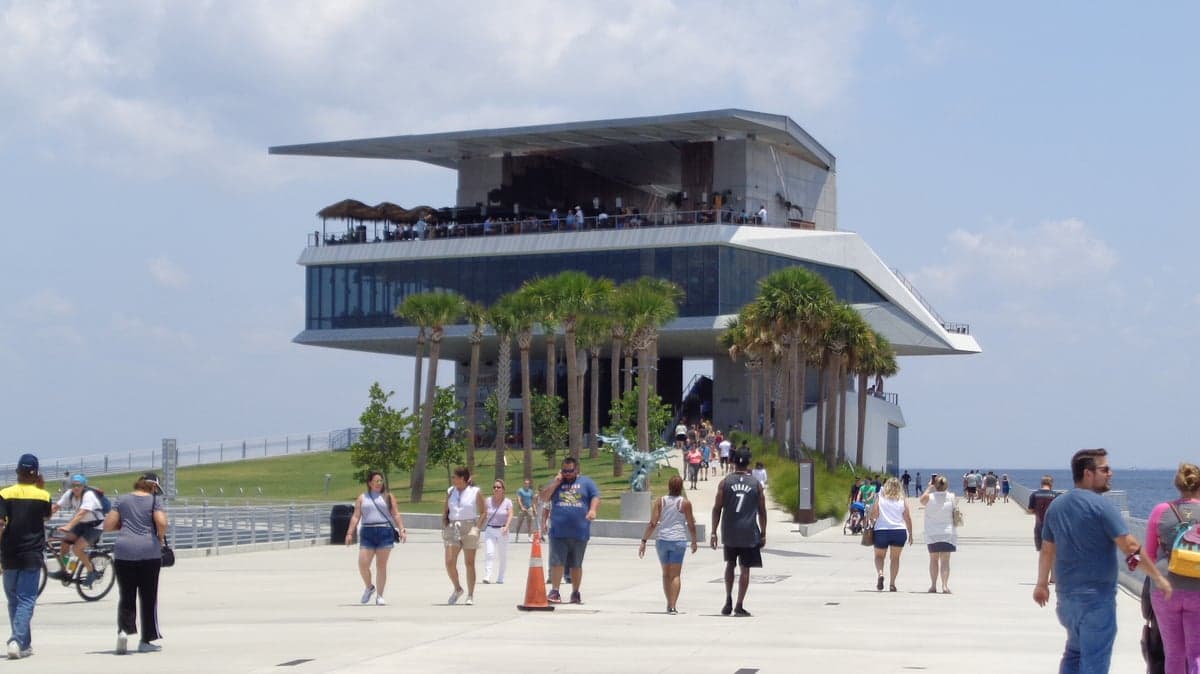
The passage of the 1965 Hart-Cellar Act had minimal direct impact on Saint Petersburg’s demographics; the city’s foreign-born population remains just 3.2%, far below the national average. Instead, the post-1965 era was defined by domestic in-migration and suburbanization. The completion of Interstate 275 in the 1970s accelerated white flight to unincorporated Pinellas County, while the city’s Black population, which had been concentrated in Midtown and Childs Park, began to expand southward into Lakewood Estates and the Greater Pinellas Point area. The 1980s and 1990s brought a wave of Hispanic residents, primarily of Puerto Rican and Mexican descent, who settled in the Disston Heights and Central Oak Park corridors, establishing small businesses and churches that remain anchors today. The most transformative shift came after 2000, when the city’s downtown waterfront redevelopment—led by the Pier District and the Dali Museum—began attracting a new wave of young professionals and empty-nesters from other Florida metros and the Northeast. This influx has driven the college-educated share to 41.3% and has pushed housing prices up sharply, particularly in Historic Old Northeast and the Edge District, where former industrial blocks have been converted into condominiums and breweries.
The future
Saint Petersburg’s population is becoming more diverse, but the change is gradual and driven by domestic migration rather than international immigration. The Hispanic share, now 9.3%, is the fastest-growing segment, projected to reach 12-14% by 2040 as younger families move into the Disston Heights and Lealman areas from other parts of Florida. The Black population, at 19.2%, is stable but aging, with younger Black residents increasingly moving to southern Pinellas County suburbs like unincorporated South Pasadena and Gulfport rather than the city core. East and Southeast Asian residents, at 2.3%, are a small but growing presence concentrated in the Gateway area near the Pinellas Park border, while the Indian-subcontinent community, at 0.8%, is dispersed and largely employed in the medical and tech sectors. The city’s cultural identity is shifting from a retiree haven to a younger, more professional, and more politically progressive place, but the pace of change is moderate—the median age has dropped only slightly, and the city remains whiter and less immigrant-heavy than Tampa across the bay.
For someone moving in now, Saint Petersburg offers a rare combination: a walkable, amenity-rich urban core with a stable, long-established population that is slowly diversifying. The city is not experiencing the rapid ethnic turnover seen in Miami or Orlando; instead, it is becoming a more educated, more expensive, and slightly more Hispanic version of its former self. New residents will find a community that values its historic neighborhoods, its waterfront, and its arts scene, but they should expect a city where change comes incrementally, and where the demographic story is one of domestic migration and gentrification rather than international immigration.

* Values derived from national, state, county, city and local statistics and may differ in a specific area. Last updated: 2026-11-20T05:17:55.000Z
Narrative content on this page is AI-generated and may contain mistakes. Verify any details that matter before acting on them.
ReloMaps may earn a commission from affiliate links at no extra cost to you.

