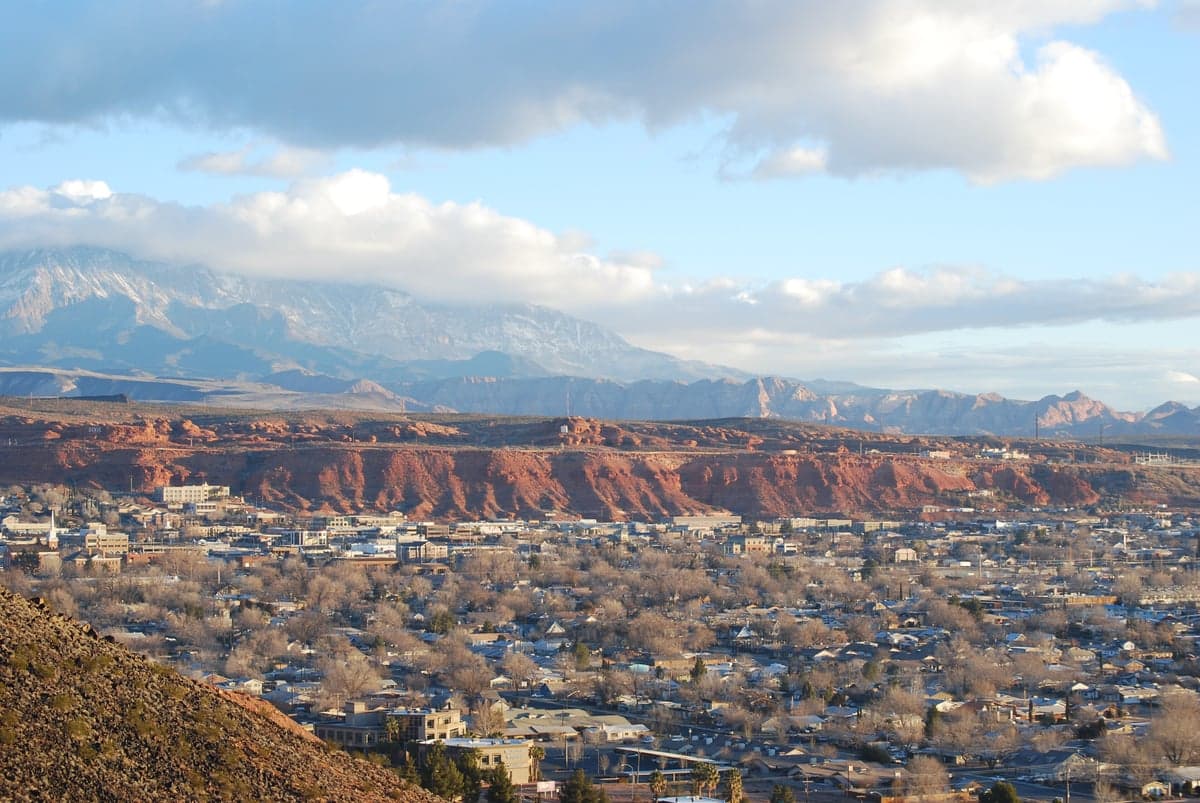
Photo: Wikipedia
Political ClimatePolitical Climate in Saint George, UT
District shown is the primary district for this city’s centroid. Cities may span multiple districts.
Inherited from parent county — no local data available.
* Lean and PVI are calculated from Saint George, UT’s own 2020 presidential results (precinct returns summed to the city), with 2024 estimated from the surrounding county’s 2020–2024 shift, Cook-style. Sources: state election offices; VEST 2020 precinct results (CC BY 4.0).
Political rankings in Utah
- Most Conservative Cities in Utah
- Most Liberal Cities in Utah
- Best Liberal-Leaning Towns in the Mountain West
- Safest Liberal-Leaning Towns in the Mountain West
- Safest Conservative-Leaning Cities in the Mountain West
- Affordable Small Towns for Conservatives
- Most Affordable Liberal-Leaning Small Towns in the U.S.
- Safest Conservative-Leaning Cities in the U.S.
- Most Conservative Counties in Utah
- Most Liberal Counties in Utah
Local Political AnalysisPolitical Analysis of Saint George, UT
Saint George is one of the most conservative cities in the entire country, with a Cook Partisan Voting Index (PVI) of R+27 — a full 16 points more Republican than the state of Utah as a whole, which sits at R+11. This isn't a recent shift; the area has been a deep-red stronghold for decades, driven by a high concentration of active LDS families, retirees from California and the Intermountain West, and a local economy built around conservative values. If you look at the voting maps, Washington County consistently delivers some of the highest Republican percentages in Utah, and Saint George is the anchor. That said, the city is growing fast — over 100,000 people now — and the influx of out-of-state transplants, especially from blue states, is slowly introducing more political diversity, though the overall lean remains overwhelmingly conservative.
How it compares
To understand how red Saint George really is, compare it to the rest of Utah. The state as a whole is reliably Republican, but places like Salt Lake City (D+18) and Park City (D+16) are deep blue islands. Saint George is the opposite end of the spectrum. Even within Washington County, there's a subtle gradient: the city of Hurricane to the northeast is even more conservative, while Ivins and Santa Clara, with their higher retiree populations, lean slightly less hard-right but still vote Republican by wide margins. The real contrast is with St. George's own Washington City — a suburb that's actually a bit more moderate, though still R+20 or so. The bottom line: if you're used to the political mix of Salt Lake or Provo, Saint George feels like a different planet politically.
What this means for residents
For conservative residents, Saint George is about as comfortable as it gets. Local government, school boards, and city council are all reliably Republican, and policies around taxes, development, and social issues reflect that. You'll find strong support for gun rights, low property taxes, and a general hands-off approach to business regulation. For liberal or moderate residents, the reality is more nuanced. While you won't face open hostility, you'll likely be in the minority in most social and civic settings. The local Democratic Party is small but active, and there are growing pockets of progressive thought, especially among younger transplants and some faculty at Utah Tech University. But don't expect a vibrant left-leaning political scene — it's just not there yet. The biggest practical impact is on local elections: primaries are often more decisive than general elections, and candidates who are too moderate can struggle to gain traction.
Culturally, Saint George's political lean shapes everything from the dominance of the LDS Church in community life to the city's approach to growth and land use. The area is deeply family-oriented, with a strong emphasis on volunteerism and community service, but also a noticeable resistance to public transit expansion and denser housing — both seen as "big government" solutions. The recent push for a new downtown arts district and the expansion of the St. George Regional Airport show that the city is willing to invest in quality of life, but always within a framework of fiscal conservatism. For newcomers, the biggest adjustment is often the social expectation of political conformity — it's not that you can't hold different views, but you'll find fewer people who share them, and local conversations tend to avoid politics unless you're in explicitly political spaces. Over the next decade, as the city continues to grow and diversify, expect the political temperature to warm slightly, but Saint George will remain one of the most reliably conservative cities in America for the foreseeable future.

State Political ClimatePolitical Climate in Utah
State Political AnalysisPolitical Environment in the State
Utah is one of the most reliably Republican states in the country, with a Cook Partisan Voting Index of R+11, meaning it votes about 11 points more Republican than the national average. The dominant political coalition is a blend of the Church of Jesus Christ of Latter-day Saints (LDS) cultural influence, a strong free-market business community concentrated along the Wasatch Front, and a growing population of conservative transplants. Over the past 10-20 years, the state has shifted slightly more Republican in presidential races — Trump won by 20 points in 2020 and by a similar margin in 2024 — but the internal dynamics have grown more complex, with a rising libertarian streak and a small but vocal progressive movement in Salt Lake City.
Urban vs. rural divide
The political map of Utah is defined by the Wasatch Front corridor, which runs from Provo in the south through Salt Lake City to Ogden in the north. This corridor holds roughly 80% of the state's population. Salt Lake County, the most populous, has trended purple over the last decade — it voted for Hillary Clinton in 2016 and Joe Biden in 2020, making it the only county to go blue in a sea of red. Provo and Utah County remain deeply conservative, driven by Brigham Young University and a dense LDS population. St. George in the southwest is a fast-growing retirement and exurban hub that votes heavily Republican, while Moab and Park City are notable blue dots, fueled by tourism, outdoor recreation, and second-home owners from coastal states. Rural counties like Duchesne, Uintah, and San Juan are among the most Republican in the nation, often voting 80-90% for GOP candidates.
Policy environment
Utah's policy environment is shaped by a low-tax, limited-government philosophy. The state has a flat income tax rate of 4.65% and a state sales tax of 4.85%, though local options push the combined rate higher in some cities. There is no inheritance tax. The regulatory posture is business-friendly, with right-to-work laws and a strong tort reform environment. Education policy is a major focus: the state passed a universal school voucher program in 2023, allowing families to use public funds for private or homeschool expenses. Healthcare policy leans toward market-based solutions, with a state-run reinsurance program that stabilized the individual market after the Affordable Care Act. Election laws are moderately restrictive — voter ID is required, and same-day registration is not available. Utah uses a unique hybrid primary system where unaffiliated voters can participate in either party's primary, but registered partisans cannot cross over.
Recent policy direction
Utah's recent legislative sessions have pushed a distinctly conservative-libertarian agenda. On gun rights, the state enacted permitless carry in 2021, allowing any law-abiding adult to carry a concealed firearm without a permit. On parental rights, a 2023 law requires schools to notify parents if a student requests changes to their gender identity or pronouns, and a 2024 law banned transgender girls from participating in female school sports. On speech and privacy, Utah passed a social media regulation law in 2023 requiring age verification for minors and parental consent for accounts under 18, though it faces First Amendment challenges. Medical and bodily autonomy is sharply divided: abortion is banned after 18 weeks, with a trigger law that would ban it entirely if the federal landscape changes, but the state also legalized medical cannabis in 2018 through a voter initiative, though the program remains tightly regulated. Property rights are strong, with no statewide rent control and a low property tax rate. On voting, Utah has resisted the trend toward mail-in voting restrictions seen in other red states — it actually expanded universal mail-in voting in 2020 and kept it. The state also passed a data privacy law in 2022 giving residents more control over how companies collect and sell their personal information.
Civil unrest & political movements
Utah is not known for large-scale civil unrest, but there have been notable flashpoints. The 2020 Black Lives Matter protests in Salt Lake City drew thousands and included some property damage, but were smaller and less violent than in many other major cities. The state has a visible anti-government movement in rural areas, particularly around Kanab and San Juan County, where county commissioners have passed resolutions challenging federal control of public lands — a form of "county supremacy" rhetoric that stops short of secession but signals deep distrust of Washington. Immigration politics are relatively moderate for a red state: Utah was one of the first states to pass a "compact" approach to immigration reform in 2011, allowing undocumented residents to apply for a state-issued driving privilege card. That said, the legislature has moved rightward in recent years, with a 2024 law requiring local law enforcement to cooperate with federal immigration authorities. Election integrity controversies are minimal — Utah's mail-in system has broad bipartisan support, and there have been no major fraud allegations or audit demands. The most visible political movement is the "Utah Way" — a pragmatic, civically engaged conservatism that prizes community problem-solving over partisan combat, though it is increasingly strained by national polarization.
Projection
Over the next 5-10 years, Utah will likely remain solidly Republican but with growing internal tension. The Wasatch Front's population growth — driven by in-migration from California and other high-cost states — is bringing more moderate and libertarian-leaning voters, especially in Salt Lake County and Summit County (Park City). This could push the state toward a more libertarian-conservative blend rather than a purely social conservative one. The LDS Church's influence is slowly receding among younger members, which may soften the state's stance on some social issues over time. Rural areas will continue to vote overwhelmingly Republican, but their political weight will shrink as the Wasatch Front grows. Expect continued fights over public lands, water rights, and education funding, with the legislature likely to push further on school choice and parental rights. A new resident moving in now should expect a state that is deeply conservative in its bones but increasingly open to pragmatic, business-friendly policies that sometimes break with national GOP orthodoxy — think carbon capture incentives, Medicaid expansion, and a cautious embrace of tech-driven governance.
For a new resident, the bottom line is this: if you are conservative, you will find Utah's political climate comfortable and affirming, with a government that generally shares your values on taxes, regulation, and family policy. If you are liberal, you will find a small but active community in Salt Lake City and Park City, but you should expect to be in the minority on most state-level issues. The practical takeaway is that Utah offers a stable, predictable political environment with low taxes and a high degree of personal freedom in many areas — but also a culture that is still shaped by a dominant religious tradition and a cautious approach to social change. It is not a place of dramatic political swings or deep polarization, but rather a state where conservative governance is the norm and change comes slowly, through incremental legislation rather than ballot-box revolution.
* Values derived from national, state, county, city and local statistics and may differ in a specific area. Last updated: 2026-11-20T05:13:53.000Z
Narrative content on this page is AI-generated and may contain mistakes. Verify any details that matter before acting on them.
ReloMaps may earn a commission from affiliate links at no extra cost to you.

