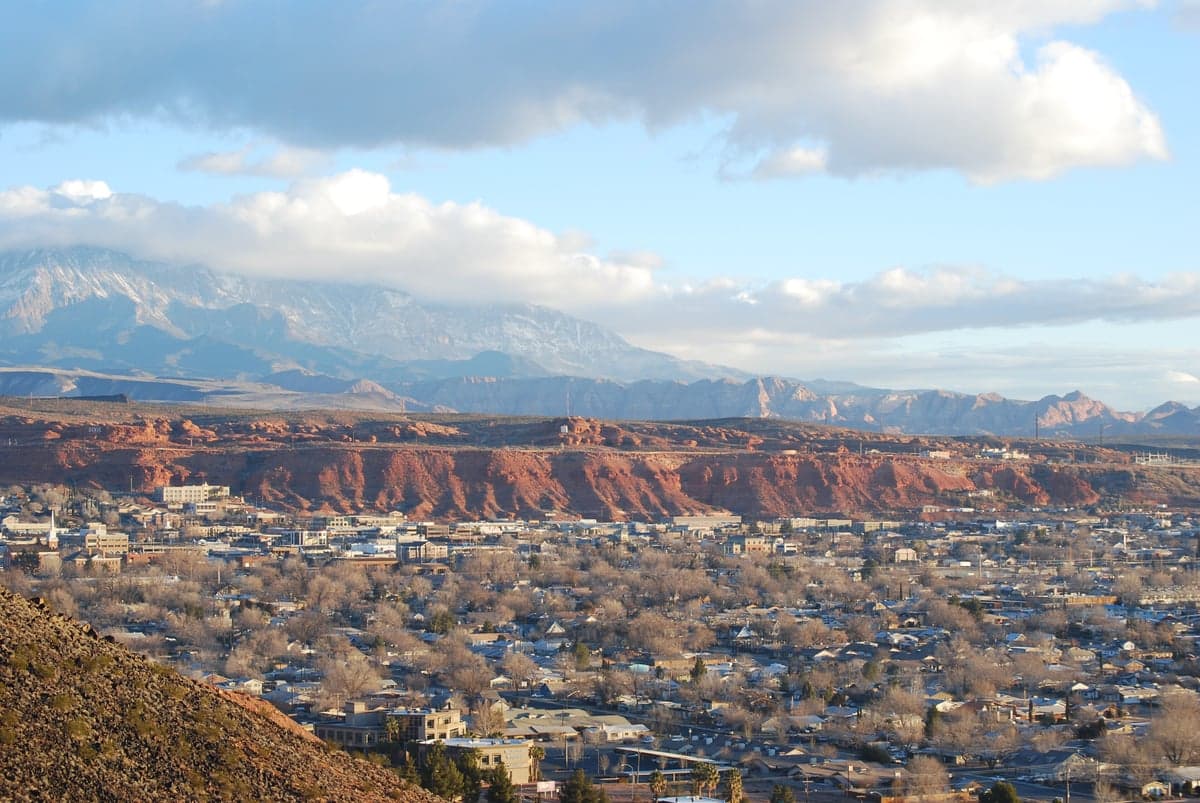
Photo: Wikipedia
Strategic Assessment of Saint George, UT
Meaningful friction. Expect exposure to either population pressure, blast zones, or natural disaster risk. Consider buying a retreat property.
What does the Strategic Assessment tell us?
Our Strategic Assessment grades tactical survivability of an area. Major population centers, military targets, fallout zones, natural disasters, and border exposure all drive risk — lower exposure means a more defensible position in a crisis.
This is heavily inspired by Joel Skousen's Strategic Relocation book. Highly recommended you checkout the book ($)What does this tell us?
Our Strategic Assessment grades tactical survivability of an area. Major population centers, military targets, fallout zones, natural disasters, and border exposure all drive risk — lower exposure means a more defensible position in a crisis.
This is heavily inspired by Joel Skousen's Strategic Relocation book. Highly recommended you checkout the book ($)Strategic Pillars
Key Distances
Regional Safe Places
Below is our recommended "safe zones" in Utah and the surrounding area based on our strategic heuristics. For most people, it's unrealistic to live in a “safe zone” full-time due to work, family or other personal reasons. They tend to be more rural. However, many of these areas are perfect for second homes and retreat properties that double as a vacation home or even a short-term rental.


Important Note: For informational purposes only. This does not mean nothing bad ever happens in the green zones. Please use common sense. This is based on public data and modeled with AI. We tried to take a conservative approach but mistakes happen. We update this regularly as new information becomes available.
Solar Generator Recommendations
Backup power matters more here than in safer locations. We've picked three solar generators across budgets and capacity tiers — start with the budget unit if you only need a few essentials, or step up if you want to run a fridge and HVAC for days at a time.

Jackery Portable Power Station Explorer 300
Budget OptionPower on the Go: Weighing only 11 lbs, it's convenient to set up and store with book-sized foldable solar panels

BLUETTI Portable Power Station AC180
Designed for both indoor and outdoor scenarios, AC180 is highly capable as it has a robost capacity and continuous output power.

EF ECOFLOW DELTA Pro Ultra Power Station
Upgraded PickEcoFlow DELTA Pro Ultra is a whole-home energy system designed to grow with your family. Integrated with the Smart Home Panel 2, it scales to meet your evolving energy needs — keeping your home powered, intelligent, and secure through every stage of life.
We earn a commission, at no additional cost to you.
Strategic Assessment Analysis
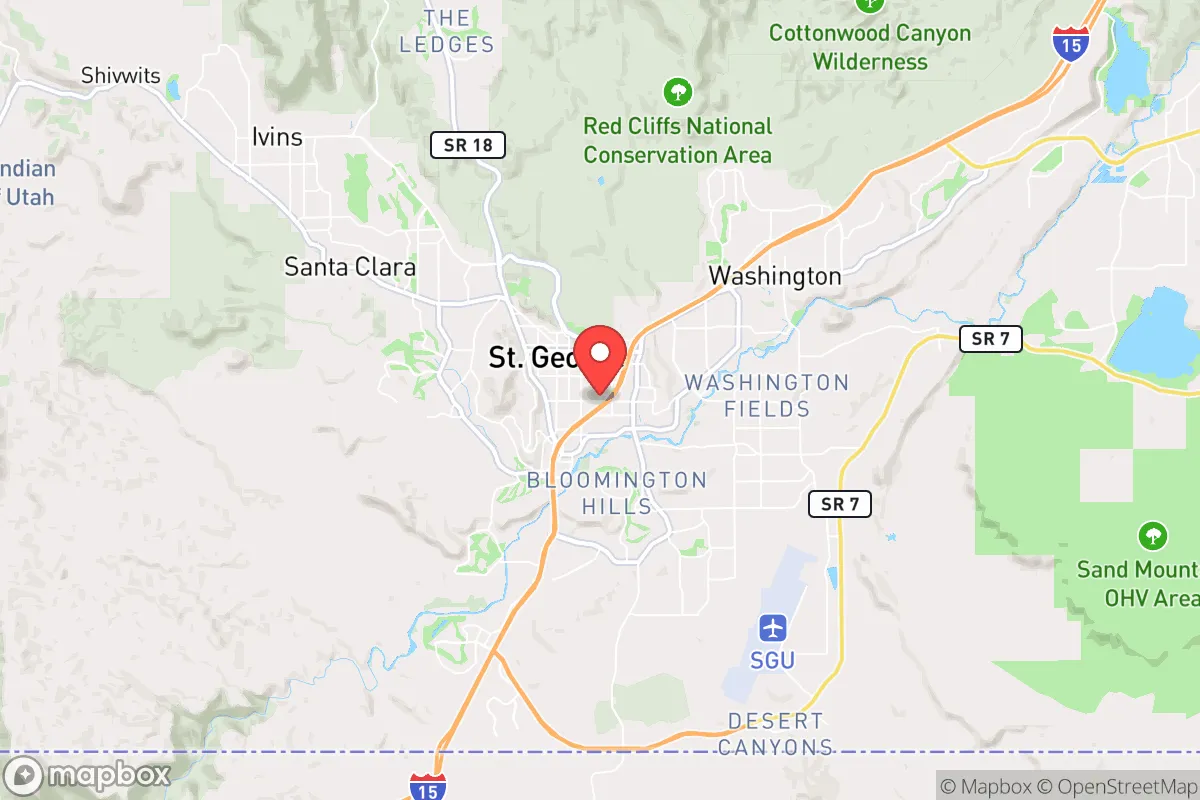
St. George sits in Washington County in Utah's southwestern corner, roughly 120 miles northeast of Las Vegas and 300 miles south of Salt Lake City, at the junction of I-15 and the Virgin River. That location—remote from major population centers but tied to a single north-south interstate—is the core of its resilience story. The city has grown from about 50,000 residents in 2000 to over 100,000 today, making it one of the fastest-growing metros in the country, and that growth cuts both ways: it brings services and infrastructure, but it also strains water and pushes development into fire-prone terrain.
Geographic Position and Natural Advantages of St. George, Utah
St. George's setting is genuinely favorable for a resilience-minded relocator. It lies in the high Mojave Desert at about 2,700 feet elevation, in a basin ringed by the Pine Valley Mountains to the north and the Beaver Dam Mountains to the west. That elevation moderates summer heat compared to Las Vegas and Phoenix, and the surrounding public land—the Dixie National Forest, Red Cliffs National Conservation Area, and the vast BLM tracts of Washington County—means a short drive gets you out of dense development. The nearest interstate-grade alternative routes are limited, but the city is not a crossroads for military targets or industrial hazards. The region's economy rests on retirees, tourism (Zion National Park is 45 minutes east), healthcare (Intermountain Health's Dixie Regional Medical Center is the regional trauma hub), and light manufacturing. St. George also has its own municipal airport and is about 90 minutes from Harry Reid International Airport in Las Vegas, giving it redundant air access.
Risks and Exposure: Proximity to Fallout-Relevant Landmarks
The single biggest strategic negative for St. George is its proximity to Las Vegas, about 120 miles southwest. Las Vegas is a major metropolitan area with military-adjacent infrastructure: Nellis Air Force Base and Creech Air Force Base sit on its northeast edge, and the Nevada Test Site (now the Nevada National Security Site) lies about 65 miles northwest of Las Vegas—roughly 180 miles from St. George. In a worst-case scenario involving a high-altitude detonation or a strike on the test site or Nellis, St. George's prevailing winds are worth knowing: the region's dominant flow is from the southwest, which would push airborne material toward St. George's northeast rather than directly over it, but the margin is not large. More concretely, the 2020s have shown the area's real hazards are natural. The 2024 and 2025 wildfire seasons repeatedly closed I-15 near the Arizona border, and the city's rapid growth into the foothills has increased wildland-urban interface risk. Flash flooding is a recurring issue along the Virgin River corridor and its tributaries—the 2021 and 2022 monsoon seasons caused significant damage in nearby communities like Springdale and in Washington County's slot canyons. The area also sits in a seismic zone with moderate earthquake potential along the Hurricane Fault, which runs along the city's western edge and produced a magnitude 5.7 quake in 1992. And water is the long-term structural risk: Washington County depends on the Virgin River and the depleted regional aquifer, and the area has been under drought stress for most of the past two decades, with state water managers actively restricting new growth tied to water availability.
Practical Resilience for Relocators: Water, Food, Energy, and Defensibility
On the practical side, St. George rewards preparation but demands it in specific ways. Water is the first consideration: the Virgin River and local reservoirs (Sand Hollow and Quail Creek) provide supply, but a household should plan for independent storage, and the county has active conservation incentives. Rainwater harvesting is legal in Utah and increasingly common. Food self-sufficiency is harder than it looks; the desert soil and heat make gardening a matter of raised beds, shade cloth, and drip irrigation, though the area's long growing season (roughly 200 frost-free days) is a genuine asset for fruit trees and warm-season crops. Energy is a mixed picture: Rocky Mountain Power serves the area, and the region has strong solar potential—among the best in Utah—so rooftop solar with battery backup is a practical option, and the city's grid has historically been stable. Defensibility in the personal-security sense is decent: the metro is small enough that a neighborhood watch or community network is workable, and the surrounding public land offers evacuation corridors along Utah State Route 18 and old Highway 91 toward the north. The key is not to rely on a single route out; I-15 southbound toward Mesquite and northbound toward Cedar City are both viable, but both can close during wildfire or flooding events.
Overall Strategic Picture for a Preparedness-Minded Relocator
St. George is a solid but not exceptional choice for someone thinking seriously about disaster readiness. It offers real advantages—elevation, isolation from major military targets, strong solar potential, a functioning regional hospital, and a growing local economy—and its natural hazards are manageable with planning. The negatives are structural and worth weighing honestly: the city's dependence on a single interstate corridor, its proximity to Las Vegas and the Nevada Test Site, and above all its water vulnerability in a drying climate. For families, the calculus tilts on whether you can secure water independence and a defensible home site; for single individuals, the social and economic infrastructure is a plus, and the risk profile is tolerable if you treat the area as a place to build local networks rather than a bunker. The short version: St. George is a good base if you prepare for drought and wildfire first, fallout scenarios second, and treat its growth as an opportunity rather than a guarantee.

* Values derived from national, state, county, city and local statistics and may differ in a specific area. Last updated: 2026-11-20T05:13:53.000Z
Narrative content on this page is AI-generated and may contain mistakes. Verify any details that matter before acting on them.
ReloMaps may earn a commission from affiliate links at no extra cost to you.

