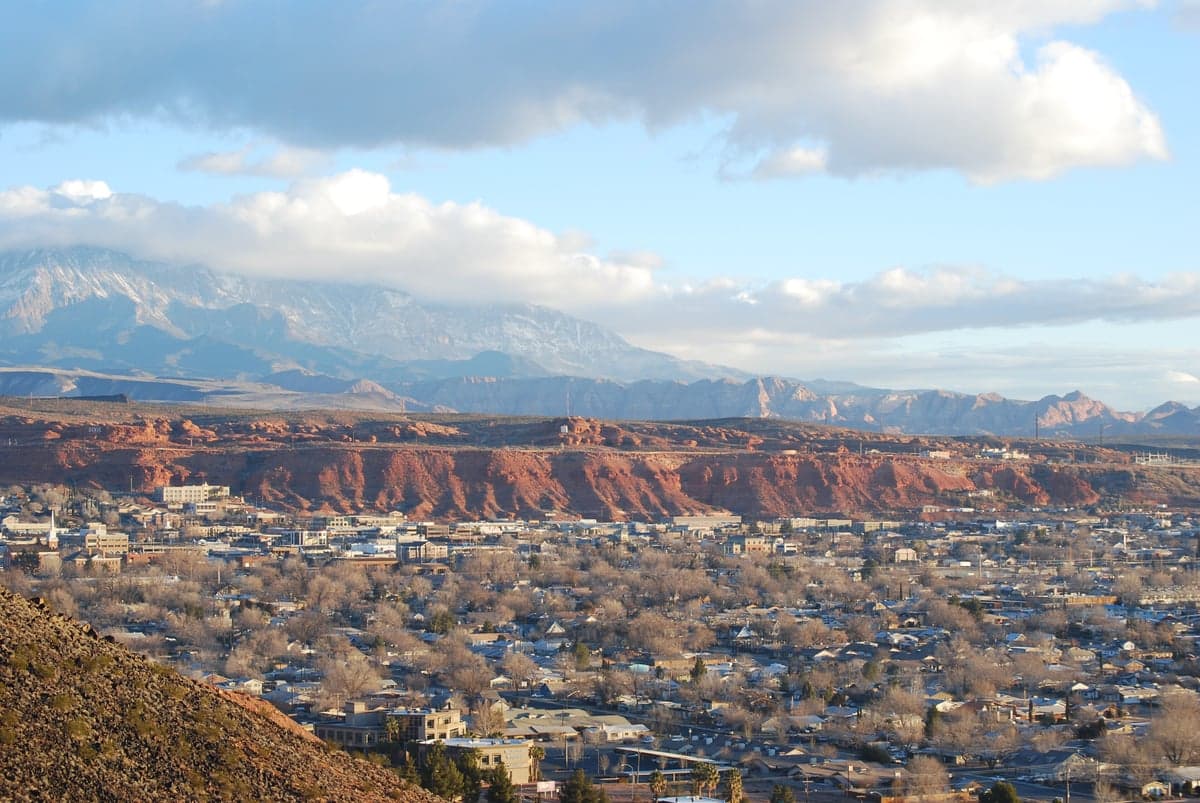
Photo: Wikipedia
Personal Sovereignty in Saint George, UT
Viable for self-reliance. Generally workable, though some barriers may limit total independence.
What does Personal Sovereignty tell us?
Personal Sovereignty measures your capacity for self-reliance and independence with minimal government friction. Higher scores mean fewer barriers between you and the way you want to live... but it assumes you have the space you need and good neighbors.
What does this tell us?
Personal Sovereignty measures your capacity for self-reliance and independence with minimal government friction. Higher scores mean fewer barriers between you and the way you want to live... but it assumes you have the space you need and good neighbors.
State Policy
Energy independence: Net exporter (108% of energy produced in-state)
Personal Liberty
Homesteading

Personal Liberty Analysis
Saint George, Utah, offers a personal sovereignty environment that is among the strongest in the Intermountain West, driven by a state-level commitment to limited government, robust Second Amendment protections, and a cultural ethos of self-reliance. While not a libertarian free-for-all—local zoning and HOA restrictions are real—the area consistently ranks as one of the most autonomy-friendly mid-sized cities in the U.S. for individuals and families who prioritize controlling their own lives, finances, and property.
Tax burden and regulatory posture: how light is the government footprint
Utah's state-level tax and regulatory framework is designed to minimize friction for residents and businesses, and Saint George benefits directly from this posture. There is no state income tax on wages—Utah levies a flat 4.65% individual income tax, but that rate applies to all income types, not just wages, and there is no progressive bracket creep. More significantly, Utah has no state-level personal property tax on vehicles, boats, or RVs, a major savings compared to neighboring states like Arizona or Nevada. Property taxes in Washington County are moderate, with an effective rate around 0.6% of assessed home value, roughly half the national average. The state's regulatory environment is consistently ranked among the top 10 least burdensome in the nation by the Mercatus Center and other indices, meaning fewer occupational licensing hurdles, simpler business formation, and less administrative overhead for entrepreneurs. However, Saint George itself has active municipal zoning and building codes, and HOA-governed subdivisions cover a large portion of newer housing stock, so the "light touch" label applies more accurately to state-level policy than to every neighborhood covenant. For a family or individual who wants to minimize tax leakage and bureaucratic interference in daily commerce, the combined state and local posture is among the most favorable in the West.
Self-defense and gun law specifics: what the Second Amendment looks like on the ground
Utah is a constitutional carry state, meaning that as of 2021, any law-abiding adult 21 or older can carry a concealed firearm without a permit. Saint George residents enjoy the full suite of state preemption laws: no local municipality, including Saint George, can enact its own gun restrictions stricter than state law, so the city council cannot ban open carry, restrict magazine capacities, or impose waiting periods. The state's permitless carry framework is paired with a "shall issue" permit system for those who want reciprocity with other states—Utah's concealed firearm permit is recognized in over 30 states. Stand-your-ground laws are fully in effect; there is no duty to retreat in any place where a person has a legal right to be. Use-of-force statutes are broadly protective of defensive actions, including in vehicles and workplaces. For a relocation-minded gun owner, the practical reality is that Saint George offers one of the most permissive and legally predictable environments for self-defense in the country, with no local ordinances to track and a state government that actively preempts municipal overreach. The only notable restriction is that carrying in K-12 schools remains prohibited without a special permit, and private property rights still allow businesses to post no-gun signs, though compliance is voluntary unless the property is posted under specific state statute.
Self-reliance and homesteading viability: lot sizes, zoning, and off-grid feasibility
The homesteading and self-reliance potential in Saint George is a mixed picture that depends heavily on whether you are inside city limits or in unincorporated Washington County. Within Saint George proper, minimum lot sizes in standard residential zones are typically 6,000 to 8,000 square feet, and most newer subdivisions are platted at 4-6 units per acre, leaving little room for substantial food production or livestock. The city's zoning code restricts chickens to a limited number of hens (no roosters) and prohibits goats, pigs, or larger livestock on standard residential lots. Off-grid living is effectively impossible inside city limits: the city requires connection to municipal water and sewer, and building codes mandate grid-tied electrical service. However, the picture changes dramatically just outside city boundaries. In unincorporated Washington County, parcels of 1 to 5 acres are still available at prices well below Salt Lake City or St. George city lots, and county zoning is far more permissive regarding accessory dwelling units, workshops, and small-scale agriculture. Rainwater harvesting is legal and encouraged in Utah, and solar panel installation is straightforward with net metering available from Rocky Mountain Power. For a family serious about food production, water self-sufficiency, and reduced reliance on municipal infrastructure, the surrounding county areas—particularly toward Hurricane, Leeds, and the Santa Clara River bench—offer viable paths that Saint George city itself does not. The limiting factor is water: the region averages 8 inches of annual rainfall, so any serious homesteading requires a well or hauled water, and new well permits in the Virgin River basin are increasingly scrutinized.
Personal liberties: parental rights, medical autonomy, speech, and property
Utah has positioned itself as a national leader on several fronts of personal liberty that matter to sovereignty-minded relocators. Parental rights are explicitly protected: Utah's "Parental Rights in Education" statute (HB 331, 2023) affirms that parents have the fundamental right to direct their children's education, healthcare, and moral upbringing, and the state has passed laws requiring school districts to notify parents of curriculum changes and medical services offered on campus. Medical autonomy is a more complex picture: Utah has not enacted broad medical freedom legislation comparable to some states, but it does have a robust conscience clause for healthcare providers and has resisted federal vaccine mandates in state employment. Telehealth and direct-primary-care arrangements are legal and growing in the St. George area. Free speech protections are strong, with no state-level hate speech laws that criminalize expression, and the city has no local ordinances restricting political signage or public assembly beyond standard time-place-manner rules. Property rights are reinforced by Utah's "private property protection" statutes, which require government to compensate owners for regulatory takings that reduce property value by more than 20%. The practical effect is that eminent domain abuse is rare, and zoning changes that would devalue a property are subject to compensation. The one notable constraint on personal liberty in Saint George is the prevalence of HOAs—roughly 60-70% of homes built after 2000 are in covenant-controlled communities, which can restrict everything from vehicle parking to paint colors to front-yard gardens. For a relocator who values maximum personal discretion, buying outside an HOA or in an older neighborhood without covenants is essential.
Overall, Saint George delivers a personal sovereignty package that ranks among the top tier of mid-sized Western cities, particularly for those who prioritize low taxes, strong self-defense laws, and protected parental rights. The trade-offs are real: water scarcity limits off-grid homesteading, HOA density constrains property autonomy within city limits, and the local housing market's rapid appreciation means that the "freedom" of homeownership comes with a high entry cost. Compared to cities in California, Oregon, or Colorado, Saint George offers a dramatically lighter regulatory touch and a cultural baseline that assumes individual competence rather than government oversight. For a family or individual who wants maximum control over their finances, their safety, their children's upbringing, and their property—and who is willing to navigate HOA covenants and arid-land realities—this is one of the most sovereignty-friendly environments available in the contiguous United States.

* Values derived from national, state, county, city and local statistics and may differ in a specific area. Last updated: 2026-11-20T05:13:53.000Z
Narrative content on this page is AI-generated and may contain mistakes. Verify any details that matter before acting on them.
ReloMaps may earn a commission from affiliate links at no extra cost to you.

