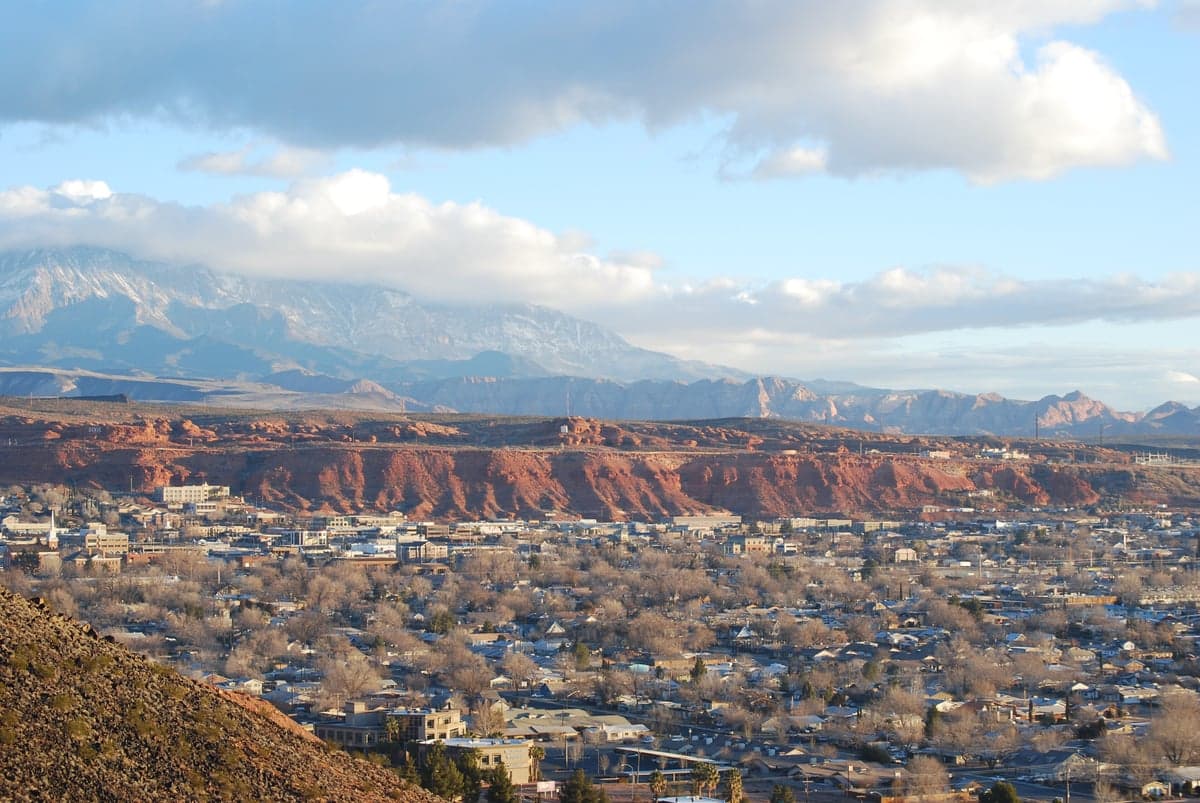
Photo: Wikipedia
Demographics of Saint George, UT
Affluence Level in Saint George, UT
A middle-class area roughly in line with national averages across income, home values, education, and employment.
People of Saint George, UT
The people of Saint George, Utah, today number 99,184, forming a predominantly white (80.7%) and politically conservative community with a growing Hispanic minority (12.7%) and a notably small foreign-born population (4.7%). The city is characterized by a high concentration of families, retirees, and members of The Church of Jesus Christ of Latter-day Saints (LDS), giving it a distinctive, family-oriented social fabric. With 34.1% of adults holding a college degree, the population is moderately educated, and the city's rapid growth—driven by domestic in-migration from California and other Western states—has created a blend of long-time local families and newer transplants seeking a lower cost of living and outdoor recreation.
How the city was settled and grew
Saint George was founded in 1861 by LDS pioneers sent by Brigham Young to establish a cotton and silk mission in the warm, low-elevation climate of the Utah Territory. The original settlers were predominantly Mormon families from northern Utah and the British Isles, who built the city around a central grid plan anchored by the St. George Utah Temple (completed 1877). The historic Ancestor Square and St. George Historic District contain the oldest homes and commercial buildings, reflecting the pioneer-era architecture and the community's early reliance on agriculture, particularly cotton, grapes, and livestock. The arrival of the railroad in the 1880s brought a modest wave of non-Mormon merchants and laborers, but the city remained overwhelmingly LDS and white through the first half of the 20th century. The neighborhoods around Dixie College (now Utah Tech University) became a hub for educators and students, while the Bloomington area, developed later, attracted a mix of local families and early retirees.
Modern era (post-1965)
The post-1965 era transformed Saint George from a quiet agricultural town into a booming retirement and recreation destination. The Immigration and Nationality Act of 1965 had minimal direct impact here—the foreign-born share remains low at 4.7%—but the city experienced explosive domestic in-migration starting in the 1980s, driven by retirees from California, Nevada, and Arizona seeking warm winters and lower taxes. This wave settled heavily in the SunRiver and Green Valley active-adult communities, which are now predominantly white and older. The Hispanic population, which now stands at 12.7%, grew steadily from the 1990s onward, largely through domestic migration from the Southwest and some immigration from Mexico and Central America. Hispanic families concentrated in the Dixie Downs and Washington Fields areas, where more affordable housing and service-sector jobs (construction, hospitality, landscaping) were available. East/Southeast Asian communities (1.1%) and Black residents (0.5%) remain very small, with no significant ethnic enclaves; these groups are dispersed across newer subdivisions like Little Valley and Desert Canyons. The Indian subcontinent population is effectively zero (0.0%), reflecting the city's limited draw for tech or academic professionals who might otherwise cluster in larger Utah cities like Salt Lake City or Provo.
The future
Saint George's population is projected to continue growing rapidly, potentially exceeding 150,000 by 2040, driven almost entirely by domestic migration from the West Coast and Mountain West. The city is becoming slightly more diverse: the Hispanic share is expected to rise toward 15-18% over the next decade, while the white share will decline gradually. Newer master-planned communities on the city's periphery—such as Black Desert and The Ledges—are attracting a mix of younger families and remote workers, many from California, who are less likely to be LDS than the native-born population. This is creating a subtle cultural shift, with a growing number of non-Mormon residents and a more secular, recreation-oriented lifestyle. However, the city's political and social identity remains firmly conservative, and the low foreign-born share means Saint George will likely stay less diverse than the national average. The Indian and East/Southeast Asian populations are expected to remain small, as the city lacks the high-tech employment base or university research sectors that draw these groups to other Sun Belt metros.
For someone moving in now, Saint George is a rapidly growing, family-and-retiree-oriented city where the dominant culture is white, LDS, and conservative, but where a rising Hispanic minority and an influx of out-of-state transplants are gradually broadening the social landscape. The city offers a safe, outdoor-focused lifestyle with a strong sense of community, but those seeking significant racial or ethnic diversity, or a large foreign-born population, will find it limited. The next 10-20 years will likely see continued growth, modest diversification, and a slow blending of traditional Mormon culture with a more secular, recreation-driven ethos.

* Values derived from national, state, county, city and local statistics and may differ in a specific area. Last updated: 2026-11-20T05:13:53.000Z
Narrative content on this page is AI-generated and may contain mistakes. Verify any details that matter before acting on them.
ReloMaps may earn a commission from affiliate links at no extra cost to you.

