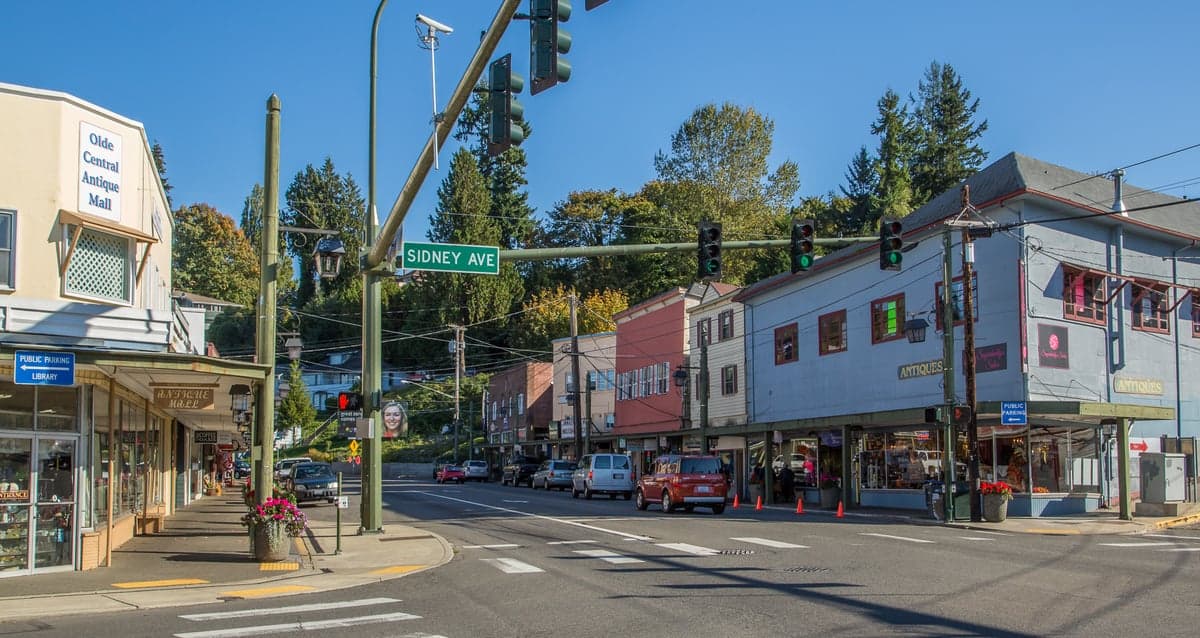
Photo: Wikipedia
Political ClimatePolitical Climate in Port Orchard, WA
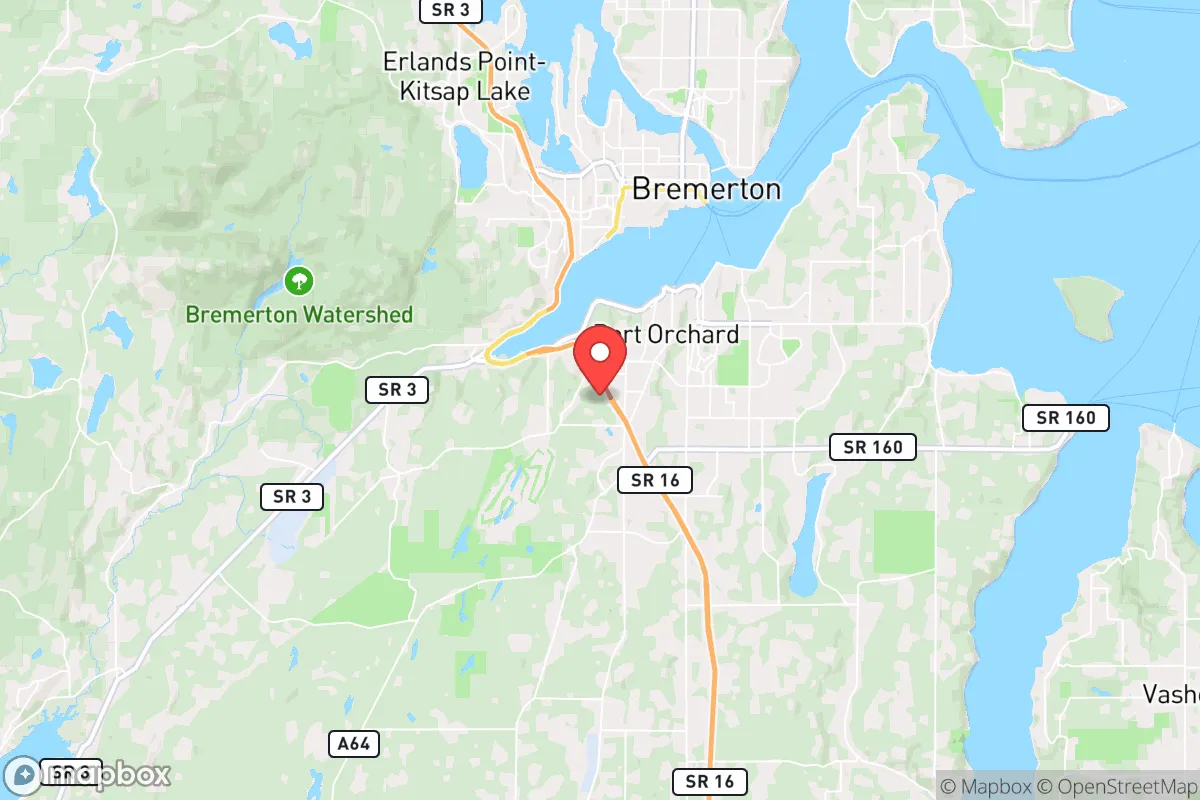
District shown is the primary district for this city’s centroid. Cities may span multiple districts.
Local Political AnalysisPolitical Analysis of Port Orchard, WA
Port Orchard leans reliably Democratic, with a Cook PVI of D+10 that places it well to the left of the national average. That number has crept bluer over the past decade as the Seattle exurban wave has pushed deeper into Kitsap County, bringing younger families and remote workers who tilt the electorate further left than the old shipyard-and-timber base. The city itself has voted Democratic in every presidential race since at least 2008, and local races—city council, port commission, school board—now routinely go to candidates who run on progressive platforms, though often with a pragmatic, small-town delivery.
How it compares
Port Orchard is significantly more liberal than the rest of Kitsap County, which overall leans D+6. Drive 15 minutes south to Belfair or Allyn in Mason County, and you’re in solidly red territory—those precincts voted +12 to +18 for Trump in 2020. Head north to Poulsbo or Bainbridge Island, and you find communities even bluer than Port Orchard (Bainbridge is roughly D+20). The contrast with rural Washington is stark: while the state as a whole is reliably Democratic at the presidential level (voting D+19 in 2020), the political geography is a patchwork. East of the Cascades, places like Yakima and Spokane County lean Republican, and even within Western Washington, the rural-urban divide is sharp. Port Orchard sits in the middle—blue enough to feel comfortable for liberals, but with enough conservative neighbors that the local discourse stays more civil and less polarized than in Seattle proper.
What this means for residents
For liberal residents, the D+10 lean means local elections usually align with their values—zoning reforms, climate action plans, and funding for social services tend to pass. The city council has supported affordable housing initiatives and expanded public transit connections to the Bremerton ferry terminal. For conservative residents, the reality is that they are a clear minority, but not an invisible one. The Kitsap County Republican Party remains active, and conservative voices hold seats on the county commission and in the state legislature (the 26th Legislative District, which includes Port Orchard, has a Republican senator and a split house delegation). You won’t feel out of place flying a Trump flag in your yard, but you’ll likely have more neighbors with Harris-Walz signs. The practical effect is that taxes and regulations lean progressive—property taxes fund robust schools and parks—but gun rights and property rights are still broadly respected, reflecting Washington’s statewide balance.
Culturally, Port Orchard retains a working-class, Navy-town identity that softens the edges of its blue politics. The Puget Sound Naval Shipyard in nearby Bremerton is the largest employer, and many residents are active-duty or retired military, which brings a more moderate, patriotic strain of liberalism than you’d find in Seattle. Policy-wise, the city has embraced the state’s progressive environmental and labor laws—minimum wage is tied to the state’s $16.28/hour floor, and plastic bag bans are enforced—but local ordinances tend to be less ambitious than in King County. The trajectory is toward a bluer future, but the pace is slow enough that the town still feels like a place where both sides can grab a beer at the same bar on Bay Street. If you’re moving here, expect a community that votes blue but talks like a purple small town—and that’s likely to hold for the next decade.

State Political ClimatePolitical Climate in Washington
State Political AnalysisPolitical Environment in the State
Washington state has been a reliably blue stronghold for over a decade, but its politics are far from monolithic. The Democratic coalition dominates statewide elections, powered by the Seattle metro area, while the rest of the state—particularly east of the Cascades—votes just as reliably Republican. Over the past 20 years, the state has shifted leftward on social and environmental policy, but the urban-rural chasm has widened dramatically, creating two distinct political realities within the same border.
Urban vs. rural divide
The political map of Washington is essentially a story of two states. King County, home to Seattle, Bellevue, and Redmond, casts roughly one-third of the state’s total votes and consistently delivers margins of 70-80% for Democratic candidates. That alone is enough to swing any statewide election. Pierce County (Tacoma) and Snohomish County (Everett) have become reliably blue as well, though with slightly narrower margins. In contrast, the eastern half of the state—Spokane, the Tri-Cities (Kennewick, Pasco, Richland), and Yakima—votes heavily Republican. The 2020 presidential election saw Joe Biden win the state by 19 points, but he lost counties like Yakima and Spokane by double digits. The divide isn’t just geographic; it’s cultural. Voters in Spokane Valley or Wenatchee often feel their concerns about agriculture, water rights, and rural law enforcement are ignored by a legislature dominated by Puget Sound representatives. Meanwhile, suburban swing areas like Clark County (Vancouver) and Kitsap County have trended blue in recent cycles, driven by in-migration from California and Oregon and a growing tech-adjacent workforce.
Policy environment
Washington’s policy environment is defined by a few key structural choices. The state has no personal income tax, relying instead on a high sales tax (state rate 6.5%, with local add-ons pushing it to 10%+ in some cities) and a business-and-occupation tax on gross receipts. Property taxes are moderate but have been rising. The regulatory posture is among the most aggressive in the nation on environmental and labor issues: Washington has a cap-and-invest carbon market (the Climate Commitment Act), a long-term care payroll tax (the WA Cares Fund), and some of the strongest tenant protections and paid family leave laws in the country. On education, the state fully funds K-12 through a levy system that limits local property tax supplements, but outcomes vary wildly by district. Healthcare is heavily regulated, with a state-based insurance exchange and strict insurance mandates. Election laws are among the most accessible: all-mail voting is universal, same-day registration is available, and ballots are postage-paid. Voter turnout regularly tops 70% in presidential years.
Recent policy direction
The last five years have seen a flurry of legislation that signals where the state is headed. On gun and self-defense law, Washington passed a ban on certain semi-automatic firearms (HB 1240) and a requirement for a permit to purchase a pistol (HB 1143), both in 2023. A 2024 law bans carrying firearms in public transit and certain government buildings. On parental and education rights, the state has expanded LGBTQ+ inclusive curriculum mandates and removed parental opt-out provisions for sex education in some districts, sparking backlash in conservative areas. Speech and privacy are protected by a strong state constitution, but a 2023 law (SB 5443) restricts the use of facial recognition by law enforcement. Medical and bodily autonomy is fully protected: abortion and gender-affirming care are legal and shielded from out-of-state subpoenas (SB 5699). Property rights have been curtailed by the Climate Commitment Act, which imposes carbon costs on development, and by a 2023 law (HB 1110) that effectively ends single-family zoning in most cities, allowing duplexes and fourplexes. Taxation remains income-tax-free, but a 2021 state Supreme Court ruling upheld a capital gains tax on high earners, which opponents argue is an income tax in disguise. Ballot access remains wide open, with no voter ID law beyond signature verification.
Civil unrest & political movements
Washington has a long history of protest and activism. The 2020 Black Lives Matter protests in Seattle were among the largest and most sustained in the nation, including the six-week Capitol Hill Autonomous Zone (CHAZ) that became a national flashpoint. Since then, organized movements have become more polarized. On the left, groups like the Washington State Labor Council and environmental coalitions (e.g., Front and Centered) push for stronger climate and labor laws. On the right, the Washington State Republican Party has shifted toward grassroots activism, with county-level groups in places like Spokane and Yakima focusing on election integrity and school board races. Immigration politics are defined by the state’s 2019 “sanctuary” law (SB 5497), which limits local law enforcement cooperation with federal immigration authorities. Secession rhetoric is common in eastern Washington, with periodic calls for a “Liberty State” or “Cascadia” movement, but no serious legislative effort. Election integrity controversies flared after 2020, with Republican-led audits in a few counties finding no systemic fraud, but distrust persists in rural areas. Visible flashpoints for a new resident: you’ll see political yard signs and bumper stickers that are more polarized than in many states, and local city council meetings in places like Spokane Valley or Vancouver can get heated over zoning and school policy.
Projection
Over the next 5-10 years, Washington’s political trajectory points further left, but with growing friction. In-migration from California and Oregon continues to fuel Democratic majorities in the Puget Sound region, while rural counties are losing population and political clout. The state’s carbon market and housing density mandates will likely be challenged by ballot initiatives and lawsuits, but the Democratic supermajority in the legislature (as of 2025) makes repeal unlikely. The capital gains tax is almost certain to be expanded or replaced with a broader income tax, though that would require a constitutional amendment or a court reversal. For a conservative relocator, expect continued expansion of gun restrictions, higher energy costs from the carbon market, and a school system that increasingly emphasizes progressive curricula. For a liberal relocator, expect strong protections for reproductive rights, LGBTQ+ equality, and climate action, but also rising housing costs and a growing tax burden on high earners. The urban-rural divide will likely deepen, with more counties in eastern Washington exploring “home rule” charters or symbolic secession resolutions.
Bottom line for a new resident: If you’re moving to Washington, your experience of the state’s politics will depend almost entirely on where you land. In Seattle or Bellevue, you’ll live in a deep-blue bubble where progressive policies are the norm. In Spokane or Yakima, you’ll find a conservative community that feels increasingly at odds with the state government. The state’s lack of an income tax is a real draw, but the cost of living—especially housing—is high, and the regulatory environment is not business-friendly for small operations. For families, the school system is well-funded but ideologically charged. For single professionals, the job market in tech and healthcare is strong, but the political climate is unmistakably left-leaning. Come for the mountains and the lack of income tax; stay if you can navigate the policy landscape.
* Values derived from national, state, county, city and local statistics and may differ in a specific area. Last updated: 2026-09-24T15:02:11.000Z
Narrative content on this page is AI-generated and may contain mistakes. Verify any details that matter before acting on them.
ReloMaps may earn a commission from affiliate links at no extra cost to you.

