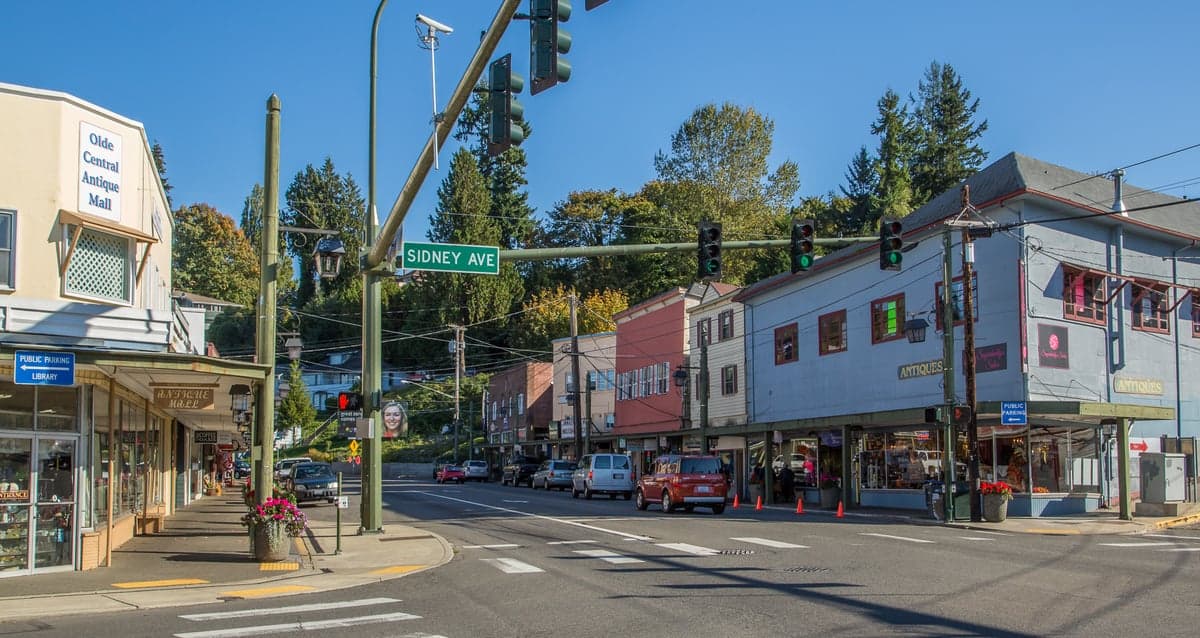
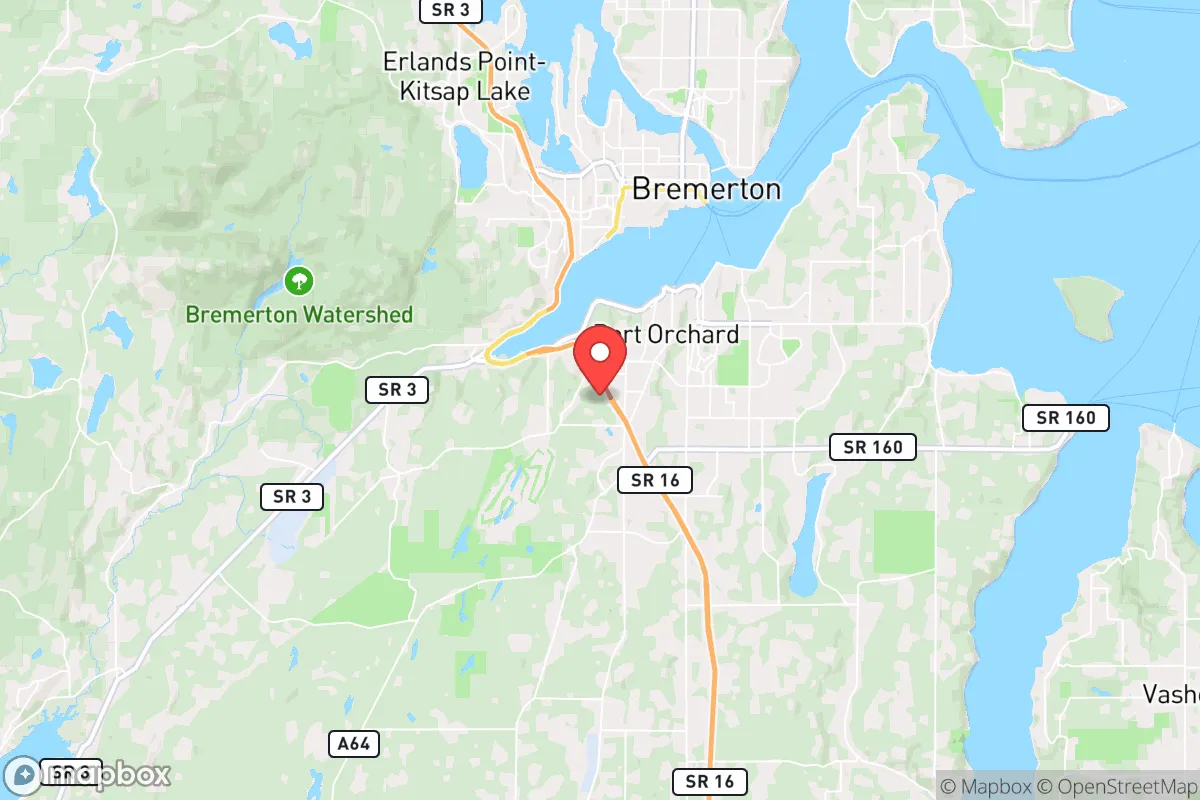
Photo: Wikipedia
Strategic Assessment of Port Orchard, WA
Multiple tactical vulnerabilities. Population density, target proximity, or disaster risk are likely compounding. A retreat property and exit planning is required.
What does the Strategic Assessment tell us?
Our Strategic Assessment grades tactical survivability of an area. Major population centers, military targets, fallout zones, natural disasters, and border exposure all drive risk — lower exposure means a more defensible position in a crisis.
This is heavily inspired by Joel Skousen's Strategic Relocation book. Highly recommended you checkout the book ($)What does this tell us?
Our Strategic Assessment grades tactical survivability of an area. Major population centers, military targets, fallout zones, natural disasters, and border exposure all drive risk — lower exposure means a more defensible position in a crisis.
This is heavily inspired by Joel Skousen's Strategic Relocation book. Highly recommended you checkout the book ($)Strategic Pillars

Key Distances
Regional Safe Places
Below is our recommended "safe zones" in Washington and the surrounding area based on our strategic heuristics. For most people, it's unrealistic to live in a “safe zone” full-time due to work, family or other personal reasons. They tend to be more rural. However, many of these areas are perfect for second homes and retreat properties that double as a vacation home or even a short-term rental.
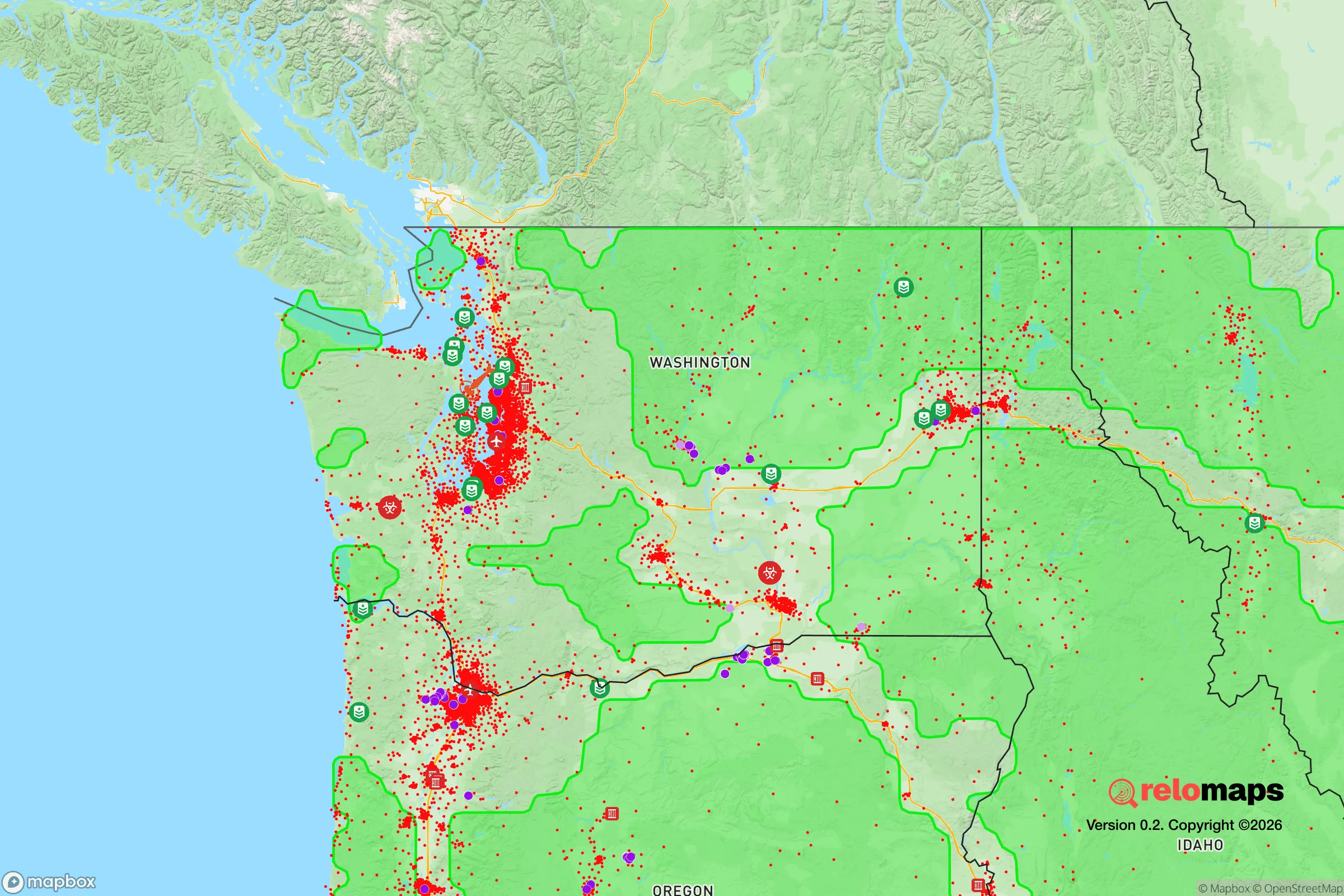
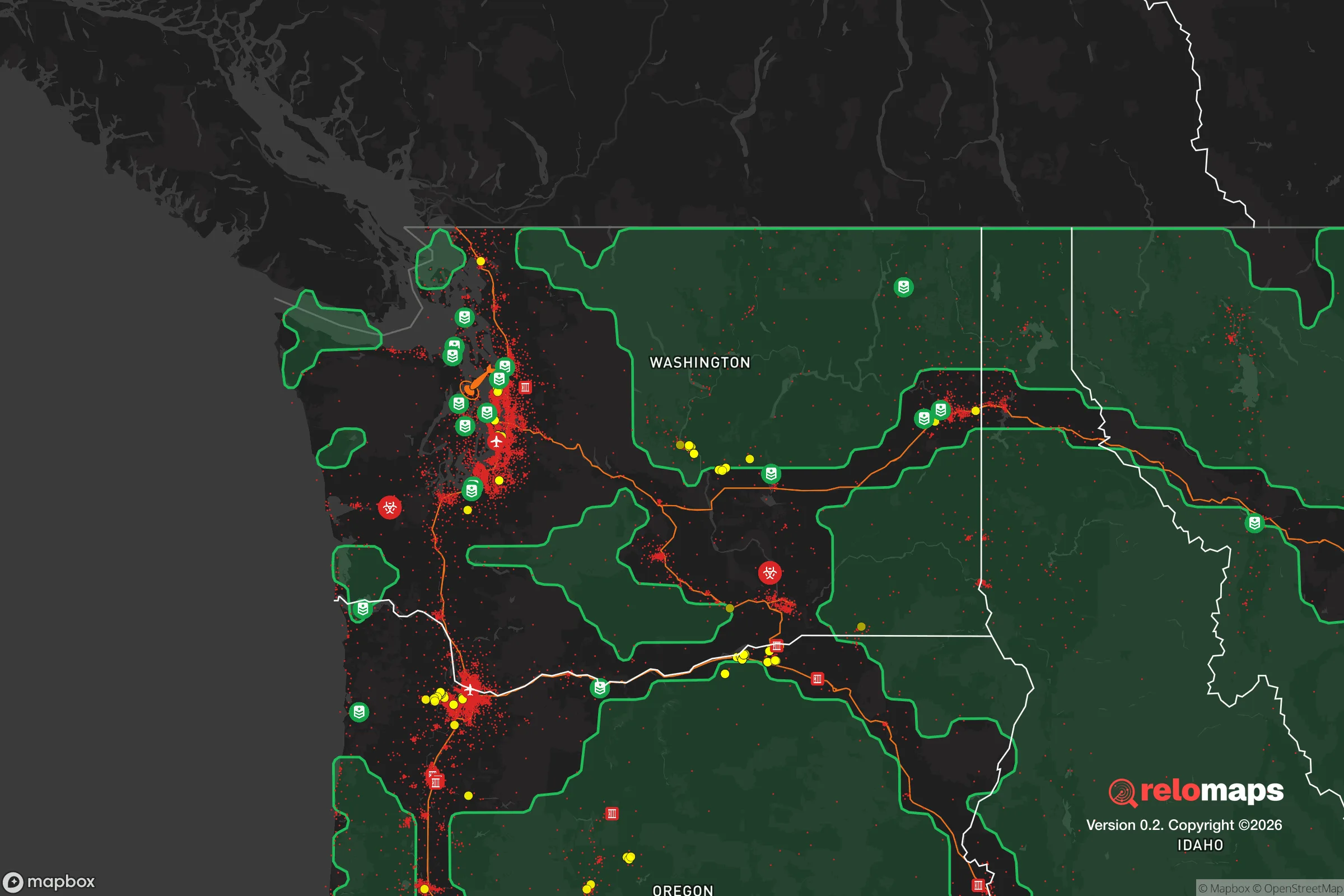


Important Note: For informational purposes only. This does not mean nothing bad ever happens in the green zones. Please use common sense. This is based on public data and modeled with AI. We tried to take a conservative approach but mistakes happen. We update this regularly as new information becomes available.
Solar Generator Recommendations
Backup power matters more here than in safer locations. We've picked three solar generators across budgets and capacity tiers — start with the budget unit if you only need a few essentials, or step up if you want to run a fridge and HVAC for days at a time.

Jackery Portable Power Station Explorer 300
Budget OptionPower on the Go: Weighing only 11 lbs, it's convenient to set up and store with book-sized foldable solar panels

BLUETTI Portable Power Station AC180
Designed for both indoor and outdoor scenarios, AC180 is highly capable as it has a robost capacity and continuous output power.

EF ECOFLOW DELTA Pro Ultra Power Station
Upgraded PickEcoFlow DELTA Pro Ultra is a whole-home energy system designed to grow with your family. Integrated with the Smart Home Panel 2, it scales to meet your evolving energy needs — keeping your home powered, intelligent, and secure through every stage of life.
We earn a commission, at no additional cost to you.
Strategic Assessment Analysis
Port Orchard, Washington, offers a strategic blend of proximity to the Puget Sound economic engine and a geographic buffer that makes it a serious contender for relocation-minded individuals and families prioritizing resilience. Situated across Sinclair Inlet from Bremerton and roughly a 60-minute ferry ride from downtown Seattle, this Kitsap County seat of roughly 16,000 residents provides a semi-rural feel with access to urban resources, but its location on the Olympic Peninsula side of the Sound introduces distinct advantages and trade-offs for disaster readiness. The area's resilience profile is shaped by its position on a peninsula, its reliance on marine transportation, and its proximity to both military infrastructure and natural resource zones, making it a location that rewards careful planning.
Geographic position and natural advantages for self-sufficiency
Port Orchard's primary strategic asset is its location on the Kitsap Peninsula, which is bounded by the Puget Sound to the east and the Hood Canal to the west. This geography inherently limits access points, reducing the risk of mass evacuation or supply chain disruption from a single direction. The area is surrounded by working forests, including the 1.3-million-acre Olympic National Forest to the west, which provides a substantial buffer of undeveloped land and potential resources for timber, game, and water. The local climate, with roughly 50 inches of annual rainfall, supports year-round gardening and rainwater catchment, a significant advantage over drier inland regions. The presence of the Cascade Range to the east and the Olympic Mountains to the west also provides a natural shield against certain weather extremes, though the region is not immune to Pacific storms. For a relocator, the ability to tap into local water sources—such as the numerous creeks and the nearby Union River—combined with relatively fertile soil, makes Port Orchard a viable location for semi-self-sufficient living, provided one secures property with well and septic systems rather than relying on municipal infrastructure.
Risks, exposures, and proximity to fallout-relevant landmarks
The most significant risk for Port Orchard is its proximity to Naval Base Kitsap, a major U.S. Navy installation that includes the Puget Sound Naval Shipyard in Bremerton and the Bangor submarine base just north of the city. Bangor is one of two homeports for the U.S. nuclear submarine fleet and stores a substantial portion of the nation's nuclear warheads. While this presence brings economic stability and jobs, it also makes the area a potential target in a major conflict, a factor that a resilience-minded relocator must weigh seriously. Additionally, the city lies within the Cascadia subduction zone's tsunami inundation zone for the Puget Sound, though modeling suggests the direct wave impact would be less severe than on the open coast. Earthquake risk is moderate to high, with the Seattle Fault zone running roughly 20 miles to the east; a major quake could disrupt ferry service, the primary link to Seattle, and damage the aging infrastructure of the peninsula. Industrial hazards include the nearby oil refineries in Tacoma and the shipping lanes of Puget Sound, which could create localized contamination events. For a relocator, the key takeaway is that Port Orchard is not a remote bunker—it is a semi-urban area with a clear military target profile, and any resilience plan must account for the possibility of evacuation or extended isolation if the naval base is compromised.
Practical resilience for a relocator: food, water, energy, and defensibility
Port Orchard's practical resilience is a mixed bag that rewards proactive investment. Water availability is strong for those on private wells, with the region's aquifers generally reliable, though drought years can stress shallow wells. Rainwater collection is straightforward given the climate, and the city's municipal water supply draws from the Union River, which has a robust flow. Food production is feasible on most residential lots, with a long growing season (March through October) for cool-weather crops, and local farmers' markets and U-pick farms provide backup supply. The area has several feed stores and garden centers, but a major disruption would require reliance on local agriculture, which is limited compared to the eastern Washington breadbasket. Energy resilience is a challenge: the grid is served by Puget Sound Energy, and power outages from winter storms are common, lasting hours to days. Solar potential is moderate due to cloud cover, but a backup generator or battery system is a near-necessity for serious preparedness. Wood heating is viable, with abundant firewood from surrounding forests, but air quality regulations in Kitsap County can restrict burning during inversions. Defensibility is moderate: the peninsula's limited road network—primarily State Route 16 and a few two-lane highways—creates chokepoints that could be controlled, but also makes egress difficult. The ferry system is a vulnerability, as it can be shut down by weather or labor disputes. For a family, the best approach is to secure property away from the main corridors, ideally with a well, septic, and space for a garden, and to build a community network with neighbors who share preparedness values.
Overall, Port Orchard presents a realistic strategic picture for the resilience-minded relocator: it offers genuine advantages in water, growing conditions, and a semi-rural lifestyle within reach of urban medical and supply resources, but it carries the clear liability of being adjacent to a high-value military target. The area is not a retreat for those seeking complete isolation, but it can work well for a family willing to invest in off-grid infrastructure and maintain a low profile. The key is to treat Port Orchard as a base camp rather than a fortress—a place where you can build self-sufficiency while staying connected to the broader region, provided you have a plan for the day the ferries stop running or the base goes on alert. For the right person, it is a solid choice; for those seeking absolute security, the Olympic Peninsula's interior or the San Juan Islands may offer fewer trade-offs.

* Values derived from national, state, county, city and local statistics and may differ in a specific area. Last updated: 2026-09-24T15:02:11.000Z
Narrative content on this page is AI-generated and may contain mistakes. Verify any details that matter before acting on them.
ReloMaps may earn a commission from affiliate links at no extra cost to you.

