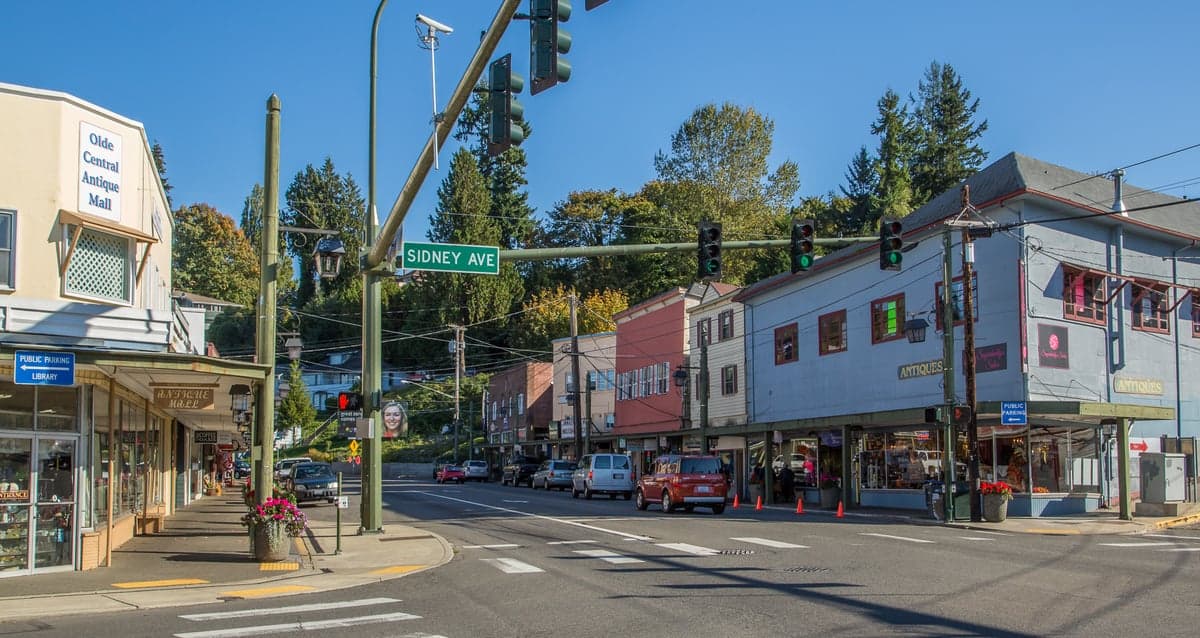
Photo: Wikipedia
Personal Sovereignty in Port Orchard, WA
Viable for self-reliance. Generally workable, though some barriers may limit total independence.
What does Personal Sovereignty tell us?
Personal Sovereignty measures your capacity for self-reliance and independence with minimal government friction. Higher scores mean fewer barriers between you and the way you want to live... but it assumes you have the space you need and good neighbors.
What does this tell us?
Personal Sovereignty measures your capacity for self-reliance and independence with minimal government friction. Higher scores mean fewer barriers between you and the way you want to live... but it assumes you have the space you need and good neighbors.
State Policy
Energy independence: Importer (55% of energy produced in-state)
Personal Liberty
Homesteading

Personal Liberty Analysis
Port Orchard, Washington, offers a mixed personal sovereignty environment that reflects the broader tensions of Kitsap County: a rural-minded, self-reliant culture operating under a state government in Olympia that increasingly centralizes authority on taxation, regulation, and individual liberties. For a relocation-minded individual or family who prioritizes autonomy, the key trade-off is clear — you get a lower cost of entry and more physical space than Seattle or Bellevue, but you must navigate Washington’s relatively high state tax burden, strict gun laws, and growing regulatory reach. The city itself leans moderately conservative compared to the county seat of Port Orchard, but the surrounding unincorporated areas and smaller communities like Manchester, Southworth, and Olalla offer a noticeably lighter regulatory touch, especially regarding land use and self-reliance.
Tax burden and regulatory posture in Kitsap County
Washington State has no personal income tax, which is a significant advantage for earners and business owners. However, the state’s tax structure is heavily reliant on a high sales tax (currently 8.6% in Port Orchard, combining state and local rates) and above-average property taxes. The effective property tax rate in Kitsap County is roughly 0.93% of assessed value, which is moderate nationally but higher than many parts of the inland Northwest. For a $450,000 home — typical for a three-bedroom in Port Orchard — that translates to about $4,185 annually. The regulatory posture is mixed: Kitsap County’s building and land-use codes are more permissive than King County’s, but the state’s Growth Management Act imposes strict urban growth boundaries that limit rural development. Port Orchard’s city government is generally business-friendly, with a streamlined permitting process for small-scale construction, but the Washington State Department of Ecology and the Puget Sound Clean Air Agency add layers of environmental review for any project near shoreline or wetlands — which covers much of the area. For a self-reliant individual, the lack of income tax is a clear win, but the cumulative sales and property tax burden, combined with state-level regulatory overhead, makes this a medium-touch environment rather than a low-tax haven.
Self-defense and gun law specifics in Washington State
Washington is not a permissive state for gun owners. The state requires a background check for all firearm sales, including private party transfers, and has a 10-day waiting period for handgun purchases. Magazine capacity is limited to 10 rounds for new sales, and the state bans certain semi-automatic rifles defined as "assault weapons" under a 2023 law that is currently being litigated. Open carry is legal without a permit, but the state’s preemption law is strong — no local jurisdiction in Kitsap County can impose stricter rules than the state. Concealed carry requires a license, which Kitsap County issues on a shall-issue basis with a typical turnaround of 30 days. The county sheriff’s office is generally supportive of Second Amendment rights, and the local gun culture is robust, with several indoor and outdoor ranges within a 30-minute drive. For a self-defense-minded individual, the practical reality is that you can own and carry firearms, but the legal landscape is more restrictive than in Idaho or Montana. Stand-your-ground laws do not exist in Washington; the state uses a duty-to-retreat standard in public spaces, though the castle doctrine applies inside your home. This is a meaningful distinction for anyone who prioritizes self-defense autonomy.
Self-reliance and homesteading viability in Port Orchard
Port Orchard and its surrounding unincorporated areas offer genuine homesteading potential, especially compared to the urban core of the Puget Sound region. Zoning in Kitsap County’s rural areas (Rural Residential and Rural Farm Forest zones) allows for lot sizes as small as 2.5 acres, but many parcels available for purchase are 5 to 20 acres, particularly in the Olalla and Lake Symington areas. Chickens, goats, and even small-scale livestock are permitted on parcels of 1 acre or more in unincorporated Kitsap County, though city limits restrict livestock to lots of 20,000 square feet or larger. Off-grid feasibility is moderate: the maritime climate means ample rainfall (roughly 50 inches annually), making rainwater catchment viable, but the state requires a permit for any potable water system, and composting toilets must meet Washington Department of Health standards. Solar power is marginal due to frequent cloud cover — expect about 3.5 peak sun hours per day — so a hybrid system with a backup generator is more realistic than full off-grid independence. The county’s building department is pragmatic about owner-built structures, but any dwelling must meet state energy codes, which add cost. For a family wanting to grow food, keep animals, and reduce reliance on utilities, Port Orchard’s rural fringe is one of the better options within commuting distance of a major metro area, but true off-grid autonomy requires navigating state-level health and building codes.
Personal liberties: parental rights, medical autonomy, speech, and property
Washington State has some of the strongest parental rights protections in the country regarding medical decisions — parents can refuse vaccines for school attendance under the state’s philosophical exemption, and there is no state-level mandate for childhood vaccines beyond the standard school-entry requirements. However, the state’s medical autonomy landscape is mixed: the 2023 "My Health, My Data" act imposes strict privacy rules on health data, but it also creates a regulatory framework that some view as overreach. On medical freedom, Washington allows physician-assisted suicide but has no right-to-try law for terminally ill patients seeking experimental treatments outside of clinical trials. Free speech protections are robust under the state constitution, which has been interpreted more broadly than the First Amendment in some cases, particularly regarding political speech on private property. Property rights are constrained by the Growth Management Act, which limits how landowners can subdivide or develop rural land — a significant restriction for anyone wanting to build a second dwelling or sell off a portion of their property. Kitsap County’s planning department is known for being more flexible than King County’s, but the state’s environmental review process can delay or block projects near critical areas. For a conservative-leaning individual, the parental rights environment is favorable, but property rights are notably weaker than in states like Texas or Idaho.
Overall, Port Orchard offers a moderate level of personal sovereignty that sits between the heavily regulated urban core of Seattle and the freer environments of eastern Washington or Idaho. The lack of income tax and the rural zoning flexibility are genuine advantages, but the state’s gun laws, environmental regulations, and property-use restrictions create a ceiling on autonomy. For a family or individual who values self-reliance and is willing to work within a state-level regulatory framework, Port Orchard provides a viable base — especially if you choose unincorporated Kitsap County over the city limits. Compared to other Puget Sound suburbs, it ranks among the more freedom-oriented options, but it is not a low-regulation jurisdiction by national standards.

* Values derived from national, state, county, city and local statistics and may differ in a specific area. Last updated: 2026-09-24T15:02:11.000Z
Narrative content on this page is AI-generated and may contain mistakes. Verify any details that matter before acting on them.
ReloMaps may earn a commission from affiliate links at no extra cost to you.

