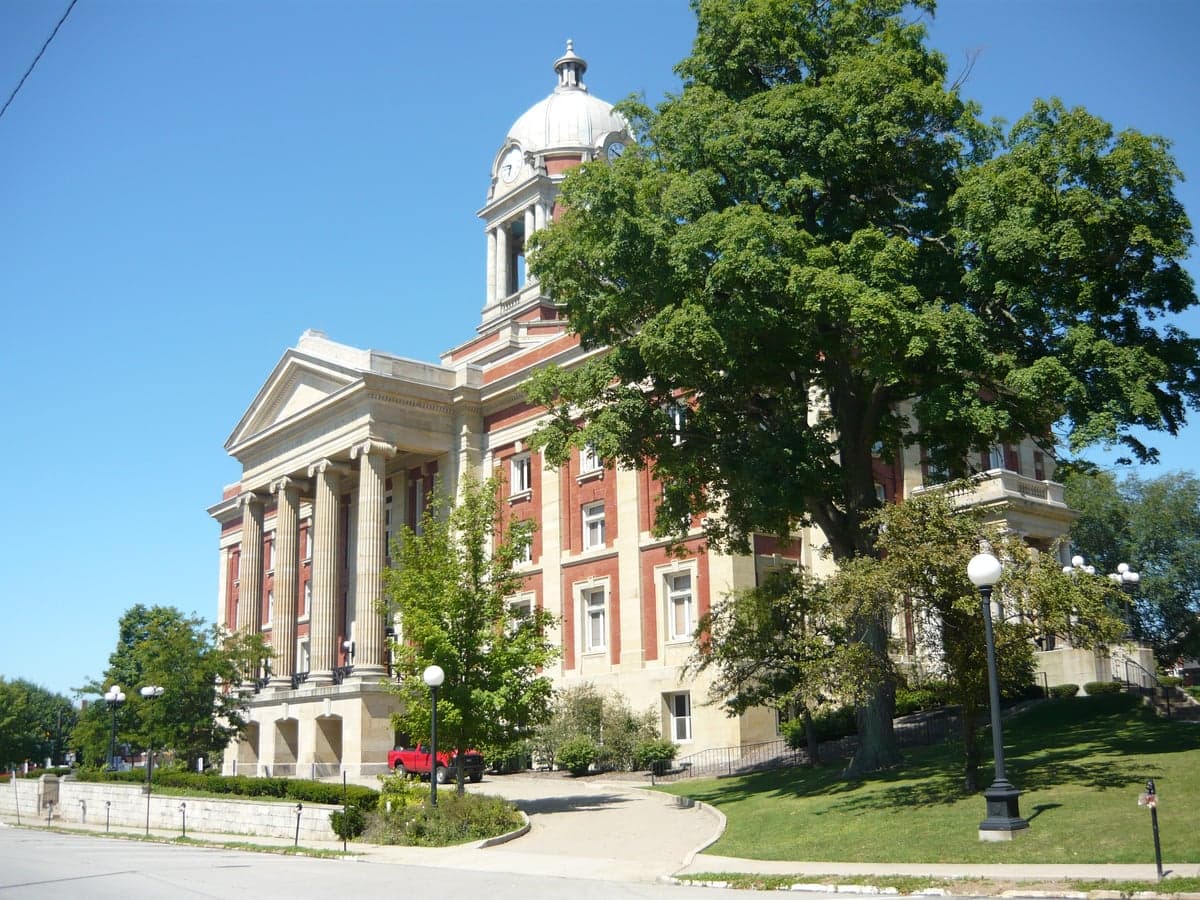
Photo: Wikipedia
Political ClimatePolitical Climate in Mercer County
Showing district-level results — no local-only data available.
Local Political AnalysisPolitical Analysis of Mercer County
Mercer County, Pennsylvania, sits at R+11 on the Cook Partisan Voting Index, making it a reliably Republican area in a state that’s a dead-even toss-up at EVEN. That’s a 21-point gap from the statewide average, and it’s held steady through recent cycles—Trump carried the county by roughly 21 points in 2020 and 18 points in 2024, though down-ballot races like the 2022 Senate race saw a slightly tighter but still red margin. The real story is less about big swings and more about internal variation: the county’s politics are not monolithic, and the differences between its towns tell you where the political energy lies.
How it compares
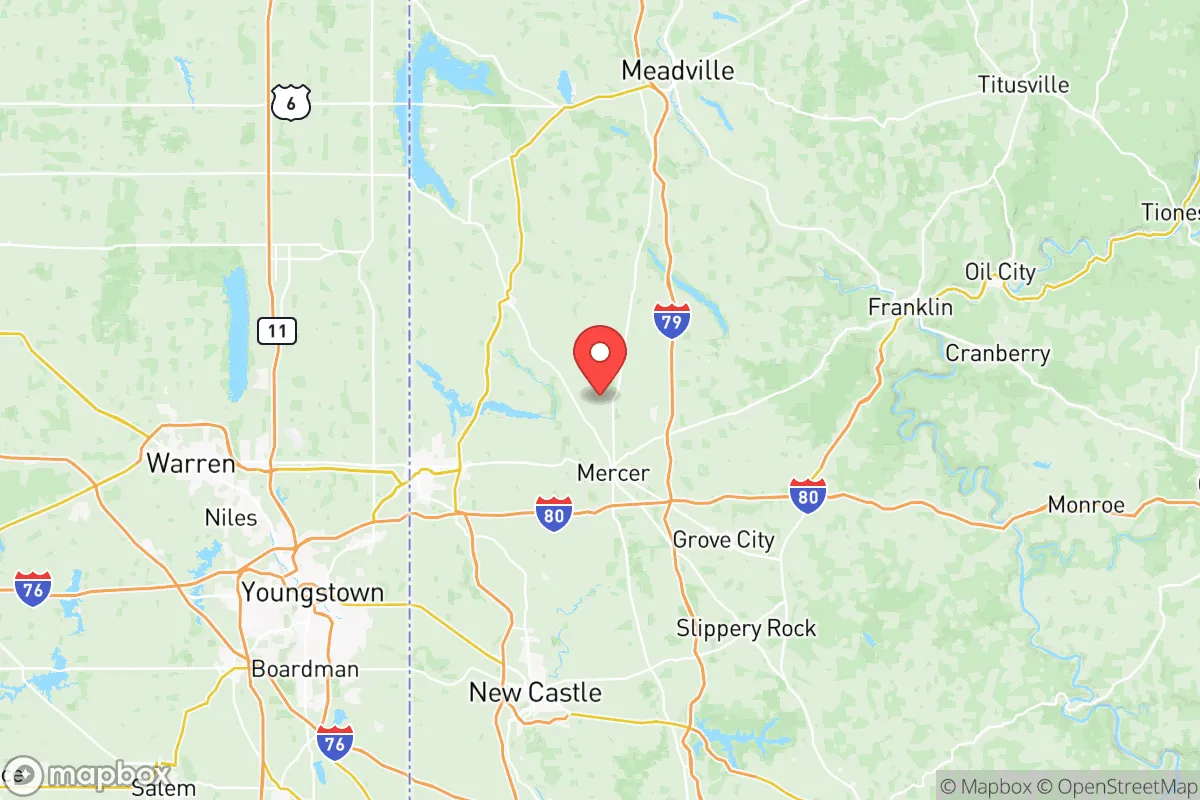
Statewide, Pennsylvania is a hyper-competitive battleground where Philadelphia and its suburbs push blue, and the central and northern rural counties drive red. Mercer County, nestled along the Ohio border in the northwestern corner, is firmly in the latter camp, but with important nuance. The county seat, Mercer (population ~2,000), is a conservative anchor, voting over 70% Republican in recent presidential elections. In contrast, Sharon and Hermitage—the urbanized core near the Ohio line—are the county’s blue oases, with precincts in Sharon’s downtown and around the Shenango Valley mall often favoring Democrats by 5-10 points. The key swing precincts are actually in the suburban areas between these extremes—places like West Middlesex and parts of Greenville, where the vote splits within 5 points. The big shift over the last decade hasn’t been partisan swing but population drift: the blue-leaning Sharon-Hermitage area has been slowly losing residents, shrinking around 3% since 2010, while the redder outer townships hold steady, which mathematically reinforces the county’s R+11 rating even without ideological change.
What this means for residents
For conservative residents, Mercer County offers a comfortable political fit that aligns with state-level frustration: you’re in a county that votes red, but you see state policies driven by Philly and Pittsburgh, which justifies the “us vs. Harrisburg” attitude common in local politics. For liberal residents, it can feel isolating—local government is overwhelmingly Republican (the county commissioner board has been all-GOP for decades), but Sharon provides a social and electoral pocket where progressive candidates for city council and school board can actually win. The practical impact shows up most in policy areas like land use and gun laws, where the county tends to oppose state preemption attempts and local zoning fights are typically conservative-leaning. In day-to-day life, political talk is common at coffee shops in Greenville or diners along Route 18, but it’s usually civil—people know each other, and the county’s economic challenges (declining manufacturing, aging population) tend to overshadow partisan bickering.
A cultural distinction that sets Mercer County apart from the broader Pennsylvania swing-state dynamic is its strong “Pennsylvania-Ohio border character.” The county shares media markets with Youngstown, Ohio, and many residents commute across state lines for work or shopping, which makes the local political dials slightly more Midwestern conservatism than the Northeastern or Appalachian strains found further east. You see it in the local issues that get talked about: pocketbook concerns like property taxes and gas prices dominate over national culture-war fights. The county’s instinct is pragmatic and local, even within its red tint, and that’s unlikely to change—the suburbanization that’s shifting other Pennsylvania counties hasn’t arrived here, and the demographic base is stable. For anyone moving in, expect a place where the politics are reliably right-of-center but the political temperature is lower than the state’s headline races would suggest.

State Political ClimatePolitical Climate in Pennsylvania
State Political AnalysisPolitical Environment in the State
Pennsylvania sits as a true swing state—Cook PVI EVEN—with a political makeup that has shifted from reliably blue-leaning a decade ago to a pure battleground today. The dominant coalitions are a shrinking union-and-city base in Philadelphia and Pittsburgh pitted against a growing exurban and rural conservative vote, with the sprawling Philly suburbs and the "T" region of central and northeastern counties acting as the decisive swing turf. Over the last four election cycles, the state has gone from Obama +5 in 2012 to Trump +0.7 in 2016 to Biden +1.2 in 2020 to Trump +1.7 in 2024, a pattern that shows neither side can take it for granted and that the margin of victory keeps shrinking.
Urban vs. rural divide
Pennsylvania's political geography is a textbook case of the urban-rural chasm. Philadelphia and Pittsburgh are Democratic strongholds—Philly delivered about 80% of its vote to Biden in 2020 and a similar share to Harris in 2024—while the vast rural interior runs deep red. The critical battleground is the Philadelphia suburban collar counties: Bucks, Chester, Delaware, and Montgomery collectively swung from reliably Republican in the 1990s to Democratic-leaning in the Trump era, though that trend has begun to plateau. Farther out, places like Lancaster, York, and Lebanon counties are reliably Republican, with Lancaster County delivering about 60% for Trump. The "T" regions—northeastern counties like Lackawanna (Scranton) and Luzerne (Wilkes-Barre)—are blue-collar areas that flipped sharply from Obama to Trump and have stayed Republican-leaning since. Erie County on Lake Erie is one of the purest bellwethers in the nation, voting for the winner in every presidential election since 2004. State College, home to Penn State, is a blue island in Centre County thanks to the university population.
Policy environment
Pennsylvania operates with a flat income tax rate of 3.07%, one of the lowest flat rates in the country, and a state sales tax of 6% (with no local sales taxes on top except in Philadelphia and Allegheny County, which add 2% and 1%, respectively). The property tax burden is above average—about 1.35% of home value—which is a recurring pain point, especially for retirees. The regulatory posture is moderate: PA is not a "right-to-work" state, and union influence remains significant in construction, education, and manufacturing. Education policy is a flashpoint: the state has a property-tax-based school funding system that was ruled unconstitutional by the state Supreme Court in 2023, leading to ongoing legislative battles over redistribution. Election laws are relatively accessible: no-excuse mail-in voting was enacted in 2019 with bipartisan support (Act 77), but that law is now under constant partisan attack, with some Republicans in the legislature pushing to repeal absentee voting entirely. Gun laws lean permissive: Pennsylvania is a "shall-issue" state for concealed carry, and there is no permit required for open carry except in Philadelphia, which requires a license. The state preempts most local gun ordinances.
Recent policy direction
Pennsylvania has seen a burst of legislative activity since the Democratic trifecta in 2023 (Governor Shapiro, House majority, Senate still Republican-controlled until mid-2024) produced a mixed bag. On gun and self-defense law, a major shift came in late 2024: a constitutional carry bill passed the GOP-controlled Senate but stalled in the House, though the state's preemption of local gun laws was strengthened. Parental and education rights have become central: the school funding lawsuit ruling has forced a statewide debate on equity, and there is an active movement expanding school choice—a 2023 bill to create a $100 million tax-credit scholarship program for low-income students passed with bipartisan support. On medical and bodily autonomy, abortion remains legal up to 24 weeks under a 1989 state Supreme Court ruling, and Governor Shapiro signed an executive order in 2023 protecting access to medication abortion and contraception. A proposed constitutional amendment to declare no right to abortion is pending and could appear on the ballot in 2027. On voting and ballot access, Act 77's no-excuse mail-in voting is still law, but the GOP has pushed for voter ID requirements—the state already requires ID for first-time voters, but a 2024 bill to require photo ID for all voting passed the Senate and is expected to resurface. Property rights are generally strong, though Pennsylvania's lack of statewide zoning reform means local NIMBYism can constrain new housing. Privacy and surveillance: the state has no comprehensive data privacy law, though a proposed Pennsylvania Data Privacy Act is advancing. Overall, the policy direction is split: on social and cultural issues, the state moves leftward under a Democratic governor, while fiscal and regulatory debates stay gridlocked with a divided legislature.
Civil unrest & political movements
Pennsylvania has a long history of political activism, from the 2020 election cycle's intense protests in Philadelphia over the George Floyd killing to ongoing battles at the state Capitol. Election integrity controversies have been persistent: the 2020 election saw numerous lawsuits and audits, with GOP activists focusing on Philadelphia ballot counting procedures and the use of ballot drop boxes (which were ultimately upheld by the state Supreme Court). The 2024 election cycle was comparatively quieter, but immigration politics flared up when a bus of migrants was sent to Philadelphia in early 2023, prompting local sanctuary city debates. Philadelphia itself operates as a sanctuary city with a 2017 executive order limiting cooperation with ICE, which has become a regular flashpoint in state politics. On the right, the Pennsylvania Freedom Caucus has grown in influence, pushing for school choice, constitutional carry, and anti-abortion amendments. On the left, groups like CeaseFirePA have been active in pushing for universal background checks and red flag laws, which passed the state House in 2023 but stalled in the Senate. There is no significant secession or nullification movement in Pennsylvania, but there is a persistent undercurrent of rural frustration with Philadelphia and Pittsburgh dominance, visible in the "State of the State" county resolutions that occasionally circulate.
Projection
Over the next 5–10 years, Pennsylvania will likely stay a battleground state, but the internal demographics are shifting in ways that favor Republicans in the long run. The Philadelphia suburbs are aging and becoming more Democratic, but the fastest-growing parts of the state are the exurban and rural counties—York, Lancaster, Berks, and the Poconos region—which trend conservative. In-migration is largely from New York and New Jersey into the eastern exurbs, bringing mixed political preferences but often fiscally conservative, socially moderate voters. The Democratic stronghold in Philadelphia is slowly losing population, while the Republican-leaning growth counties are gaining. This suggests that Pennsylvania's EVEN PVI could tilt slightly red over the next few cycles if current trends hold. On policy, expect continued gridlock on big-ticket items: a constitutional carry bill may eventually pass if Republicans win the governorship in 2026, while abortion rights could be put to a ballot vote that would likely favor the pro-choice position given polling. The school funding lawsuit will force some level of redistribution, but don't expect radical changes to the property tax system. The 2026 governor's race is the next big pivot point—if a Republican wins, the policy direction shifts sharply right on guns, abortion, and union power. If Shapiro wins reelection, the state stays in its current moderate-to-left track on social issues.
Bottom line for a new resident: If you're a conservative moving to Pennsylvania, you'll find a state where your vote matters—you'll be one of the most consequential voters in the country—but you'll have to live with a governor who is likely to veto the most ambitious conservative legislation. Your best landing zones are Lancaster, York, or the northern Pittsburgh exurbs like Butler County where the politics align with your values and the cost of living is reasonable. If you're a liberal, Philadelphia's suburbs or Pittsburgh's urban core will feel comfortable, and you'll generally appreciate the governor's direction, but you'll have to accept that statewide politics are a constant fight. Regardless of your lean, expect high property taxes, a strong union presence in the trades, and the satisfaction of living in a place where your vote genuinely decides national elections.
* Values derived from national, state, county, city and local statistics and may differ in a specific area. Last updated: 2026-07-07T07:11:25.000Z
Narrative content on this page is AI-generated and may contain mistakes. Verify any details that matter before acting on them.
ReloMaps may earn a commission from affiliate links at no extra cost to you.

