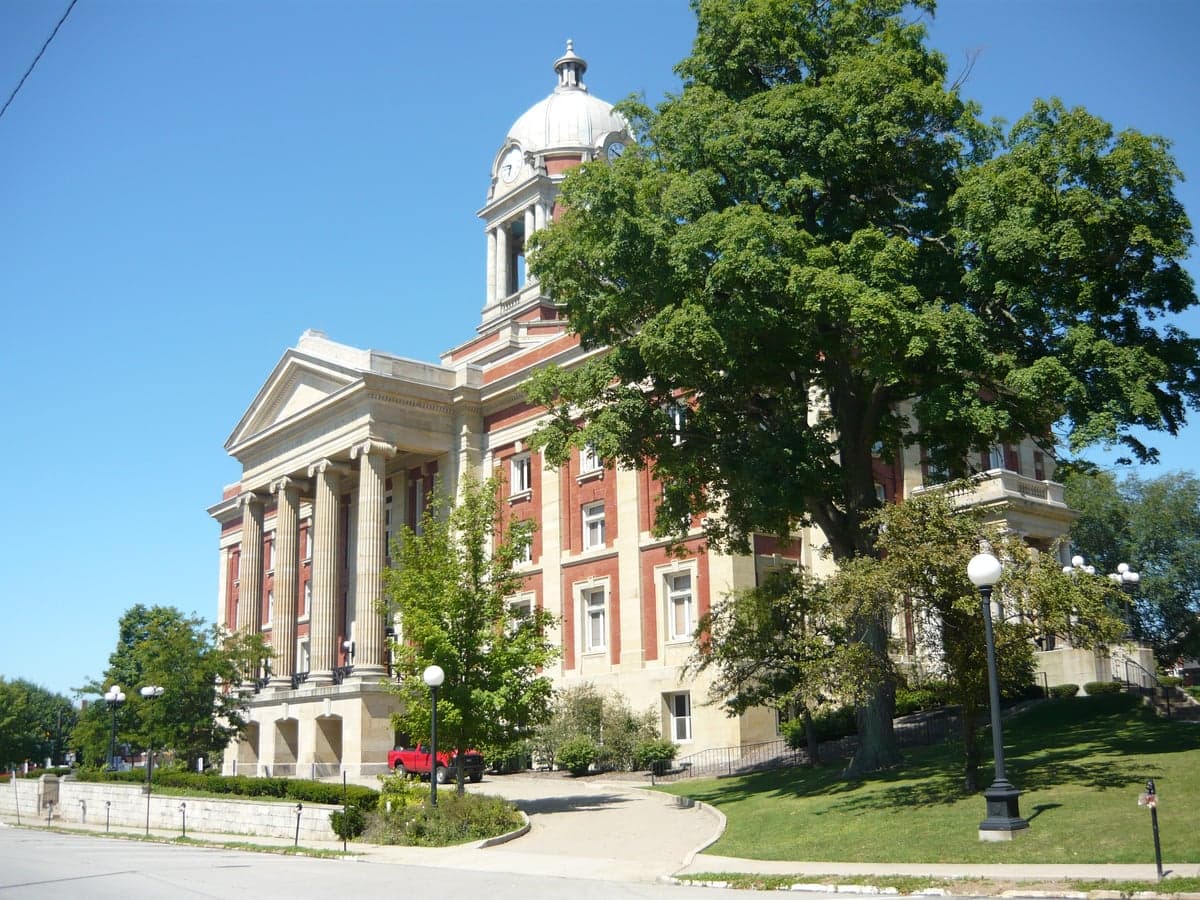
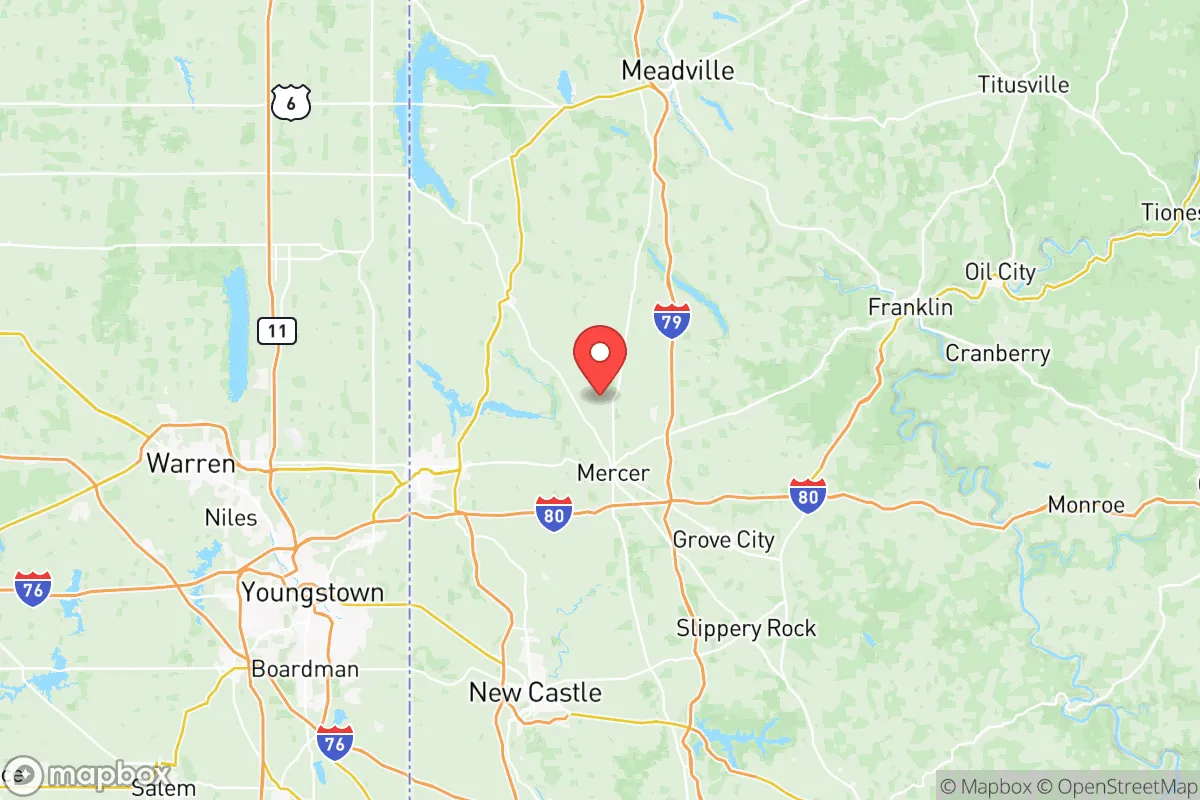
Photo: Wikipedia
Demographics of Mercer County
Affluence Level in Mercer County
A middle-class area roughly in line with national averages across income, home values, education, and employment.
People of Mercer County
Mercer County, Pennsylvania, is a predominantly white, rural-to-suburban community of 109,852 residents where a quiet, self-reliant character shaped by generations of industrial and agricultural work still holds. With 88.6% of the population identifying as white and a foreign-born share of just 0.4%, the county remains one of the least ethnically diverse in the state, though a small but established Black community (5.5%) and a tiny Hispanic population (1.6%) add modest variety. The county’s identity is rooted in its steel-and-manufacturing past, its small towns like Sharon, Hermitage, and Greenville, and a population that is older, less college-educated (25.1%), and more rooted than the national average. For a relocating family or individual, Mercer County offers a place where neighbors know each other, costs are low, and the pace of life is deliberate — but where demographic change is slow and the economy has yet to fully reinvent itself.
Settlement & growth (pre-1960)
Before European settlement, the area now known as Mercer County was part of the traditional homeland of the Erie people, who were largely destroyed or dispersed by the Iroquois Confederacy in the mid-17th century during the Beaver Wars. By the time the first white settlers arrived, the region was sparsely inhabited and used primarily as a hunting ground by the Seneca and other Iroquois nations. The French and British both claimed the area during the colonial period, but no permanent European settlements were established until after the American Revolution.
The first major wave of settlers came in the 1790s and early 1800s, predominantly Scots-Irish and German farmers pushing west from Pennsylvania’s older counties. They followed the Shenango River valley and established small farming communities that would later become the towns of Mercer (the county seat, founded 1803), Sharon (founded 1795), and Greenville (founded 1819). These early settlers were drawn by cheap, fertile land offered through the Pennsylvania Land Office, and they brought with them a Presbyterian and Lutheran religious tradition that still marks the county’s cultural landscape.
The second transformative wave arrived with the industrial revolution in the mid-to-late 19th century. The discovery of iron ore and coal, combined with the arrival of the Erie Extension Canal (1844) and later the railroad, turned Mercer County into a manufacturing hub. Sharon became the epicenter of this boom, home to the Sharon Steel Corporation (founded 1900) and a host of foundries and rolling mills. This industrial growth pulled in a new population: first, English and Welsh ironworkers; then, from the 1880s through the 1910s, large numbers of Italian and Polish immigrants who settled in Sharon’s South Side and in the mill towns of Farrell and Wheatland. These Catholic and Eastern European communities built their own churches, social clubs, and neighborhoods, creating ethnic enclaves that persisted for generations. A smaller wave of Slovak and Hungarian immigrants also arrived during this period, settling in Hermitage and Sharpsville.
The third major demographic event was the Great Migration of African Americans from the South, which reached Mercer County between roughly 1915 and 1960. Black workers were recruited by Sharon Steel and other mills to fill labor shortages during World War I and World War II. They settled primarily in Sharon and Farrell, where a distinct Black community formed around the Second Baptist Church and along the city’s eastern corridor. By 1960, Mercer County’s Black population had reached roughly 5% — a share it has maintained with little change ever since.
Throughout this period, the county’s population grew steadily, peaking at around 127,000 in the 1960s. The economy was almost entirely industrial, with steel, iron, and manufacturing providing the bulk of jobs. The cultural identity was working-class, unionized, and ethnically European — a mix of Scots-Irish farmers, Polish and Italian millworkers, and a small but rooted Black community.
Modern era (post-1965)
The 1965 Hart-Cellar Act, which opened immigration to non-European countries, had almost no effect on Mercer County. The county’s foreign-born population today is just 0.4%, one of the lowest rates in Pennsylvania. Unlike many Rust Belt counties that saw an influx of Hispanic or Asian immigrants to fill labor gaps, Mercer County’s industrial collapse in the 1970s and 1980s — Sharon Steel declared bankruptcy in 1987, and most other mills closed by the early 1990s — meant there was little economic pull for new immigrants. The county’s tiny Hispanic population (1.6%) and even smaller East/Southeast Asian community (0.4%) are concentrated in Sharon and Hermitage, often working in healthcare, retail, or the remaining light manufacturing. The Indian-subcontinent population (0.2%) is negligible, mostly professionals at the county’s hospitals or at the Penn State Shenango campus in Sharon.
The dominant demographic story of the modern era is domestic out-migration and suburbanization. As the steel mills closed, tens of thousands of residents — disproportionately young adults and families — left for the Sun Belt or for larger Pennsylvania cities like Pittsburgh and Philadelphia. The county’s population fell from 127,000 in 1970 to 109,852 today, a decline of roughly 13%. Those who stayed tended to be older, whiter, and more rooted. Suburbanization played out modestly: Hermitage, a planned community incorporated in 1975, grew as a bedroom suburb for those still working in the region, while Sharon and Farrell lost population and saw rising poverty. The Black population, once concentrated in Sharon and Farrell, has become slightly more dispersed, with some families moving to Hermitage and Grove City, but the county remains residentially segregated by both race and class.
Since 2000, the county has seen a small influx of white retirees from higher-cost areas of the Northeast, drawn by low housing costs and the rural lifestyle. This has slightly raised the median age (now around 44) and reinforced the county’s conservative political leanings. The Hispanic population has grown from under 1% in 2000 to 1.6% today, driven by a small number of Mexican and Central American workers in agriculture and food processing, particularly around Greenville and Stoneboro. The East/Southeast Asian population remains tiny, mostly Korean and Vietnamese families who arrived in the 1990s and 2000s to work in healthcare or to run small businesses in Sharon.
The future
Mercer County’s population is projected to continue a slow decline over the next 10-20 years, falling to roughly 100,000-105,000 by 2040, according to state estimates. The county is becoming slightly more diverse, but at a glacial pace: the Hispanic share may reach 3-4% by 2040, and the Asian share may inch toward 1%, but the county will remain overwhelmingly white and native-born. The Black population is stable at around 5-6%, with no major in-migration expected.
The most significant demographic trend is aging. The county’s median age is already above the state average, and the share of residents over 65 is projected to exceed 25% by 2035. This will strain local services and healthcare, but also create demand for senior housing and healthcare jobs. Young adults continue to leave for college and careers elsewhere, and the county has not yet developed a strong enough tech or service economy to reverse that flow. The small but growing Hispanic community in Greenville and Stoneboro may become more visible, but it will remain a minor presence. The county’s cultural identity — conservative, churchgoing, rooted in industrial and agricultural traditions — is likely to persist, though it may soften slightly as retirees from outside the region bring new perspectives.
For someone moving in now, Mercer County offers a stable, affordable, and safe environment where community ties are strong and the cost of living is low. But it is not a place of rapid demographic change or economic dynamism. The people who thrive here are those who value quiet, familiarity, and a slower pace — and who are comfortable in a community that looks and feels much as it did a generation ago.

* Values derived from national, state, county, city and local statistics and may differ in a specific area. Last updated: 2026-07-07T07:11:25.000Z
Narrative content on this page is AI-generated and may contain mistakes. Verify any details that matter before acting on them.
ReloMaps may earn a commission from affiliate links at no extra cost to you.

