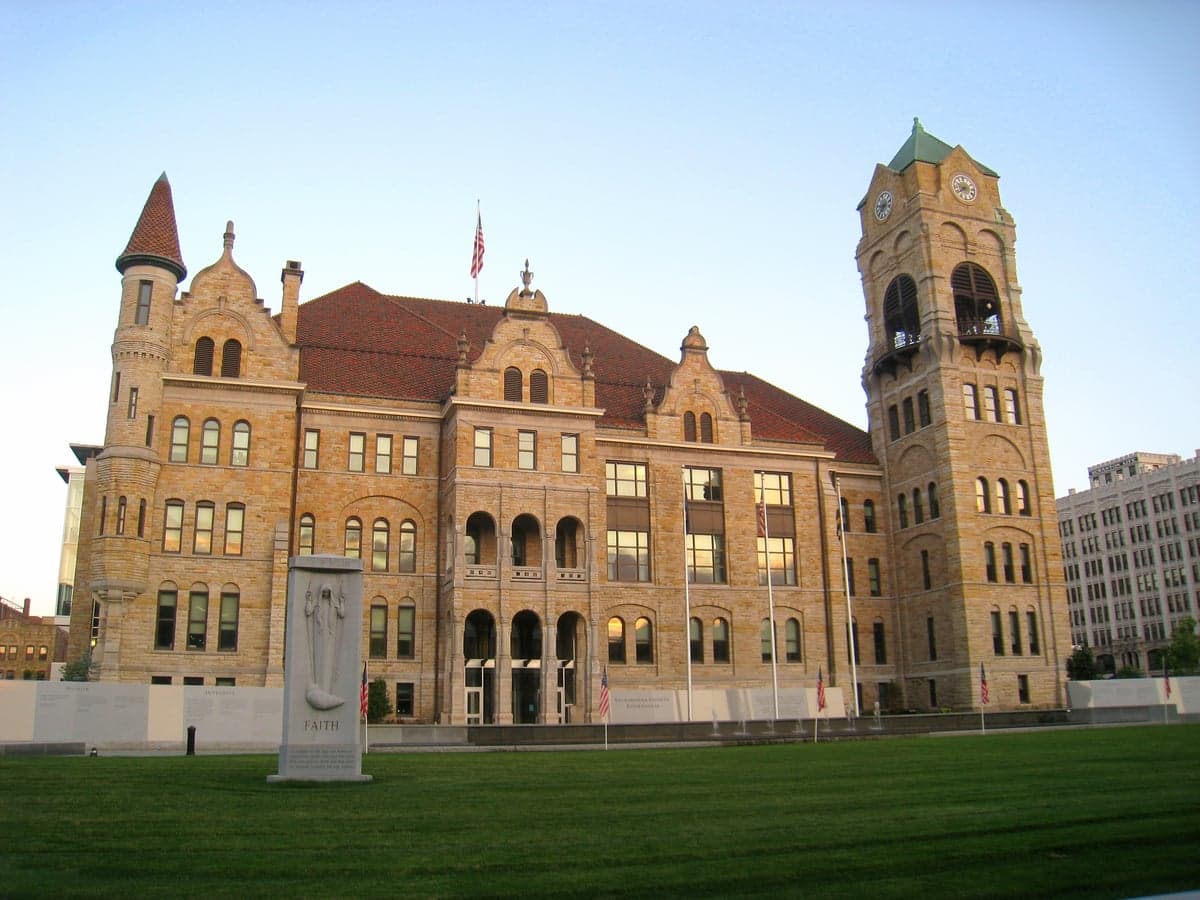
Photo: Wikipedia
Political ClimatePolitical Climate in Lackawanna County
Showing district-level results — no local-only data available.
Local Political AnalysisPolitical Analysis of Lackawanna County
Lackawanna County has shifted from a reliable Democratic stronghold to a competitive toss-up, now carrying a Cook PVI of R+4 — meaning it votes about four points more Republican than the national average. This is a dramatic swing from just a decade ago, when the county routinely backed Democrats by double digits. The surrounding state of Pennsylvania, by contrast, sits at a Cook PVI of EVEN, making it a pure swing state. Locally, the trend is unmistakable: working-class voters, especially in the Scranton area, have drifted rightward, while the more suburban and exurban towns have become the new battlegrounds.
How it compares
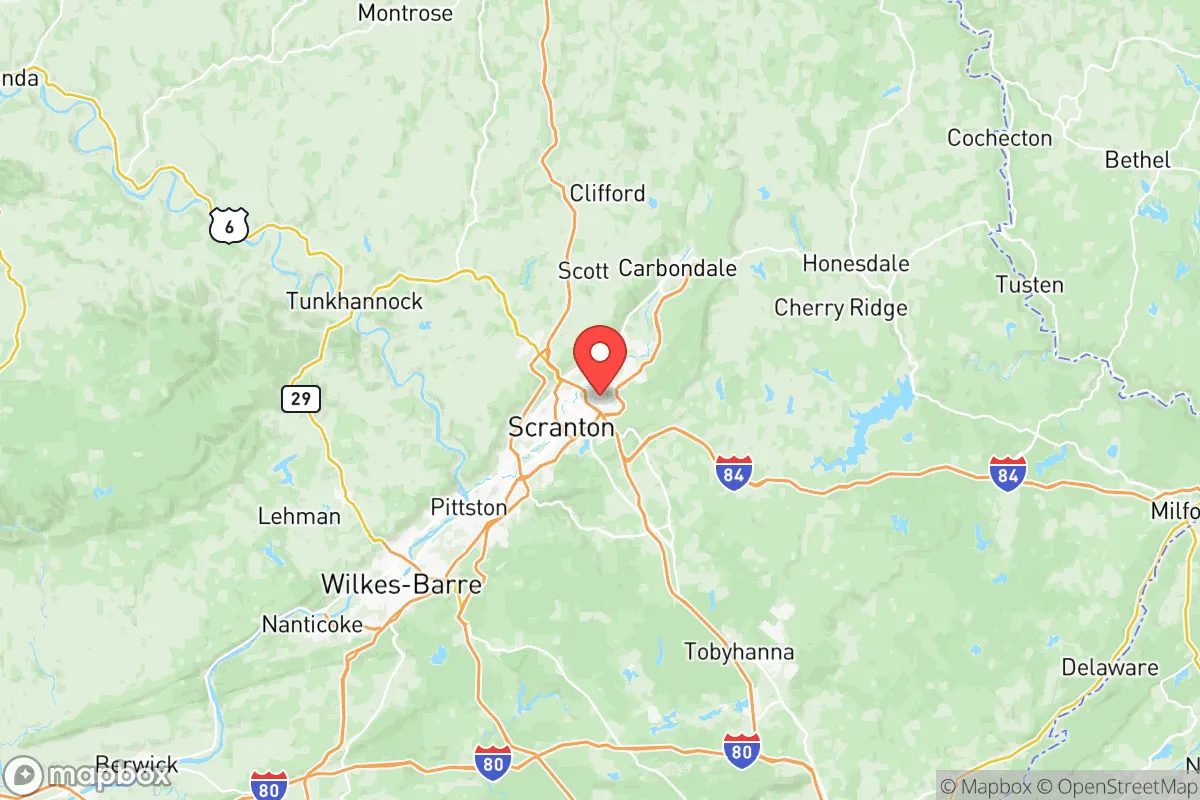
Pennsylvania as a whole is a classic purple state, but Lackawanna County is now redder than the state average. The county's R+4 PVI means it leans Republican, while the state's EVEN rating reflects a perfect national bellwether. This divergence is driven by the collapse of the old Democratic machine in Scranton, the county seat, and the rise of Trump-aligned voters in outlying areas. For example, Scranton itself still leans blue, though by narrower margins — precincts around the University of Scranton and downtown core vote Democratic, while the city's western and northern edges have flipped red. Dunmore and Taylor are classic swing towns, often deciding countywide races by a few hundred votes. Meanwhile, Clarks Summit and Dalton in the northern Abingtons are reliably Republican, and Carbondale in the northeast has trended red as union ties weaken. The rural townships — like Jefferson Township and Newton Township — are deeply conservative, while Moosic and Old Forge near the Luzerne County line remain Democratic-leaning but fading. In practice, this means a Republican candidate can win the county by running up margins in the Abingtons and rural townships, while a Democrat needs to dominate Scranton and hold the swing boroughs.
What this means for residents
For conservative residents, the shift means their votes now carry real weight in local elections — county commissioner races, judicial seats, and school board contests are genuinely competitive. Republicans have won countywide offices in recent cycles, and the GOP holds a voter registration edge in several townships. For liberal residents, it means no longer taking the county for granted; grassroots organizing and turnout in Scranton and the blue-leaning boroughs are essential to counterbalance the redder suburbs. The practical effect is a more polarized local discourse — issues like school funding, zoning, and property taxes are debated along sharper partisan lines than a generation ago. But there's also a silver lining: competitive elections force both parties to actually campaign here, meaning more attention to local concerns like the struggling downtown Scranton economy, the opioid crisis, and infrastructure on the aging I-81 corridor.
Culturally, Lackawanna County retains a distinct identity from the rest of Pennsylvania. The area's strong Catholic and union heritage still influences social norms — even many conservative voters here are less libertarian than their counterparts in, say, rural Tioga County. The local Democratic Party, though weakened, still has deep roots in the ethnic clubs and parish halls of Scranton and its suburbs. Policy-wise, the county's shift has meant more resistance to statewide Democratic initiatives on gun control and energy regulation, with local officials often siding with the GOP on these issues. Yet the county also benefits from state-level Democratic funding for infrastructure and education, creating a pragmatic tension. In short, Lackawanna County is no longer the safe blue anchor it once was, but it's not a deep-red outpost either — it's a microcosm of the national political realignment, where old loyalties are fading and new coalitions are still being forged.

State Political ClimatePolitical Climate in Pennsylvania
State Political AnalysisPolitical Environment in the State
Pennsylvania is the ultimate swing state, with a Cook PVI of EVEN, meaning it votes almost exactly in line with the national average. Over the last 20 years, it has flipped from reliably blue in presidential races (voting for Gore, Kerry, Obama twice) to a true battleground, narrowly going for Trump in 2016 and Biden in 2020, with Trump flipping it back in 2024. The state’s political reality is a knife-edge balance between the heavily populated, union-heavy southeast (Philadelphia and its collar counties) and the vast, culturally conservative rural and exurban regions of central and western Pennsylvania, with the old industrial cities like Pittsburgh and Scranton acting as the fulcrum.
Urban vs. rural divide
The political map of Pennsylvania is a tale of two states. Philadelphia and its immediate suburbs (Montgomery, Delaware, Chester counties) are the Democratic engine, delivering margins of 400,000+ votes that Republicans must overcome everywhere else. Pittsburgh and its Allegheny County base are also solidly blue, though less overwhelmingly so than Philly. The rest of the state—the "T" stretching from Erie down through the center and across to the northern tier—is deeply red. Lancaster County, once a swing area, has shifted hard right, voting +20 points for Trump in 2024. The critical battlegrounds are the "collar counties" like Bucks, Northampton, and Erie, which have trended toward Republicans in recent cycles. Scranton and Wilkes-Barre in Lackawanna and Luzerne counties are the classic "Reagan Democrat" zones—blue-collar, union-heavy areas that have swung hard toward Trump, flipping Luzerne from Obama +5 in 2012 to Trump +14 in 2024. The urban-rural split is so stark that a drive from Philadelphia to Harrisburg feels like crossing a political continent.
Policy environment
Pennsylvania’s policy environment is a mixed bag that reflects its purple status. The state has a flat personal income tax of 3.07%, one of the lowest in the Northeast, and a corporate net income tax that was cut from 9.99% to 8.49% in 2023, with further reductions scheduled. Sales tax is 6% (no tax on clothing or groceries). Property taxes are high and locally set, a major complaint for homeowners. There is no statewide school choice program, though a limited Educational Improvement Tax Credit (EITC) exists for low-income students. The state has no right-to-work law, and union membership remains strong in construction, education, and public services. Election laws are moderately restrictive: voter ID is required for first-time voters, but no strict photo ID law exists. Mail-in voting was expanded in 2019 under Act 77, but its use has become a partisan flashpoint. Pennsylvania is a "shall issue" state for concealed carry permits, with no permit needed for open carry (except in Philadelphia).
Recent policy direction
The last five years have seen Pennsylvania lurch in a conservative direction on several fronts, driven by a Republican-controlled legislature and a Democratic governor (Josh Shapiro, elected 2022). In 2023, the legislature passed a bill to allow permitless concealed carry, but Shapiro vetoed it. Gun rights advocates did win a preemption law in 2024 that prevents local municipalities from enacting their own gun ordinances. On education, the state Supreme Court ruled in 2023 that the school funding system is unconstitutional, leading to a $1.1 billion increase in education spending in the 2024 budget, but no voucher program. On energy, Pennsylvania remains a top natural gas producer, and the legislature has blocked carbon pricing schemes. Parental rights in education have become a hot topic, with several school boards in conservative areas like York and Cumberland counties adopting policies requiring parental notification for any changes to a student's gender identity. Election integrity remains a live issue: the legislature has attempted to require voter ID for all ballots and ban drop boxes, but Shapiro has vetoed those bills. Medical marijuana is legal and well-established, but recreational use remains illegal, with no serious push to legalize it.
Civil unrest & political movements
Pennsylvania has seen its share of political flashpoints. The 2020 election aftermath was particularly intense in Philadelphia, where Trump supporters protested outside the convention center during the vote count, and in Harrisburg, where armed protests occurred at the Capitol. The "Stop the Steal" movement had strong roots in rural counties like Bedford and Franklin. On the left, Pittsburgh saw sustained Black Lives Matter protests in 2020, with some property damage downtown. Immigration politics are less visible here than in border states, but Philadelphia is a self-declared "sanctuary city", limiting cooperation with ICE, which has drawn criticism from conservative lawmakers. The state has no formal secession or nullification movement, but there is a persistent "Northern Appalachia" identity in the rural north-central region that feels culturally disconnected from Philadelphia. Election integrity controversies remain a live wire: Luzerne County had a high-profile ballot scanning issue in 2022, and the state's lack of post-election audits has been a point of contention. A new resident in a rural area will see "Trump 2024" flags and "Let's Go Brandon" stickers; in Philly, they'll see "Defund the Police" graffiti. The two worlds barely interact.
Projection
Over the next 5-10 years, Pennsylvania is likely to remain a toss-up, but with a slight rightward tilt. Demographic trends favor Republicans: the state is aging, with the fastest-growing counties being exurban and rural (Adams, Franklin, Lancaster), while Philadelphia and Pittsburgh are losing population. In-migration from blue states like New York and New Jersey is concentrated in the Lehigh Valley and the Poconos (Monroe, Pike counties), which are trending purple but not blue. The Democratic base in Philadelphia is shrinking and aging, while the Republican base in the "T" is growing. If the current trajectory holds, Pennsylvania could become a lean-Republican state by 2032, similar to Ohio or Iowa today. However, the wildcard is the Philadelphia suburbs: if they continue to drift left (as they did in 2020), they could offset rural gains. A new resident moving to a place like Harrisburg or York will find a state that is politically competitive but culturally conservative in daily life, with low taxes relative to the Northeast and a gun-friendly environment. In Philadelphia or Pittsburgh, they'll find a more liberal urban bubble with higher taxes and more regulation.
For a new resident, the bottom line is that Pennsylvania offers a genuine choice: you can live in a deep-red rural area with low taxes and strong gun rights, or a deep-blue city with high taxes and progressive policies. The state government is a perpetual stalemate, meaning big changes are rare, but the status quo is moderately conservative on fiscal issues and moderately liberal on social issues. If you're a conservative, you'll find a welcoming environment in most of the state outside of Philly and Pittsburgh, with a strong Second Amendment culture and low income taxes. If you're a liberal, you'll find a vibrant urban scene and a state government that protects abortion rights and union labor. The key is picking the right county—and understanding that the state's political future is still being written.
* Values derived from national, state, county, city and local statistics and may differ in a specific area. Last updated: 2026-10-03T23:41:37.000Z
Narrative content on this page is AI-generated and may contain mistakes. Verify any details that matter before acting on them.
ReloMaps may earn a commission from affiliate links at no extra cost to you.

